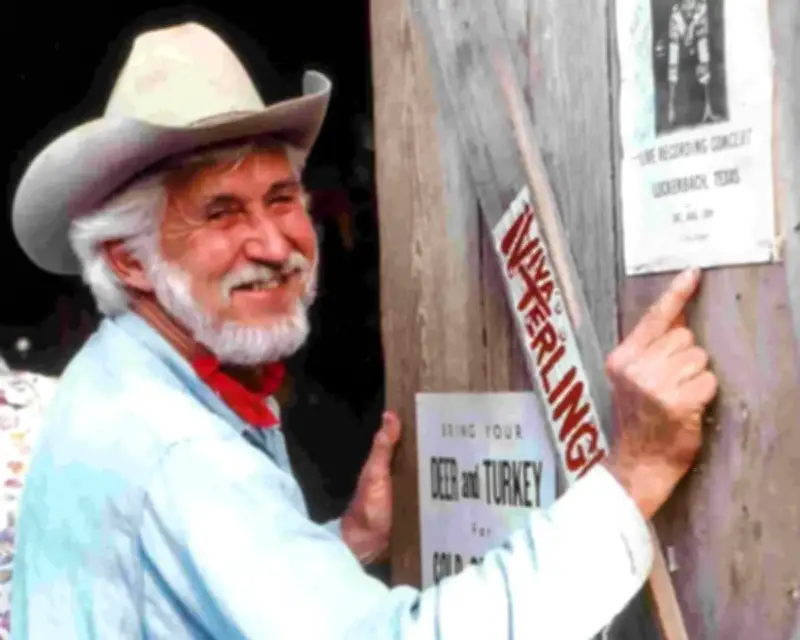
In the 1970s, Luckenbach, Texas—a ghost town with a population of just three—became an unlikely epicenter of country music, rivaling Nashville, thanks to self-appointed mayor Hondo Crouch. The town was immortalized in chart-topping songs and became a symbol of a simpler American life.
A Ghost Town Turned Gathering Place
In the summer of 1973, country singer Jerry Jeff Walker recorded his soon-to-be-classic album ¡Viva Terlingua! in an old dancehall 70 miles west of Austin, in Luckenbach. A crowd packed the hall, and an extension lead ran from it to a recording truck outside. After everyone went home, Walker told Crouch, “I wonder what we just did.”
When Crouch bought the town in 1971, its population was just three people—and according to the 2021 census, it remains the same. But in the 1970s, the ramshackle town thrived as Walker and his peers flocked there, making Luckenbach one of the most improbable yet important centers for country music.
Hondo Crouch’s Vision
Crouch, who died 50 years ago this month, was a goat-rancher, writer, and champion swimmer. With white hair and a mischievous, boyish face, he sang Mexican rancheras wherever he went. His business card read “Imagineer, authorised distributor.” In 1971, he and two friends bought Luckenbach for $30,000, acquiring an old dancehall, general store, bar, and a few outhouses. The Luckenbach Dance Hall became a gathering place for outlaw country musicians—a freer, rural alternative to Nashville.
Country star Gary P Nunn called Crouch a “pied piper,” leading musicians and eccentrics to a simpler life. Crouch’s daughter Becky Patterson met Walker at an open-mic night and brought him to the family ranch. “He had on these little Coke bottle blue glasses,” Patterson recalled. “Hondo said, ‘I knew he was a musician because he asked for seconds and ate so much. He was starving!’”
The Outlaw Country Movement
At the time, Nashville’s country industry favored the urbane, pop-friendly sound of countrypolitan, heard in stars like Patsy Cline and Charlie Rich. Musicians like Walker and Willie Nelson wanted their steel guitars and fiddles back, so they went up into the country and found Luckenbach.
Away from studio producers, ¡Viva Terlingua! sounded like the communal, unpolished life it celebrated. Nunn’s song London Homesick Blues appears on the record, and he spent that summer in Luckenbach sleeping in a teepee with his wife and baby. “My wife didn’t think much of it, everyone else was staying in hotels,” he recalled. “But Jerry Jeff used to say you can’t get that magic in the studio.”
The atmosphere in the dancehall is palpable; you can hear crickets during lulls between the crowd’s stamping and hooting. In 1975, ¡Viva Terlingua! reached space when Up Against the Wall, Redneck Mother was played to wake the Apollo–Soyuz astronauts. Rolling Stone covered the sessions, drawing hippies from across the country. By the mid-70s, Luckenbach road signs reportedly lasted about four hours before being stolen; the highway department stopped replacing them.
National Fame and Legacy
In 1977, Waylon Jennings released Luckenbach, Texas (Back to the Basics of Love), catapulting the town to even greater renown. Guy Clark had told Nashville songwriters Bobby Emmons and Chips Moman about Crouch, and they wrote the song the next morning. Willie Nelson joined Waylon on the final chorus. The song spent six weeks at No 1 on the country chart and crossed over to pop radio. “It was like the whole world were like, where’s this Luckenbach, Texas?” Nunn said. Folk came by the busload to get back to basics.
Willie Nelson famously lost a game of dominoes against the town’s elderly champions, and returned in 1995 to host his Fourth of July Picnic festival in Luckenbach for five years running. There is a “picking tree” where country musicians have passed guitars around since Crouch’s day. Contemporary star Ryan Bingham honed his trade there and organized an annual festival, The Western. Kit Patterson, Crouch’s grandson, remembered Bingham and others sitting round the picker circle: “It was this beautiful, intimate moment around the fire, reliving life before all the fame.”
Crouch’s family still runs Luckenbach through Luckenbach Texas, Inc. Protecting its name has meant taking legal action, including against a whisky brand. “Lawsuits are the antithesis of what Luckenbach is about,” said Kit, the company’s president. “But at the same time, if the integrity of what Luckenbach is isn’t protected, it becomes diluted.”
Crouch preached a backyard mysticism—a devotion to ordinary things. In surviving footage, he says, “I love this town. I love every rotten board in it.” He liked to say Luckenbach had a bigger moon than any other town, as he says on Walker’s 1977 album A Man Must Carry On. On Luckenbach Moon, he crows his poem over a stumbling guitar line: “We try to tell folks who come by here to look at our town / What a big, mean moon we have / But nobody’ll believe it.”
Crouch never heard A Man Must Carry On or Waylon Jennings’s hit. He died suddenly of a heart attack on 27 September 1976. When Patterson phoned Walker to tell him her father had died, he dropped the receiver and never returned to the call. The church overflowed at Crouch’s funeral; Willie Nelson arrived but didn’t get out of his truck, unwilling to draw attention from Crouch.
Asked whether the moon really was bigger in Luckenbach, Crouch’s youngest daughter, Cris Crouch Graham, laughed: “The moon’s the same moon as everywhere else. But he made it bigger, and so it is.”