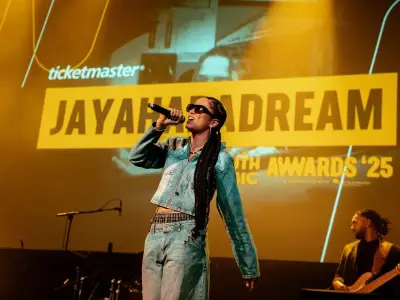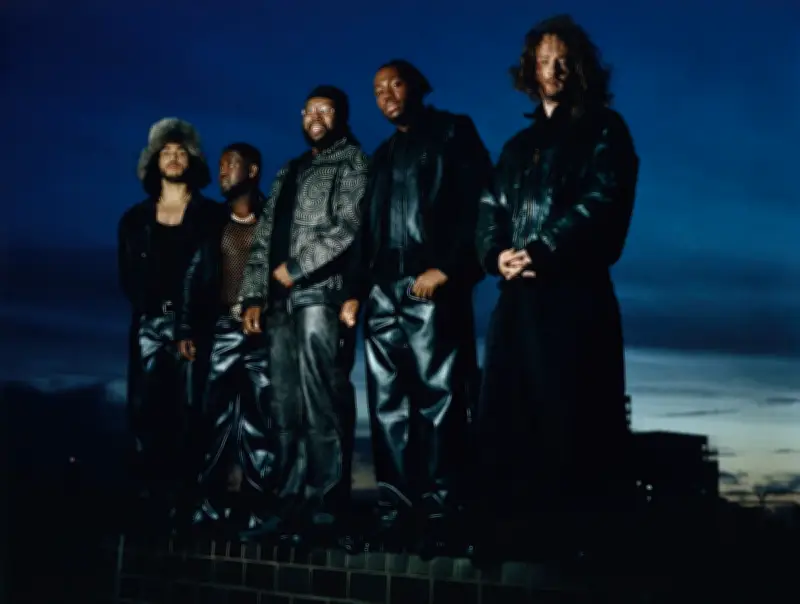
Ezra Collective have announced a one-night-only show at KOKO on 24 September to celebrate 25 years of British Airways and American Express being in partnership. Tickets go live on September 14 at £14.95 for British Airways x Amex credit card holders, and general sale on September 16.
Formed in the youth clubs of London, Mercury Prize and BRIT award winners Ezra Collective represent what the capital is all about - fun, creativity and community.
The Wembley Dream
Brothers TJ and Femi Koleoso — the bass player and drummer of jazz quintet Ezra Collective respectively — were walking up Wembley Way last month to see their beloved Arsenal play in the Carabao Cup Final. “We were approaching the stadium and Femi just turned to me, just like, ‘We can do this, man,’” says TJ, 30. By “do this”, Femi wasn’t referring to Arsenal’s chances of winning the game (they lost 2-0 to Manchester City — “terrible match”, says TJ). He meant that their band could, one day, perform a concert at Wembley Stadium, the 90,000-capacity venue of choice for the likes of Oasis, Harry Styles and Taylor Swift.

“I said, ‘You’ve been like this since day one,’” continues TJ. “We’d go and watch a gig in [small Camden venue] Koko and Femi would say, ‘We can do this, man.’ Then we’d go to the [bigger] Roundhouse and he’d say, ‘We can do this, man.’”
Femi, a year older than his sibling, admits that venue inflation occupies his mind. “I look at the O2 and think, ‘One day’, and I look at Wembley Stadium and think ‘One day’. I don’t look at it and think ‘Flatline. We won’t get there’ You can’t not look at [Glastonbury’s] Pyramid Stage and think, ‘One day’. Otherwise, what’s the point?,” the drummer and band leader says.
Jazz Breaking Out
This next-level plotting has probably been “the biggest thing that’s allowed Ezra’s jazz music to burst out of the jazz club”, says TJ. Their fusion of Afrobeat, calypso, jazz and hip-hop finds form in joyous live performances, where carnival meets cardio workout. Ezra were the first jazz band to win the Mercury Prize (in 2023) and they were named best group at last year’s Brit Awards.
Famous fans abound. In 2018 they played at the late Quincy Jones’s birthday party in Switzerland. In 2024 Barack Obama named Ezra’s single God Gave Me Feet for Dancing as one of his songs of the year. Last summer they supported Stevie Wonder in Hyde Park.
I ask all five members — the Koleosos are joined by James Mollison on tenor sax, Ife Ogunjobi on trumpet and Joe Armon-Jones on keyboards — what their biggest “pinch me” moment has been. “For sure, opening for Stevie Wonder,” says Armon-Jones. “I still can’t really believe that it happened. Basically the greatest musician and the greatest songwriter that ever lived. What an honour.”
Reflecting on 10 Years
Despite eyeing Pyramids and stadiums, this month has also been about reflection. It’s 10 years since Ezra Collective’s first EP, Chapter 7, was released. To celebrate, they played a hot-ticket show at tiny Hackney venue Colour Factory last weekend with guests including award-winning saxophonist Nubya Garcia and Sons of Kemet co-founder Shabaka Hutchings.
Jazz has too often been elitist, exclusive and expensive, says Femi. But jazz’s roots were anything but elitist. “It was built by inclusivity and community by working class people,” Femi says. Jazzers from the late Art Blakey and Charles Mingus (“a stray gangster”) to contemporary stars like Robert Glasper taught him that “jazz is the most perfect form of expression of the reality you’re living”.
“I’ve got Nigerian parents. I love grime music. I love Afrobeat. My reality is not middle-class elitism or wine that costs £30 a cup. My reality is [now-closed venue] Black Grape in Tottenham, funky house raves and pirate radio. That is the package that Ezra Collective came in,” says Femi.
From Youth Clubs to Stardom
Ezra Collective formed in 2012. Femi and Mollison played in Tomorrow’s Warriors Youth Ensemble, a band linked to a south London organisation of the same name. Victory in a Cheltenham Jazz Festival competition won the band a support slot for US trumpeter Terence Blanchard at Ronnie Scott’s. TJ and Armon-Jones joined around this time, with Ogunjobi arriving later.

The collective had a “beautiful naivety” about performing, says TJ. They’d simply turn up anywhere — pub or club — and give it their all. Not that audiences were universally appreciative. At one early show at Manchester’s Deaf Institute, the band were relying on merch sales for petrol money home. But someone swiped some goodies. “It was like Trainspotting. They might have thought they stole the jumper but they actually stole our petrol, like something out of Mad Max,” says Femi.
Key to Ezra Collective’s story is the tale of the Koleoso brothers. Their parents moved to the UK in the early 1990s, settling in Enfield, and worked their way up their respective professional ladders: their mother became a palliative care nurse and their father a haematologist. TJ explains that his parents packed a suitcase, travelled to a country “that they’d never seen” and just figured it out. “There’s a deep, deep work ethic,” he says.
Music Education Concerns
The decline in music education in UK schools is a huge concern. It’s falling at both GCSE and A-level stages, with clear ramifications. “You starve a country of its soul one music lesson at a time,” says Femi. “If there’s something that this Great Britain gave me, it was music education. Clapping and singing He’s Got the Whole World in his Hands. This country was built on them assemblies, bro. It’s no surprise we gave the world Elton John. Of course we did. He learnt in school. It’s no surprise that we just churn out Adeles and Olivias and Rayes and Amys for fun,” Femi says.
Talk moves to the recent Clapham Common “link-ups”, a social media phenomenon that saw several hundred youths descend on businesses like Marks & Spencer and McDonalds on Clapham High Street, causing havoc. Femi’s first observation is that “the discourse around it was almost more interesting than what the kids did”.
“When it happened in Sydney this year, when they were all white middle-class children, it was not a race issue. There’s a real kind of collective amnesia about the past,” he says. The link-ups, he says, were a result of “pent up energy that doesn’t have a good place to express itself”.
“When I saw those kids moving in Clapham I actually thought it was beautiful. I looked at all these beautiful, strong, black, aggressive, passionate young people. Can you imagine if you could get them in an orchestra? Can you imagine if you just opened Westminster for a day and told them they could have their own Commons debate [and] just shout at each other and come up with solutions? Can you imagine the genius things you’d hear? Can you imagine what would happen if you taught all of them how to play chess — what would happen to the country and the way we think about chess,” he says.
Following Clapham, London Mayor Sir Sadiq Khan announced £30 million of funding for late-night youth clubs in all 32 London boroughs.
Band Leadership and Future Plans
Ezra Collective is not a democracy. “Democracy doesn’t work,” says TJ bluntly. “We’d still be in the pubs, bruv!” says Femi. Although decisions are put to a band vote, it’s the drummer who guides things. He “leads by example”, says Mollison.
The responsibility can weigh heavily. “It’s not a position I’d wish upon anyone,” says Femi, a touch surprisingly. “You end up becoming the most unpopular person in the band. When it goes right, we are great. When it goes wrong, you are the problem. You know, I’ve been in bands where I’m not the band leader, like Gorillaz. It’s far less work. It’s far more fun.”
And what of the future? Ogunjobi says that in a decade’s time, Ezra will still be making music. Says TJ, “We’re gonna keep squeezing the lemon till there is absolutely no juice left.”
There’s also venue inflation to think about. In June, Femi will watch Gorillaz perform at Tottenham Hotspur’s cavernous stadium. The drummer will be there “to dance, to cry, to sing my favourite songs but also to work out how Ezra Collective would take it down if we ever got a shot at it”. Always plotting, always planning. To which there can only really be one response. They can do this, man.