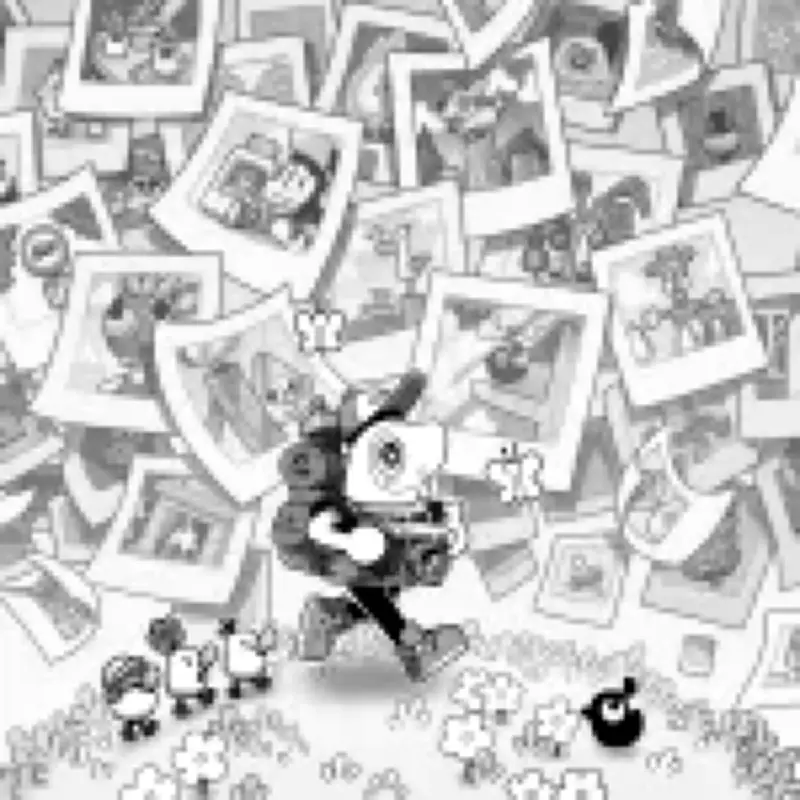
The sequel to indie favourite Toem is not much of a departure from the original, but it is the perfect antidote to other more bombastic video games. Toem 2 retains the same simple line-drawn black-and-white look, the same five-to-six-hour length, and the same camera-focused gameplay. It adds a mini-map and a few new camera tools, but could almost be mistaken for downloadable content.
A familiar world with a few new tricks
Since most video games use a virtual camera, it is not surprising that many extrapolate that to feature photography as a central theme. Fatal Frame’s Camera Obscura lets you capture spirits of the dead, New Pokémon Snap gets you to catalogue its wildlife in a safari style adventure, and Lushfoil Photography Sim had you working with a fully featured recreation of a DSLR camera. Toem took a quirkier approach: it simply wanted you to see and appreciate its world, sending you out into charming dioramas on a mission to help the folk you meet solve their problems, mostly by taking pictures of things for them.
Each room in its four levels was fully rotatable, letting you examine it from all angles, helping find lost objects or locate new creatures to photograph, each of which was then neatly filed away in your journal. The sequel is practically identical, and while it brings a small bag of its own tricks, slightly extending your range of interactions, it could almost be mistaken for DLC. The two games share the same simple line-drawn good looks; they are black and white for reasons that are never addressed; they both take around five or six hours to complete; and mechanically they are entirely orientated around your camera, which neatly switches the viewpoint from distant third person to more immediate first person.
New tools and a helpful mini-map
Once in that camera view, you can once again zoom in, a process made more tactile by the DualSense’s haptics. The same goes for taking pictures, which uses the adaptive triggers to positive effect. As before, you will need to tour all the separate rooms in each of the four towns, looking for people to help – there is a fifth town, but it acts almost solely as a celebration of your achievements in the other areas. The people’s problems are likeably esoteric and low stakes, and generally straightforward, even if many involve looking closely at each room from every angle you can find.
One issue the sequel does manage to fix is getting lost. While rooms each have between one and four exits, you effectively teleport between them, disappearing from one and reappearing in the next. Navigating each one is a breeze, but it is easy to lose track of where you are amongst the various rooms, making it simple to explore but sometimes frustrating to find places you have previously visited. Toem 2 benefits from the addition of a mini-map. Presented as a simple set of interconnected white squares, it proves to be more than enough to tell you where you are in the towns you visit. It means quests that involve collecting items and then returning them to someone or, more frequently, taking a picture of a particular animal or object and then showing it to the quest giver are now a little easier to handle.
A gentle, whimsical experience
That sense of an undemanding good time is common to pretty much all of Toem 2. Wandering its little scenes in search of animals to photograph, litter to pick up, and people to help, there is no sense of threat, with a musical accompaniment you can bolster by finding and collecting cassettes. Like the original game, there is a clutch of missions that offer more challenge, like the mini-escape room or unblocking a tangle of pipes under a fountain, but most resolve without too much head scratching.
It is a testament to developer Something We Made’s skill that none of this comes off as cloying, its gentle sense of whimsy proving pleasant without once feeling contrived. In fact, it has got quite a strong personality of its own: the fearless absence of colour, the continually shifting viewpoint, and its absolute focus on photography – the occasional very light platforming you have to do never attempting to distract you for long. These new tricks come in the form of add-ons for your camera. You are given a pair of scissors that let you snip off blooms from mischievous vines that block access to certain buildings and entrances, then a hammer you can use to knock in nails and smash obstacles, and finally a screwdriver for adjusting valves in pipes. But these accoutrements work via your camera lens and are always in service to townsfolk in need of your assistance.
There is also no pressure to solve absolutely every problem in each town. You will find that after helping out as much as you feel like, you are welcomed aboard the bus to the next venue without having to be a completist. It is thoroughly in keeping with the game’s mellow, dexterity and violence free ethos. If you have small children who love games, or just fancy a break, Toem 2 is a thoughtfully constructed and light-hearted little gem.
Toem 2 review summary
In Short: A charming photography-based game about helping people, imbued with a genuine sense of whimsy that is hard to resist, if you are in the mood for it. Pros: Fun twists on exploration and photography. New mini-map really helps avoid confusion, and there is a surprising variety of quests, given the fact that all involve using your camera. Cons: Not much challenge for seasoned gamers and gameplay that is almost identical to the original game. Score: 7/10. Formats: PlayStation 5 (reviewed), Nintendo Switch, Nintendo Switch 2, and PC. Price: £15.49. Publisher: Something We Made. Developer: Something We Made. Release Date: 29th September 2026. Age Rating: 3.