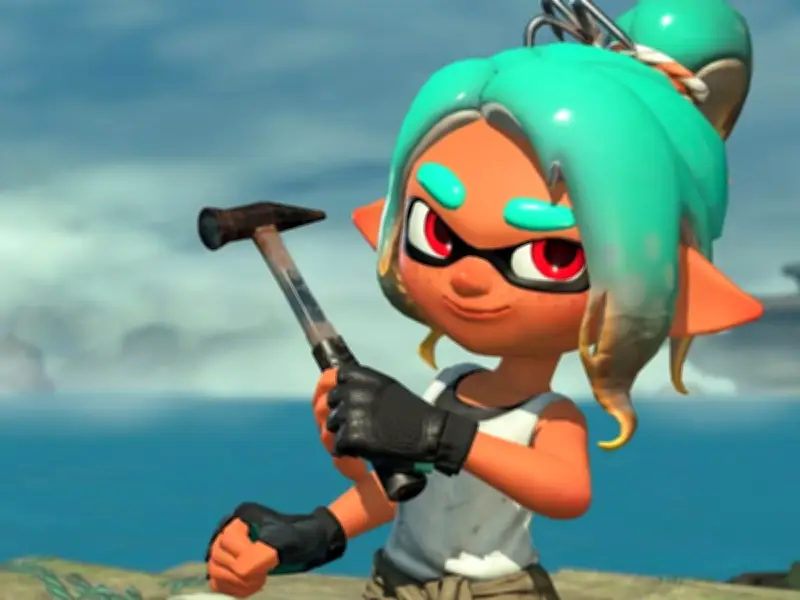
Splatoon Raiders casts you as an original character called the Mechanic, which you level up and customise as part of the journey. The game makes for a refreshing take on PvE combat by utilising the franchise's ink-fuelled shooting within a more directed structure that emphasises loot and replayability.
A new twist on Splatoon's formula
With Nintendo arguably being the king of first-party spin-offs, I knew when Splatoon Raiders was revealed it'd at least be a pretty good twist on the ink-splashing format. A PvE take on one of gaming's most creative competitive shooters is still a risk, yet it's hard to go wrong when the splatting mechanics at the franchise's core are as sublime as this. What takes it to another level this time is the unprecedented level of kit customisation introduced by the all-new Gadget system, alongside the fresh loot-based mission structure built to support and then often let you exploit it. All of which help make Raiders an infinitely enjoyable treasure hunt that encourages repeat adventures - either alone or with friends - and more closely aligned with the single-player focused Splatoon game I've always wanted.
Characters and story
Making for a nice change of pace, in addition to the move away from PvP, is that Splatoon Raiders actually features identifiable characters to get invested in. Shiver, Frye, and Big Man may already be known as this inky universe's established pop music trio to returning fans, yet for newcomers they serve as an engaging ensemble perfectly poised to keep this story of being stranded on an island and fighting off endless Salmonids moving along. Splatoon Raiders is hardly Shakespeare, but with you joining the crew as your own custom-created Mechanic character, the otherwise basic narrative structure of venturing out on the islands to find new treasures needed to reinvest in new weapons, gadgets, and your Hideout Ship hub always kept me invested across the 15 or so hours needed to roll credits.

Gameplay and missions
Speaking of treasure, the endless hunt for it serves as Splatoon Raiders' main crux that binds all the ensuing PvE exploits together. Each mission begins with you choosing one of three different equippable tank classes: Speed, Tactical or Power, after which you'll undertake one of several different objective types where you must battle waves of enemies and drill for resources in pursuit of finding enough loot to better upgrade your weapons and tools. The bite-sized nature of missions make them punchy enough to suit short-burst play sessions, all while still offering you room to experiment with Splatoon Raiders' different selection of gadget types specific to each tank.
At first I thought that restricting gadgets such as the Tactical tank's autonomously firing Shot Pot device or the Speed tank's danger-evading Splat Boost manoeuvre to one specific class would feel limiting. Or worse, unfun. In reality, though, the opposite is true since the campaign finds countless ways to encourage you to regularly flitter between all three unique Tank classes. Whether it's trying to power one up to its highest level, only making certain rewards claimable should you use a specific class on-mission, and so on. Splatoon Raiders' Gadget system is easily the best case yet for making you want to min-max your own loadout within a Nintendo game - and frankly, I'm amazed that the platform-holder has been able to strike such a perfect balance of doing this on its first try.

Shooting mechanics and customisation
It helps that bolstering this fresh emphasis on kit customisation and loadout experimentation within the PvE realm is the return of all the beloved shooting mechanics Splatoon fans know. Sploshing around bright ink using one of 10 different weapon categories, be it a giant brush, bucket, or minigun, is still as messily enjoyable as it always has been, while swimming through it to replenish your ammo remains an ingenious gameplay perk that works brilliantly to give combat encounters a fast and fluid pace. There was a risk that the magic found in the simple act of shooting ink, swimming in it, and then jumping out to get the drop on foes would be lost without the PvP format's inherent competitiveness. However, here, Splatoon Raiders always manages to make doing so feel fresh and interesting thanks to a raft of different mission objectives, wildly ambitious bosses, and increasingly inventive enemy types to take on.
It seriously would've been enough for each tank class' handful of gadget options to offer a suite of different functions to take advantage of. And yet, Splatoon Raiders finds even more ways to let you tweak your preferred style of play. In the form of uniquely functioning and increasingly powerful weapons, yes, but also via skills that can be equipped to adjust the performance of each gadget simply called Parts. From changing the time it takes for a gadget to cool down to adjusting the damage output it can achieve or area of effect it can have an impact on, it's extremely easy to find yourself digging into the minutiae of how you want each tank class to function - to the point that every player can wind up embarking on a raid or boss fight, diving down into the various sublevels of a mission whilst packing a completely different character build. Parts, when combined with Relic Powers that further tweak your character (not tank), always shakes up the splatting fun.
Mission variety and replayability
If there's one drawback to Splatoon Raiders' brand of PvE it's that, for all the various mission types, those belonging to the same category can eventually grow to become a tad repetitive. My favourite of the bunch are standard Raids, which task you to drill around areas to uncover different Spirhalite shards, which are discovered by roaming around an archipelago on foot, via water, and in the air. Even when playing offline, such endeavours feel like a team effort thanks to the inclusion of a Bot you can choose to be piloted by Shiver, Frye, or Big Man. Other mission types, meanwhile, are much more straightforward, with the guiltiest of this being Dens that challenge you to collect a certain number of Power Eggs while battling wave after wave of Salmonids so as to uncover a treasure. These effectively play out as Splatoon's de facto horde mode. They're fun enough when wanting to try out a different gadget type or tank class, yet don't stoke the most invention compared to Raids or Sampler Dungeons. The latter of which test your ability to adapt by removing your usual tools.
Thankfully, the difficulty of every mission can at least be increased with newer, 'spicier' revisions that make enemies hit a lot harder. And playing through these variations as part of the endgame made levelling up my weapons and builds a far more tempting endeavour than they otherwise would. The Raiders campaign can be completed in a little over 10 hours, true, but there's plenty to see and do once credits have rolled.
Verdict
Splatoon Raiders is the exact type of game that appears simple enough on the surface but soon reveals a flabbergasting level of mechanical depth as soon as you scratch beneath it. From overly generous ways to customise your character's kit to always thrilling Salmonid battles that stretch into the endgame and far beyond, this is a unique PvE experiment that proves there's still plenty of life left in one of Nintendo's most colourful franchises. Sure, the actual story may be wafer thin, some gadgets aren't quite as tempting as others, and the horde-based Den missions ultimately grow to grate, but that doesn't take away from the regular bouts of excitement Splatoon Raiders never struggles to provide when letting you explore the loot-filled lands of Spirhalite Island in search of ways to upgrade. Overall, then, it's a surprisingly well-rounded and confident debut for Splatoon on Nintendo Switch 2. Rating: 4/5. Splatoon Raiders is set to release exclusively on Nintendo Switch 2 this Thursday, July 23.