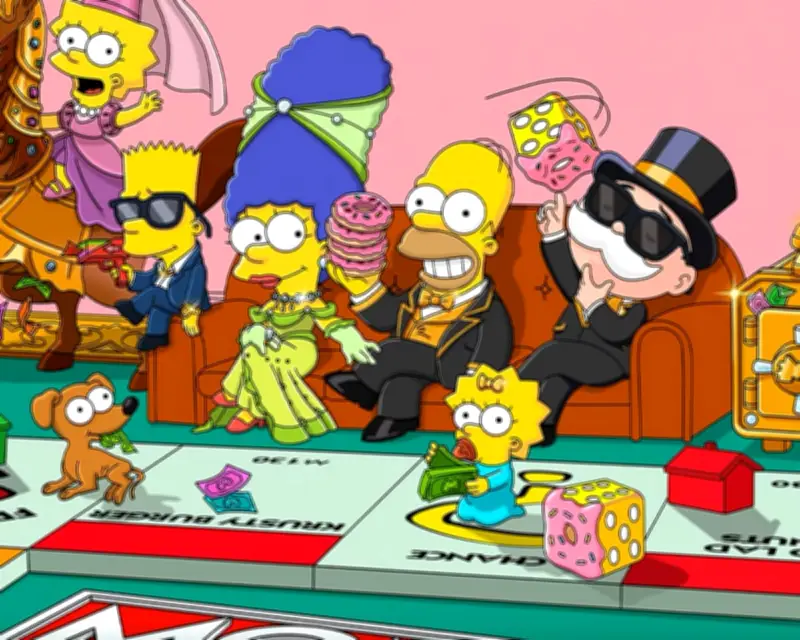
Mr Monopoly vs Mr Burns: The Simpsons take over Monopoly Go! Bart and co's latest video game venture involved the show's writers, animators and voice talent – plus a showdown between the two infamous tycoons. 'It's a true little Simpsons episode,' say creators.
Every generation gets its own Simpsons game. For some, it was the arcade cabinets that swallowed pocket money throughout the 1990s. For others, it was The Simpsons: Cartoon Studio. For millennials like myself, it was The Simpsons: Hit & Run. Joe Zanetti, vice-president of operations at Monopoly Go! developer Scopely, traces his Simpsons gaming nostalgia back to Konami's 1991 brawler, The Simpsons Arcade Game. 'That's the one that made such an impression on me,' he says.
It certainly did, because Springfield has just crash-landed in Monopoly Go! itself through a collaboration involving Simpsons writers, animators and voice talent alongside a new animated short starring Dan Castellaneta, Nancy Cartwright, Harry Shearer and Will Ferrell. While most licensed TV games have faded into obscurity, The Simpsons keeps finding new digital lives.

'It was a true Simpsons little episode,' says Loni Steele Sosthand, a co-executive producer who is in her sixth season writing for The Simpsons. She's speaking from the Fox lot in Los Angeles, where she is currently working on the show's 2027 Treehouse of Horror episodes – just to give an idea of how long these projects are in the works.
The Simpsons has always felt unusually suited to games. Unlike many sitcoms, Springfield isn't just a setting but an entire densely populated world with hundreds of characters, dozens of recognisable locations and decades of running jokes waiting to be explored, from the Stonecutters to Mr Sparkle. That flexibility has allowed the franchise to move effortlessly between genres, from arcade beat-'em-ups to open-world adventures. Monopoly Go! is simply the latest stop on the gaming monorail.
Sosthand thinks the reason is simple. 'At heart it's a family show,' she says. It's also a show that has always thrived on mischief, which gives the creators permission to be naughty themselves. 'It's not: This is our box,' says Zanetti. 'It's more: How can we break the box?'
The most unusual thing about the new Monopoly Go! collaboration – a two-month Springfield takeover featuring original storylines, animated shorts, themed mini-games and dozens of Simpsons characters – is the level of creative involvement behind the scenes. Rather than licensing characters and applying a yellow coat of paint, Scopely worked directly with Simpsons writers, artists and animators for months. It was less about borrowing Simpsons characters and more about borrowing Simpsons writers. 'We weren't just providing a homage,' says Zanetti.
The team obsessed over details. Characters such as Rich Texan and Homer's pet pig Plopper made their way into the game alongside familiar faces. One of Sosthand's favourite inclusions is Cowboy Carl, a nod to her Writers Guild award-winning episode Carl Carlson Rides Again, which explored the character's Black cowboy heritage. 'We were trying to come up with a joke for every mechanic,' Zanetti says. 'That one really felt very writers' roomy.'
Veteran animator Eric Keyes, who has worked on the show since the beginning, acted as an unofficial quality controller. 'He can just glance at something and see if there's not the right number of eyelashes,' says Sosthand.
Decades ago, a Simpsons video game typically meant a TV show adapted into interactive form. Today, the relationship runs both ways. 'I've been impressed with the richness of this world we're creating,' says Sosthand. 'I have a newfound respect for games.' Live-service games such as Monopoly Go! are places where audiences spend years rather than hours. For a franchise as established as The Simpsons, they can offer something television increasingly struggles to provide: an endlessly expandable world.

Over nearly four decades, the series has survived every major shift in entertainment: broadcast television, DVDs, streaming, social media. Most franchises eventually become trapped by nostalgia; The Simpsons seems to dump it straight back into the Springfield nuclear power plant and convert it into fresh fuel. Perhaps that's why the showdown between Mr Burns and Mr Monopoly in the game feels oddly natural. As Zanetti puts it, both occupy 'a really important place in the zeitgeist'.
More than three decades after Homer first walked into Moe's Tavern, Springfield remains woven into the fabric of popular culture. And if the journey from arcade cabinets to Monopoly Go! proves anything, it's that The Simpsons' greatest trick was never predicting the future. It was finding new ways to belong in it. The Simpsons season of Monopoly Go! is running until 29 July as a free download on iOS and Android.