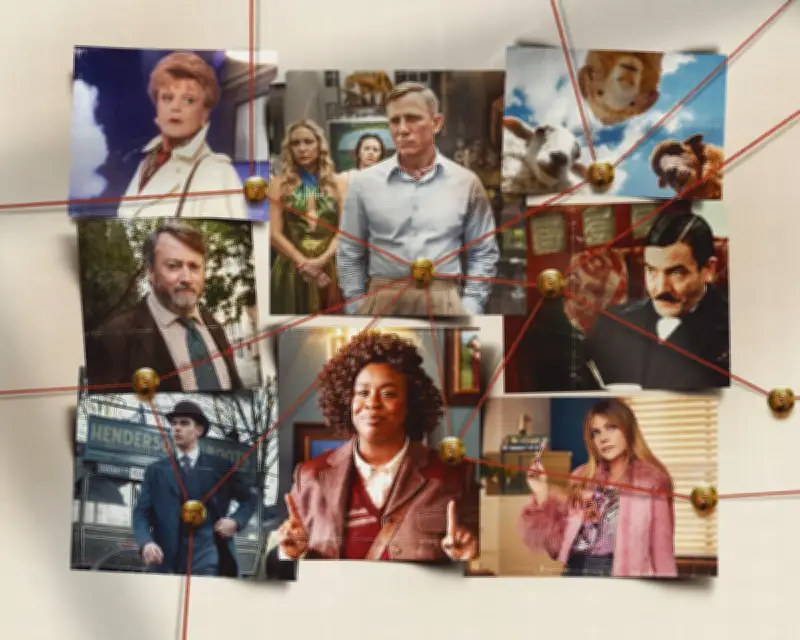
Amateur detectives are everywhere on television and in cinema, solving crimes without a badge. From the Sherlock Holmes spin-offs to The Sheep Detectives, DIY sleuths are on the case. But where did the trope of the outsider who outsmarts the professionals come from – and how do these depictions compare to reality?
On television, you don’t have to be a cop to solve crime; the police can just hire you as a consultant. All you need is the uncanny ability to solve each and every mystery in time for the next episode. You might be a retired detective (Monk, Ridley, the many Poirot spin-offs) or a bestselling mystery writer (Murder, She Wrote, Castle) or a vicar (Grantchester) or a convicted fraudster seeking redemption (White Collar, Wild Cards). You could be a faux psychic (Psych, The Mentalist), a human lie detector (Lie to Me), or a private investigator (all the Sherlock Holmes adaptations and spin-offs, and Shonda Rhimes’s The Residence). Or even, in the case of Death Valley, a retired actor widely known for playing a detective on TV.
The trope of the “consultant” – a hyper-talented investigator who isn’t part of the police, but teams up with them to solve crimes – is widespread, so much so that the pop-culture website TV Tropes gives it its own page: “No badge? No problem!” But recently the evergreen character has enjoyed a boost.

New Wave of Amateur Sleuths
In the series High Potential, for instance, Morgan Gillory is a frazzled mother of three with an exceptionally high IQ, who works as a cleaner for the LAPD. After cracking a case left overnight on an evidence board, she’s invited to join the major crimes division. Elsbeth, a spinoff of The Good Wife, follows a sweet but razor-sharp lawyer who is sent by the Department of Justice to monitor the NYPD and root out alleged misconduct. She ends up sticking around to catch a murderer each week. In Ludwig, the reclusive puzzle-maker John “Ludwig” Taylor infiltrates the Cambridge police by impersonating his missing twin brother, who’s an actual detective. When his identity is revealed, he isn’t arrested but offered a job.
We have also seen a stream of Holmes-inspired storytelling, from Guy Ritchie’s prequel Young Sherlock to the Enola Holmes franchise, which returns with its third instalment this week (though the youngsters don’t actually work with the police … yet). And the BBC has just announced yet another version of Agatha Christie’s Hercule Poirot, this time as a handsome thirtysomething private detective, leading to some consternation: “We don’t need a young and sexy Hercule Poirot,” declared Metro. Meanwhile, on the big screen, the surprise gem of this spring was a family movie called The Sheep Detectives, in which a flock of sheep (yes, you read that right) help a bumbling policeman to bring their shepherd’s killer to justice.
Origins of the Consulting Detective
The figure can be traced back to the very beginnings of detective fiction. Elspeth Latimer, an associate tutor in crime writing at the University of East Anglia, explains: “Between 1841 to 1844, Edgar Allan Poe published three mystery stories set in Paris featuring C Auguste Dupin, who uses his powers of observation and deduction to assist the gendarmerie in solving seemingly impossible crimes.” In his first outing in The Murders in the Rue Morgue, Dupin boasts that “most men, in respect to himself, [wear] windows in their bosoms” – he can tell exactly what they’re thinking. He then proceeds to identify the hitherto elusive perpetrator of a grisly double homicide (spoiler: it’s an orangutan).

“These tales of ratiocination” – that is, logical reasoning – “owe most of their popularity to being something in a new key”, wrote Poe at the time: no one was writing stories like his before. But soon enough Dupin had a copycat who would far surpass him in fame and influence. When we first encounter Arthur Conan Doyle’s Sherlock Holmes, in the 1887 story A Study in Scarlet, he introduces himself as a “consulting detective” and explains: “Here in London we have lots of government detectives and lots of private ones. When these fellows are at fault they come to me, and I manage to put them on the right scent.” Like his predecessor, Holmes is an arch-rationalist and walking encyclopedia who never misses a clue. He is also, crucially, an outsider operating beyond the official system of policing. In superhero style, he swoops on to the crime scene and saves the day.
How Fiction Compares to Reality
When I ask a friend who has worked as a detective in the Metropolitan police whether the characters I’m writing about have any basis in reality, she responds: “I am fairly certain the consulting detective exists purely in fiction.” She then admits that she rarely watches crime shows. “I get irritated when they don’t do things accurately, even though I know rationally that it’s fine that they don’t, because it’s a TV show.” She especially hates when the detective can “just tell” that someone is lying – she was trained to focus on evidence not intuition.
That is not to say that there are never situations in which someone from outside the police might get involved in a criminal investigation. Stuart Gibbon is a former detective who now works as a consultant for writers of crime fiction and true crime, advising them on the accuracy of their portrayals of police procedure. He explains that a range of expert advisers – forensic anthropologists, entomologists, psychologists, and so on – might be called on for specific elements of cases. Gibbon recalls working on a murder investigation where they had CCTV footage of the suspects. “We noted something about the way these people were moving, so we employed a forensic podiatrist – someone who does gait analysis.” The analysis found that one of the suspects had a pronounced limp, which turned out to be significant in identifying them.
Dr Lorraine Sheridan, a former behavioural investigative adviser, specialised in risk assessments for stalking, harassment and threatening behaviour. “I would review case materials: statements, communications, behavioural histories,” she says. “Then I’d provide an assessment: what does this pattern of behaviour suggest about the individual, the risk they pose, likely next steps, or how best to manage the situation. I wasn’t attending crime scenes or sitting in interview rooms,” Sheridan says. In general, the contribution looked nothing like what we see on screen. “There’s no ongoing partnership, no hot desk at the station, no banter with the detectives over coffee.” Most importantly, she was brought in due to her specialism, not because she was an all-purpose mystery-solver. “I wouldn’t be called in to profile a serial arsonist,” she says.
Then there are civilian investigators, a role that has been introduced in a number of regional forces in the UK over the past couple of decades. “That’s because there’s such a shortage of detectives and other investigators these days,” Gibbon says. Many are retired officers who already have the necessary training and are looking for extra work – though anyone can apply and be trained on the job. But they are not going to be apprehending murder suspects (they don’t have powers of arrest or detention). Usually they’ll be tasked with viewing CCTV footage or taking witness statements for low-level offences such as shop theft or criminal damage.
Not that Gibbon has any problem with the artistic licence taken by scriptwriters. The reality of investigative police work is much slower and more mundane than what we see on screen. There aren’t many viewers who want to watch an officer combing through hours of CCTV, or a suspect responding to all interview questions with “no comment”.
Appeal of the Amateur Detective
Might the consultant’s outsider status tap into our anti-authoritarian impulses? The best maverick detectives display a flagrant disregard for the rules and regulations of an institution whose representatives, from Sherlock’s Inspector Lestrade onwards, tend to be portrayed as blundering and overly bureaucratic if not outright corrupt. In High Potential, for instance, Morgan is sent to mandatory training after breaking protocol (taking home evidence, fast-tracking an autopsy report) once too often. She skips class – she calls it “obedience school for cops” – and is fired for insubordination. Soon enough, of course, she’s unfired.
It makes sense that a protagonist like this – an innately talented and ultra-competent genius, taking on a uninspired bureaucracy – should appeal in these populist times, when mistrust of experts and institutions is so high. Ultimately, though, in these shows, the subversion is contained. If there’s a dirty cop, they are rooted out, and the consultant rarely shows compunction when a perpetrator is carried away in cuffs, no matter how pitiable their circumstances may be. What these characters actually represent is the happy integration of the institution and the individual. It’s no coincidence that a recurring story arc is the romantic union of the consultant and their partner on the force. Despite their sheen of rebellion, these shows are still “copaganda”, with their basically conciliatory view of the police and the criminal justice system, even if the lead is not a cop.
Nonetheless, we can’t stop watching them. Maybe when everything feels like it’s falling apart, what people crave – at least in their TV diets – is not rebellion but stability. It has often been observed that there is something comforting about these shows, at odds with their grizzly subject matter. It’s not just that they are often rather silly in tone (though that helps). As PD James famously wrote: “What the detective story is about is not murder but the restoration of order.” The inevitable – and endlessly repeated – moment of resolution, when the mystery is solved and the bad guy vanquished, conjures a soothing fantasy: that the chaos of the universe can be understood and controlled. How nice to imagine that any of us, with no training, could step up and solve the mess we’re in. No badge? No problem.