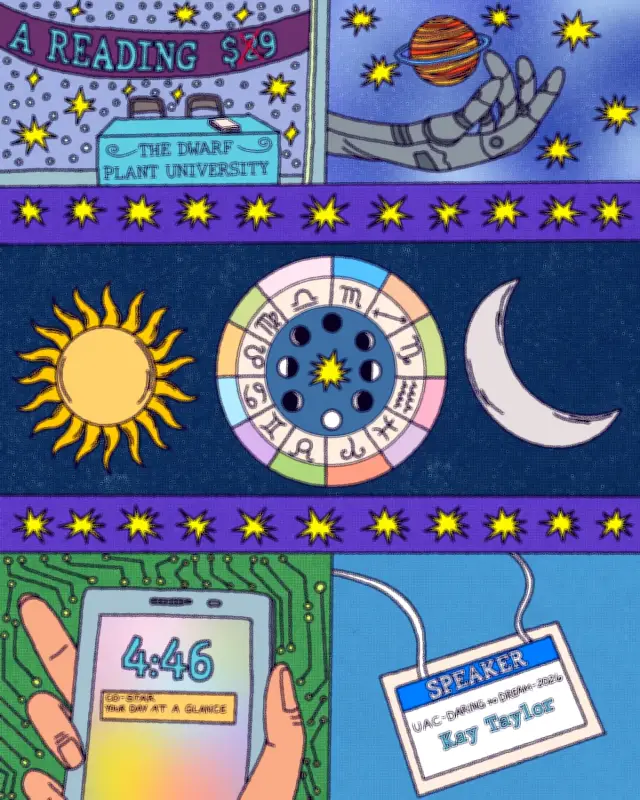
The United Astrology Conference, the largest professional gathering of astrologers in the world, took place in downtown Chicago, drawing 1,500 attenders. Vendors promoted books, tracts, affiliations, proprietary apps and software programs that have replaced the laborious chart-drawing of yore.
Despite expectations of amulets and cloaks, the crowd presented a normcore of podiatry-sensible footwear and Oxford button downs, resembling a trade convention of insurance adjusters. The room reflected astrology's broader transformation: the industry is now worth $15bn, and a 2025 Pew Research report found that 30% of American adults consult astrology, tarot or a fortune teller at least once a year, with 43% of women under 50 claiming to believe in astrology.
Factions and disputes
Modern astrology has developed its own hierarchies, factions and grudges. There are fights over tradition and fears about AI; impatient zoomers butting heads with baffled boomers; older men with reputations for harassment; and quieter epistemic disputes. Beneath it all was a more fundamental question: who gets to interpret the stars?
The basic premise of astrology is that the configuration of the sky at the moment of birth leaves its imprint on constitution and life trajectory. What astrologers make of it is not straightforward.
One seasoned practitioner said: "Astrology is really an art form. There is the technical component, but it's mostly about understanding human behavior." To another, it was a spiritual practice, a means of communing with the ancients. It was unscientific, and also "not not a science". It was a field of infinite study: "We'll never get to the bottom of it." It was moreover a language, composed of symbols and competing dialects. "No one questions whether Spanish is real," the astrologer Samuel Reynolds told me.
Controversial claims and gaffes
In one lecture, Mark Jones, an astrologer and psychotherapist, opened with the claim: "Astrology is not real." He elaborated: "not in the sense that you are". By his telling, the planets exert their influence on the psyche through a theory of object relations. He spoke with great authority on the spatial impact of Neptune and the role of the moon in the developmental self. But he said: "The single biggest problem astrologers have is that they believe in astrology too much."
There are as many branches of astrology as there are astrologers: horary, electional, evolutionary, mundane, medical, relational, predictive, and Jungian. During Covid, one astrologer explained: "People were really looking for answers. They were like, 'sky, tell me what's going on.'"
Some clients "just want the good stuff". Other practitioners prefer to rip off the Band-Aid – if dark days lie ahead, it's better to make an ominous prognostication so the afflicted can prepare. When asked what happens when you get it wrong, Alan Clay, founder of Dwarf Planet University, said: "There is no wrong. There are different interpretations. Right or wrong is a Saturnian construct, it's useful but doesn't help us understand these new energies."
One of the conference seminars was devoted to learning from readings that went awry. "When people are giving predictions, there is at least a five or 10% chance that it's not right, and the stakes are huge," said Kay Taylor, president of the UAC and the Organization for Professional Astrology.
Technology and AI
Technology has made astrology more accessible – but also, some practitioners worry, diluted its expertise. "Before, people had to do it all by hand," said Leslie Benson, an astrologer who works for AstroGraph, maker of the TimePassages app. "You had to have an ephemeris, where you looked up every placement. You had to draw it all. Now it's instant."
Most have eagerly embraced the new tools, but they also remove one of the barriers by which skill was once recognized. Artificial intelligence is where most everyone draws the line. Co-Star, the astrology app, is notably absent from the conference, and attenders clucked in disapproval over news of its recent acquisition by the AI startup Midjourney. The technology that made astrology accessible to anyone with a phone is also the technology that threatens to make the astrologer obsolete.
Throughout the conference, practitioners offered explanations involving gravity – the extremely subtle but no less palpable effects of celestial bodies on our own bodies. Or perhaps it is about the moon, whose effects on the tides might somehow produce corresponding swells within us. "We're 80% water," one astrologer offered.
Generational divide
Chani Nicholas, who has nearly 700,000 followers on Instagram, has built a devoted following around a blend of astrology and social justice. In an August post, she called for readers to "Abolish ICE and data centers and billionaires! … Manifesting a socialist utopia! Life is short! Let Gaza Live! There's another eclipse coming!" Her company promises employees a salary floor of $80,000 and comprehensive benefits, including "unlimited menstrual leave for people with uteruses".
Nicholas spoke directly to a younger generation that had shown up in Chicago in droves. "We've never had so many newcomers," one of the conference organizers observed, not without ambivalence. A scheduled speaker had been removed from the program after using the N-word on a podcast over the summer, prompting a schism among attenders. An antiracism panel followed.
At Nicholas's keynote, when she mentioned white supremacy, a handful of people got up and left. But the overwhelming number applauded when she described astrology as an essential tool for organizing in the fight against fascism – and AI.
The sociologist Ian Anthony Waller, who was there to research the gendered nature of astrological belief, described himself as a "solid seven" on his own scale of faith. "Sometimes astrologers will say things and I'm like, 'that is madness,'" Waller said. "But then other times, things that I read and then see in the world – there's something going on that is too accurate for me to dismiss out of hand."
"If anybody ever really figures it," Waller said, "it's probably not going to be an astrologer, it's probably going to be an astrophysicist or a physicist or somebody from Nasa who makes a connection between launch failures and Mercury or something like that. And that's going to be the big eureka moment – or the big Uranian innovation, as we would say in this culture."