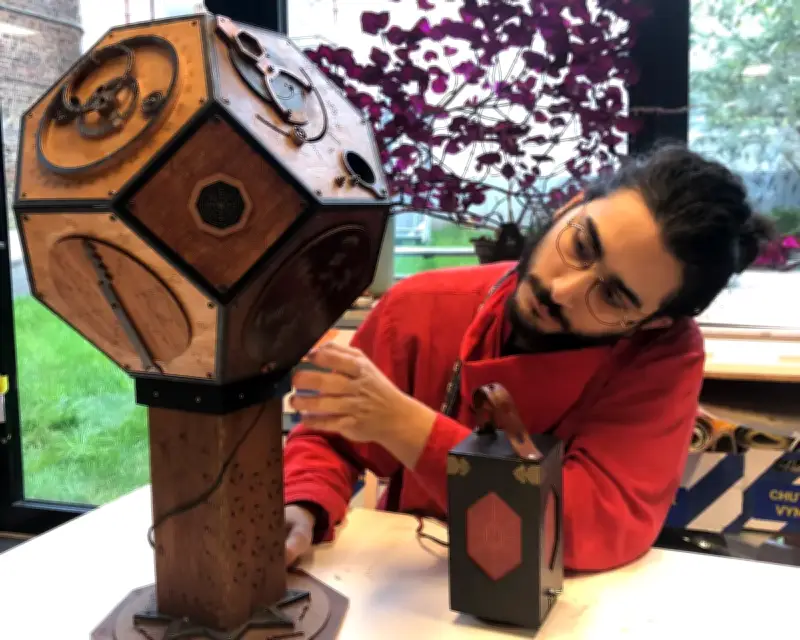
Belgian escape game designer Navid O'Lari argues that the coordination and unity required in escape games mirror the fight against fascism. He has created dozens of games and puzzles intended to foster community, educate people, and inspire them to fight for justice.
O'Lari recently brought two of his creations to the Games Transformed festival in London, which celebrates political and activist game design. The games were Resolution 194, about Palestinians' right to return to their homeland, and Fascism Minus 20, which explores new forms the ideology has taken in the 80 years since the death of Benito Mussolini.
Political Games for Action
“Mainstream art and culture is political, even if you don’t want to make a political statement,” says O'Lari. “When you are watching a Disney movie, there is still a political background to it, there is still the normalisation of some behaviours or some type of society. Every piece of culture and art normalises something, so even if I’m not making an officially political game, I want something in it that will still carry the general values I believe in.”
Some games, such as Fascism Minus 20, are explicitly designed to get people to take action. “We believe fascism died with Mussolini in the 40s but in fact it has just been taking all these other faces,” O'Lari says. “We’ve seen it in neoliberalism and in banalised racism against migrants and so on. So you have one [stage of the game] every 20 years to show how the face of racism and fascism has been changing.”
In the game, players receive items such as stickers or cardboard or paint, and at the final step, players use these to make placards for a real-life protest. The protest element means players must take the fight forward to finish the game.
Ethical Questions and Personal Experience
O'Lari has grappled with ethics in his work. “We have people who are paying to get locked in a room. When you think about that from the perspective of people who are being jailed just for being who they are, it seems very weird – it’s like those people who are paying to spend the night [in prison-themed bars] wearing orange prisoners’ clothes and getting cocktails in the cells. So can I do the same thing in an escape room without falling into this disturbing idea of making a simulation for people who will never know what it actually means?”
The question is personal: O'Lari has twice been imprisoned by Israeli authorities for his participation in aid flotillas to Gaza. While in jail, he improvised primitive versions of ludo and backgammon to help boost the morale of his cellmates. “I did build some board games in the jail using bread, because we didn’t have anything,” he says. “I used bread to make cubes and let them dry to make dice. We used olive pits to make the pawns and by rubbing them on the white wall you could change the colour. So we had black and white pawns, and we had some single-use packets of soap and I would use those to make the tiles of the game.”
Broader Themes and Reactions
Other topics tackled in O'Lari's games include the Belgian resistance in the second world war, and waste reduction. He has also made a game about Sámi indigenous knowledge inspired by a Guardian article on how climate breakdown has brought a new type of snow for which the Sámi have no name.
Reaction to O'Lari's games has been almost universally positive; people frequently thank him for making the political games, he says. But he is ready for the fight, if it comes. “I’m really looking forward to some rightwing arsehole saying ‘Hey, are you attacking me?’,” he says: “Yes. I am.”