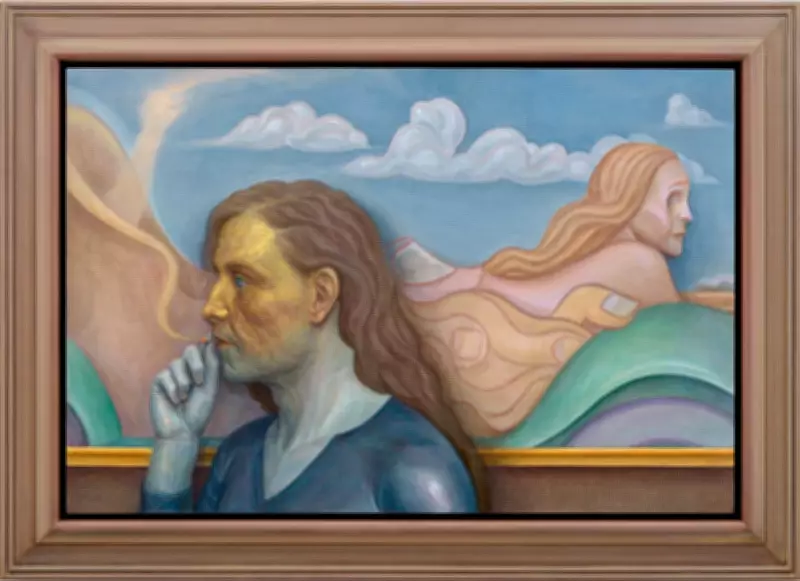
Steven Shearer is a quiet man. He is elusive, shy, and reclusive. It is difficult to pin him down for an interview, and once you have, it is tough to get him talking. Perhaps the Canadian artist thinks his work—spanning 40 years and multiple media, including stunning paintings of long-haired teens, collages of appropriated images, and billboard-sized poetry inspired by heavy metal lyrics—speaks for itself. But Shearer’s work does not really speak, at least not clearly; it mumbles awkwardly into its sleeve like a goth at a family Easter picnic.
“I wrote down lots of potential things to say,” he says from his immaculate white studio in Vancouver, ahead of his show at David Zwirner Gallery in London, his first UK exhibition since 2007. “But it’s not my nature. All the hope or will to be able to communicate kind of goes into the pictures. And I try to stay out of the way once that’s happened.”
And boy has he managed to stay out of the way. Somehow, he has never allowed any pictures of his face to find their way onto the internet. It is almost a shock to see the real Shearer is not a gouty billionaire. He is handsome, fit, and hip, his blond hair swept back as he deliberates over his answers and shows me slowly around his meticulous workspace with its huge collages, enormous printers, and perfectly hung works in progress.

He is nervous about the interview, “but I know you’re sympathetic to what I do,” he says. Surely he does not often encounter people unsympathetic to his work? “I know people like it, but it’s just better in some ways if I never talk to them. I’ll meet collectors and they’ll say: ‘Oh, you’re the only artist we’ve collected that we’ve never met.’ I just think to myself, well, I’ve ruined that.”
A Star in the Art World
Despite his awkwardness, Shearer is a star in the art world. He has caused controversy with his giant images of sleeping people taken from the internet, shocked audiences with his gory poetry. But he is most revered for the depth and intensity of his painting, his art historical nous and conceptual rigour. With all his hypersaturated colours and lonesome portraiture, his references to teenage heavy metal obsessions and suburban loneliness, his work looks like Edvard Munch high on potent weed, or the fauvists drinking cheap cider in the woods behind school. It is art history through the lens of adolescent ennui and coming-of-age alienation, a stunningly painted heavy metal malaise.
I ask if he feels any kinship with the other great Canadian chronicler of suburban youth, Mike Myers, whose 1990s comedy Wayne’s World captured a very similar kind of teenage tedium. “Oh, yeah. I mean, it’s a suburban experience, for sure. Not quite as dark, I would say.”
Darkness from the Start
Darkness has been there from the start. Shearer was born in Vancouver but grew up in Port Coquitlam, a blank suburban expanse on the eastern edge of the city. “Nothing too spectacular about it,” he says, taking a long pause. Then adds: “I lived not far from the serial killer Robert Pickton.” Pickton murdered dozens of women and fed them to his pigs in the 1990s. “I was sensitive as a kid. I could tell that there were some dark forces around. Sometimes, you’d find things that were kind of questionable in the bushes and things.”
Was it that darkness that drew him to heavy metal? “Musically, I was open to everything, but I think I was drawn to that really through the iconography, the imagery. I didn’t have exposure to art as a little child, so I was into records and posters,” he says.
Early death and black metal was low budget, extreme music made by bored teens in the suburbs. Their band photos were often ludicrously overblown—silly kids mucking about in the forest wearing makeup, pretending to be demons and zombies. Shearer takes those reference points and twists them, anonymises them, combines them with nods to art history, and repaints them over and over.

Obscure References and Universal Appeal
If you know what you are looking for, you can untangle the references and spot a teenage Cliff Burton from Metallica, a young George “Corpsegrinder” Fisher from Monstrosity and later Cannibal Corpse, a blood-drenched Quorthon from Bathory, prog icon Rick Wakeman with the word “hash” bleached into his hair, the four members of Obituary hanging from nooses. They trigger an almost Pavlovian response in me—Shearer’s endless allusions to German Romanticism and extreme metal reflect my own passions and obsessions.
But I am not his target audience. “I like to imagine the ideal viewer is someone 40 years into the future who has no idea who anybody is in the pictures,” he says. The obscure references help create a sense of almost cryptic distance. “I’m making these pictures, sending them out into the world, hoping that they can draw people into them. I want to make them universal.”
Shearer’s figures have, for the most part, always been boys on the brink of manhood—long-haired youths caught between childhood and full-blown, testosterone-drenched adult machismo. They are androgynous, tense portraits of lonely kids. I ask about the fluid gender of his figures. Both his mother and uncle, who was transgender, painted, “and I could never pick up on what the sexes were in the art that they made. But it’s not a conscious construction, it’s just my sensibility, what I’m drawn to.”
Looking at the portraits and then back at him, they suddenly all look like the same person in different guises. Are they self-portraits? “It’s part-anthropological, part-autobiographical.” So they are a mixture of cultural fascination and self-reflection? “The fact that I never have somebody posing for the pictures when I make them, I guess in art history you’d call them fancy portraits [a kind of imagined portraiture]. There’s a genealogy that connects me with all of them.”
Aging and Withering
Something is different in the new works at David Zwirner, however. The healthy teens of the earlier paintings seem to have aged and withered. The figures are frailer, their hair is greying, their faces are lined with wrinkles, and one character is flanked by a pair of crutches. The reckless abandon of youth has been replaced with the fear and discomfort of middle age. “Yeah,” he pauses again. “I would say that’s the case.” And quickly he changes the subject.
The paintings may be his prime focus, but they are far from the only thing he does. For decades he has been amassing a vast archive of images from the internet that he compiles into reference volumes and returns to again and again. It is the source of his Sleepers series, photos of people zonked out on couches and buses, archived by Shearer and blown up to massive proportions, transformed into symbols of death.
Then there are his poems, inspired by the goriest, most transgressive of heavy metal lyrics, with lines such as “foul winds of putrefaction, evisceration of the altar” and “sodomized by the cross, rapturous disembowelment”, printed up to billboard size at the 2011 Venice Biennale.
Both bodies of work have caused controversy and shocked audiences, but they are such a clear extension of Shearer’s approach. It is what Nicholas Cullinan, the director of the British Museum, has described as a “double cultural archaeology”: Shearer is mining the past and archiving the present at the same time.
But it is the painting that he keeps returning to. “What I’d like to harness is that, within a figure in a painting, you can see something that you recognise from your own experience. And then within it, you can see the lineage of people’s lives and expressions and their fleeting moments in the past. For me, it’s the culmination of everything I do.”
In painting alienation, angst and boredom, it seems he is not just painting portraits of himself, but portraits of us too. Steven Shearer: My Moody Muse is at David Zwirner Gallery, London, from 4 June to 31 July.