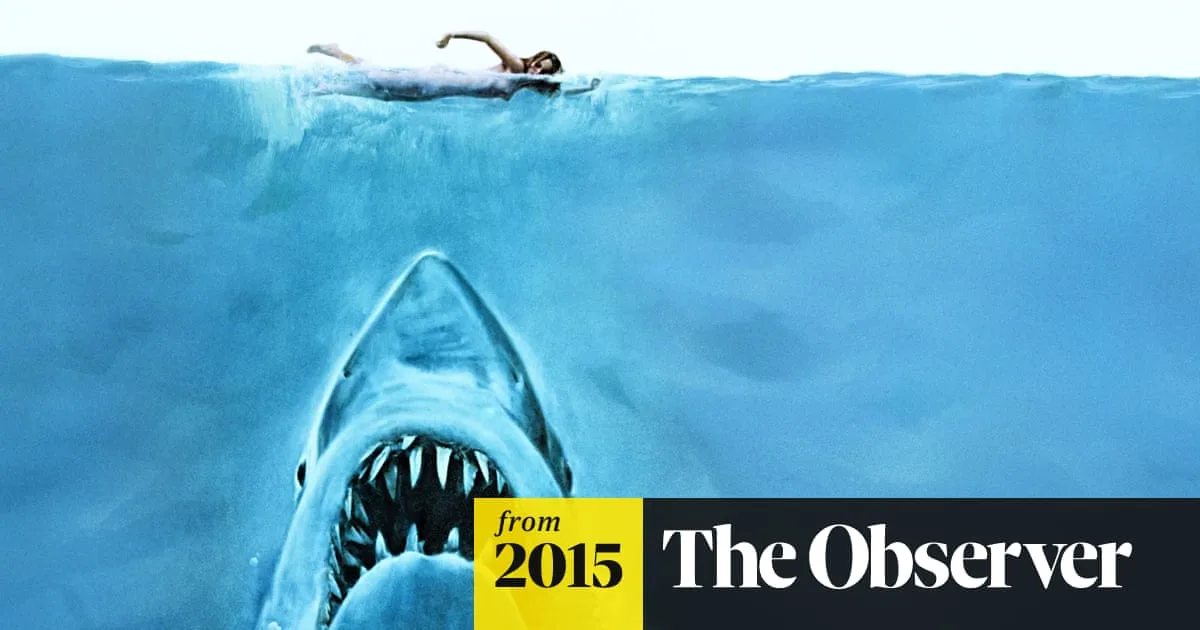
First things first; Jaws is not about a shark. It may have a shark in it – and indeed all over the poster, the soundtrack album, the paperback jacket and so on. It may have scared a generation of cinemagoers out of the water for fear of being bitten in half by the “teeth of the sea”. But the underlying story of Jaws is more complex than the simple terror of being eaten by a very big fish. As a novel, it reads like a morality tale about the dangers of extramarital sex and the inability of a weak father to control his family and his community. As a film, it has been variously interpreted as everything from a depiction of masculinity in crisis to a post-Watergate paranoid parable about corrupt authority figures.
But as a cultural phenomenon, the real story of Jaws is how a B-movie-style creature-feature became a genre-defining blockbuster that changed the face of modern cinema. In the wake of the epochal opening of Jaws 40 years ago, the film industry would find itself on the brink of a brave new world wherein saturation marketing and mall-rat teen audiences were the keys to untold riches. To this day, many consider the template of contemporary blockbuster releases to have been laid down in the summer of 1975 by a movie that redefined the parameters of a “hit” – artistically, demographically, financially.
According to David Brown, one of the film’s producers: “Almost everyone remembers when they first saw Jaws. They say, I remember the theatre I was in, I remember what I did when I went home – I wouldn’t even draw the bathwater.” I was no exception. I first saw the movie at the ABC Turnpike Lane in north London at the age of 12. It was a Sunday afternoon and I’d had to catch two separate buses to get to the cinema. I sat on the right-hand side of the packed auditorium and I remember very clearly finding the opening sequence so alarming that I wasn’t sure I’d be able to get through the rest of the film. As I told director Steven Spielberg several decades later, watching poor Susan Backlinie being dragged violently back and forth by an unseen underwater assailant, screaming blue murder, I genuinely feared that I would lose control of my bodily functions (“I like that!” laughed the director).

The lenient A certificate had meant that I’d been able to see the movie on my own, without an accompanying parent or guardian, merely the warning that “the film may be unsuitable for young children”. But the entire cinema seemed utterly traumatised by that unforgettable opening sequence, and in the wake of this ruthlessly efficient curtain-raiser (you see nothing, but fear everything), two people hurried to the exit. As they left, I remember whispering to myself in a state of sublime terror: “I am never going swimming again, I am never going swimming again…”
This, of course, had been the reaction of millions of cinemagoers in the US, where Jaws had become a summer movie sensation. In his influential essay, The New Hollywood, film historian Thomas Schatz notes that Jaws “recalibrated the profit potential of the Hollywood hit and redefined its status as a marketable commodity and cultural phenomenon as well”. Significantly, it achieved this success at a time when “most calculated hits were released during the Christmas holidays”. Not so Jaws, which according to David Brown was “deliberately delayed until people were in the water off the summer beach resorts”. Indeed, one of the film’s most memorable tag-lines was “See it before you go swimming!”. Yet it wasn’t just the resorts where Jaws showed its box‑office teeth.

Despite the fact that the summer months had traditionally been slow for cinemas (why go to the movies when the sun is shining?), Spielberg’s brilliantly constructed shocker struck a nerve with young audiences whose natural environment was not the beach but the shopping mall. Between 1965 and 1970, the number of malls in America had grown from 1,500 to 12,500 and Jaws rode high on the growing wave of multiplex cinemas that these urban meccas increasingly housed. Along with confirming “the viability of the summer hit, indicating an adjustment in seasonal release tactics”, Schatz also argues that Jaws struck a chord with a new generation of moviegoers who had “time and spending money and a penchant for wandering suburban shopping malls and for repeated viewings of their favourite films”. It didn’t hurt that these malls were air-conditioned, with the multiplex cinemas they increasingly housed providing a cool alternative to the summer heat.