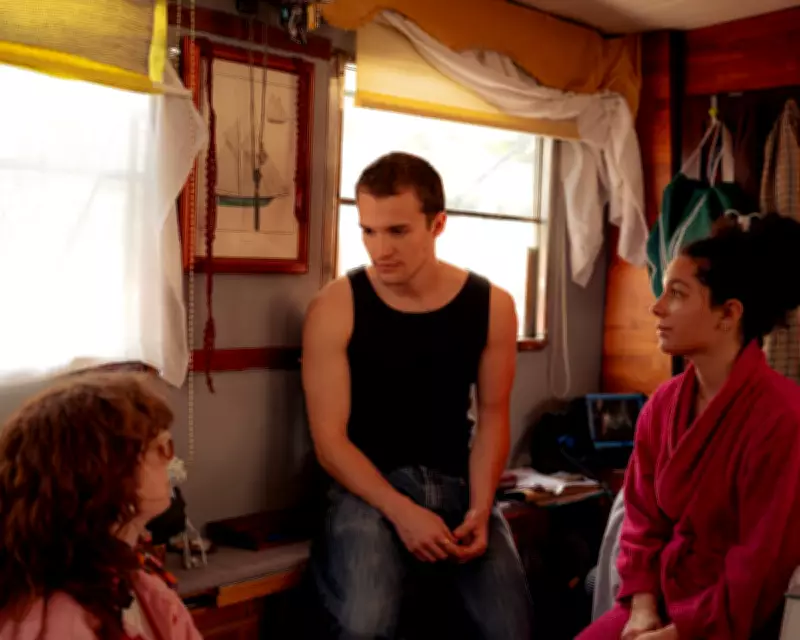
The light is wrong for what we are trying to do. Outside, it is early afternoon at the Port de l'Arsenal in Paris, bright and unmistakably day. Inside the houseboat that acts as the main set for my film Amarres (Moorings), the team has installed track lights and covered a ceiling porthole with black fabric, turning the bedroom into something closer to night. Red velvet walls, and a platform bed tucked into the curve of the bow; it is meant to feel intimate, private. But of course, it is not.
We have just come back from lunch. My actors are half-undressed on the bed, waiting. The set is closed, with only six crew members in the narrow hallway leading to the bedroom: camera, sound, myself, the first assistant director, and Nathalie Allison, our intimacy coordinator. We are behind, and I have less than an hour to direct three sex scenes back to back. What I am about to ask for has to look real, spontaneous, desirable – the kind of intimacy French cinema has long prided itself on capturing without instruction.
It does not.

I hesitate, unsure how to give that note without embarrassing the actors. Amarres, a story set on a Parisian houseboat where a young man unravels under the watch of a tight-knit port community, marks only my third time directing, and my first in France and in French, and I feel momentarily out of my depth. I have asked Nathalie to stand with me at the monitor, and the look on my face when I turn to her must say enough.
“Let us reset,” she says, gently.
She adjusts the actors with precise instructions. “You are leading this moment,” she tells Sofia Benner Nihrane, our lead actor, “and you need to imagine an anchor point.” In less professional words, move as though there is a penis inside you.
I cannot say that, and I do not want to; I do not have the language for what I am asking my actors to do. I know when something does not look right, but I do not know how to fix it. It is up to Nathalie to translate something I can feel into something we can actually film. On the next take, it works. It looks real. Even better, it looks hot.
The Rise of Intimacy Coordinators
Intimacy coordinators are a relatively recent addition to film sets, emerging in the late 2010s in response to industry-wide fervour around consent and working conditions. Their fingerprints are now all over many of the most culturally significant TV shows of the past few years, from Normal People to Bridgerton to the recent queer hockey megahit Heated Rivalry. Their role sits between choreographer, mediator and advocate, structuring scenes in advance and establishing boundaries so actors can perform safely.
On 15 May, the instructors (including Nathalie), and graduates of France’s first intimacy coordinator course were formally introduced during the Cannes film festival by AFDAS, which supports professional development in the arts, and CST, France’s association of film and audiovisual technicians. This is a milestone for a role long dismissed as an Anglo-Saxon import. For years in France, the idea that sex scenes might require choreography or oversight ran against a national cinema built on artistic freedom and improvisation.
Part of that resistance within French cinema is timing. When #MeToo reshaped industries in the US, France largely framed it as an American problem. France’s reckoning is more recent, and uneven, following actor-director Judith Godrèche’s public testimony about abuse in the industry and the ongoing legal cases involving Gérard Depardieu. Intimacy coordination has emerged in that context not as consensus, but as friction.
Nathalie, a Scottish intimacy coordinator working in France, recalls: “There were people saying it would disappear after a year or two. That it was just a temporary fix.” Now, she says, it is being reframed as part of film-making itself.
Part of what makes that shift visible to me is that I am coming at it from elsewhere. I am Canadian, and I had just come off a Netflix production there, directing social content on set. Even for a 30-second video of an actor appearing shirtless, I had to go through the intimacy coordinator, a routine formalised in Canada in 2018. This is not yet the case in France.

“I can only do the job I am given the space to do,” says Nathalie.
Boundaries and Collaboration
On some sets, that space is minimal. Directors do not always engage with her. Her authority is not formalised in the same way as in Canada or the UK. She cannot enforce decisions. Her choices are to advise, negotiate, and, in extreme cases, remove herself.
“I have said: ‘If you go ahead with this choice, I will leave the set. I am not able to protect people as necessary and therefore I have to remove myself,’” she says.
This side of the job – as a safeguard for actors – is what often positions Nathalie and her colleagues as obstacles between performers and directors. But from my conversations with Nathalie, enforcing boundaries on set is hardly her sole focus.
My work with Nathalie begins well before the camera rolls. On a video call, we go through the intimacy scenes in my script, which I have deliberately written vaguely. I note feelings, with text such as: “Le sexe semble froid” (the sex feels cold). Nathalie picks up on this.
“Do you want all the scenes to be penetrative?” she asks.
What follows is a conversation about my own intimate experience with a partner near the end of our relationship. My personal anecdote ends up altering the final intimacy scene, and Nathalie asks a few questions about framing and camera angles; she will meet with the actors next, and needs these details for their consultations.
I am surprised. I had not expected to go there so unambiguously. Creating sex scenes requires you to think about and insert your own history with sex and love. Like most screenwriting, you do this alone. But in doing this with Nathalie, I realise later, I was vulnerable.
“Did you feel safe?” Nathalie asks when I tell her this. I offer her the same question. We both say yes, and I laugh because, under any other context, it would not be appropriate to talk to your colleague about the final time you gave your ex a blowjob.
This is when my understanding of intimacy coordination deepens. I know and respect both of my leads, Sofia and her co-star Alexandre Henri Desjonqueres. I was never going to ask them to do anything they did not want to do. In this case, Nathalie is less a protector than a collaborator, allowing me to step back from the mechanics of sex and focus on performance and story. She handles the physical language so I can focus on the emotional one. Like having a stunt coordinator or cultural consultant, Nathalie’s presence allows for a division of labour I had not realised I needed.
On Set: Making It Real
Watching the scenes unfold feels strange; the hull of a boat full of people watching two others pretend to be alone. I find myself acutely aware that I asked for this. That these scenes exist because I decided they mattered. If I had not, the actors would not have to do any of it. Nathalie frames it differently.
“They have been told at several points that their consent is in this,” she says.
The responsibility does not disappear. If anything, it sharpens. One of our scenes involves spitting, an act that feels minor on paper but carries weight in practice. The actors are clear: they will do it for real, and ideally once, maybe twice at most. I agree.
After the first take, I watch the playback with Nathalie. I feel good about it. Still, I hesitate. Every instinct I have learned about directing says more takes mean more options. But this is not just another scene. I confer with Nathalie. She agrees: the take is strong. I call it and we move on.
Industry Context and Future
In the US and Canada, intimacy coordinators are not legally required but are standard on most professional sets. In France, they are brought in only if production hires one, or if actors request it. On Amarres, I was the one who insisted on having Nathalie present from the outset, a decision that raised practical questions about budget, but little creative resistance once we were rolling.
“People think we are going to take something away,” Nathalie says. “That we are going to cover people up, that we are going to make it look mechanical.”
In my experience, having her by my side did the opposite. Creating with her has made me a more precise director, just like working with grips, camera or sound. Less reliant on instinct, more aware of what I am actually asking for.
I have not looked at the rushes from this day; I know there will be parts I would shoot differently, frames where the time pressure shows. But I also know I did not want to push the actors, to keep asking them to repeat something already strange and new. I hope we have enough – and that I knew when to stop.
We wrap the final scene and I am pulled straight into the next set-up, where dozens of extras are waiting. There is no time to debrief with Alex or Sofia. But the actors have Nathalie. She quietly descends into the darkened berth as I race across the pontoons, the sun almost exactly where it was when we started.