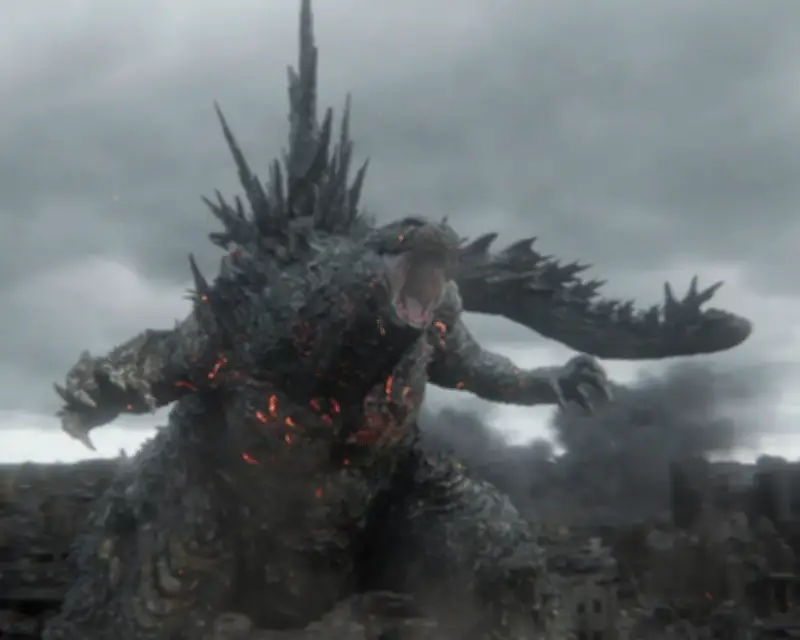
Godzilla Minus Zero, the sequel to the Oscar-winning Godzilla Minus One, world-premiered at the New York film festival, delivering spectacular monster action alongside thoughtful social commentary. The Toho-made film continues the winning streak of the Japanese Godzilla franchise, which became mainstream enough for its characters to appear in Happy Meals.
A return to post-war Japan
Writer, director and VFX maestro Takashi Yamazaki returns for the sequel, bringing back lead characters from the previous film. Former military pilot Kōichi Shikishima (Ryunosuke Kamiki) is reunited with his now-wife Noriko (Minami Hamabe) and their adopted daughter Akiko (Sae Nagatani) two years later, in 1949. A new monster threat looms in the form of a dragon-like creature dubbed Ghidorah, whose menace will be familiar to kaiju fans. Ghidorah is featured from the very first scene.
Ghidorah’s appearance sends off alarms in the disaster-response agency that now employs Kenji Noda (Hidetaka Yoshioka), also from the previous film. Noda is joined by Makoto Aoyama (Masami Nagasawa), a meteorologist who introduces less artillery-heavy defense mechanisms for this new threat.
Human drama amid monster mayhem
In the tradition of its emotionally involving predecessor, Godzilla Minus Zero grapples directly with humans’ attempts to assert control over forces that initially seem impossible to harness. The film’s version of the US military is willing to provide planes but not troops to aid in the fight, drawing Kōichi and Noriko back into conflict despite young Akiko’s pleading. The partners’ skill sets make them valuable assets, perpetuating questions about what sacrifices might be expected when sending citizens into battle.
Yamazaki mentioned at a NYFF press conference that he sought to avoid conforming to fan guesswork about how kaiju business in a sequel might proceed. True to his word, the movie stays true to the human melodrama that proved effective in the previous film, though the family-soap parts sometimes falter. The restrained relationship between Kōichi and Noriko seems weirdly glum in a state of co-parenting stasis, with little sense of time’s passage.
Spectacular climax and ambiguous landing
The extended climax features some of the most majestic CG monster action put to film, cross-breeding fight-to-the-death grappling with disaster-movie scope and horror-movie teeth. The movie favors quality of visual effects over quantity; details like Ghidorah’s lightning-like attack beams have a jagged beauty that makes them both cooler and scarier than obligatory effects-movie laser shows.
The world of Godzilla Minus Zero often appears perched on the verge of a post-war technology boom, and on the precipice of further global disasters invited by the collision of humankind’s innovations and unknowable forces of nature. If Yamazaki’s previous Godzilla movie allowed crowd-pleasing thrills to punch through its mid-century anxieties, this one lands more ambiguously. Godzilla Minus Zero is screening at the New York film festival and will be released in Australia on 5 November and in the US and the UK on 6 November.