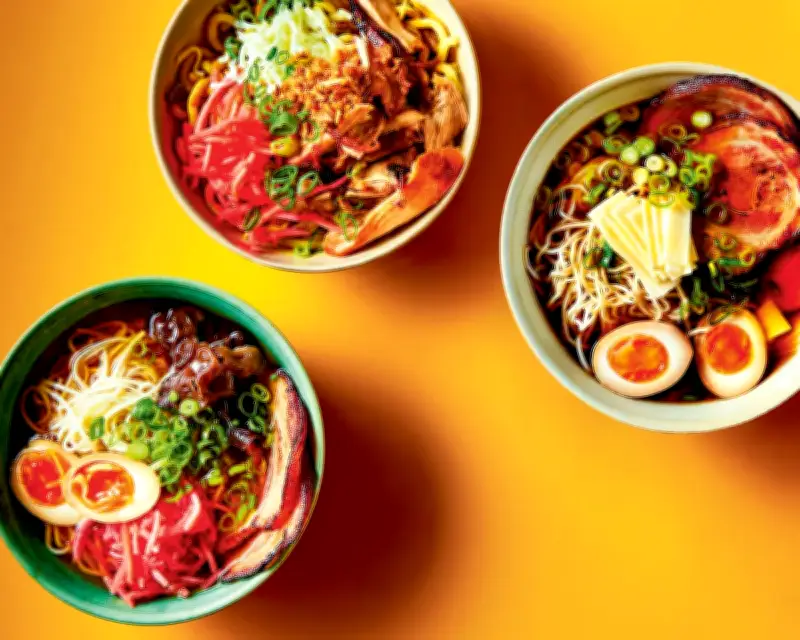
Ramen, at its simplest, is a balance of five elements: broth, tare (a secret seasoning sauce), noodles, fat, and toppings. Understanding this opens up a seemingly cryptic and complex corner of Japanese food culture. The first four elements take time, but shop-bought stock and decent noodles are acceptable shortcuts. The toppings, however, offer the real payoff, turning a midweek meal into something worth showing off.
Universal Notes for Every Bowl
Spring onions should top every bowl, with finely diced white onion as a backup. Aim for 300ml of broth per bowl, and instant dashi is fine unless you are vegan, in which case steep 20g each of kombu and dried shiitake in one litre of cold water overnight, keeping the mushrooms for the soboro. Noodle portions are 130g unless stated otherwise, and specialist items are available online or at local Asian supermarkets.
These toppings are not exclusive to one bowl, so swap them about. They all work beyond ramen: chashu in a cheese toastie, soboro on rice, or ajitama in a caesar salad. The tares are multiuse too: tantanmen tare is great in scrambled eggs, miso tare on corn on the cob, and shio tare improves almost anything.
Tokyo Shoyu: The Platonic Ideal
This is ramen's platonic ideal, where one piece of pork provides the topping, tare, and fat. The broth is a 50:50 mix of chicken stock and dashi. The tare is 3-4 tbsp of chashu braising liquid, and the fat is 1 tbsp skimmed from the chilled braising liquid. Use medium classic noodles and top with pork belly chashu, shop-bought menma (seasoned bamboo), and ajitama.
For the chashu (serves 6-8), roll and tie 500g pork belly and brown it all over in a pan. Deglaze with 150ml sake, add 300ml each of shoyu, mirin, and water, 30g demerara sugar, six sliced garlic cloves, and a sliced 4cm piece of ginger. Simmer gently, turning, for two hours. Cool in the liquid to room temperature, then chill overnight. Cut into 1cm-thick slices and torch or pan-fry to serve.
Tantanmen: Sichuan Dan Dan Noodles as Ramen
Tantanmen is Sichuan dan dan noodles transformed into ramen, with sesame, spice, and a soboro that works like a ragu. The broth is a 50:50 mix of kombu-shiitake dashi and unsweetened soy milk. The tare combines 2 tbsp tahini, 1½ tbsp shoyu, 2 tsp black vinegar, 1 tsp sugar, and a pinch each of MSG and ground Sichuan pepper. Add 1 tbsp rayu chilli oil as fat, and use medium classic noodles. Top with spicy mince soboro and pak choi.
For the spicy mince soboro (serves 6-7), soften a small diced onion and 2cm piece of grated ginger in oil for five minutes. Add five grated garlic cloves, then 500g fatty pork mince (any mince works, but vegan mince needs more water), and fry until it forms grains, not lumps. Add three tablespoons of doubanjiang (chilli bean sauce), one and a half tablespoons each of shoyu and mirin, plus a splash of water. Cook for 15 minutes until glossy.
Hakata Tonkotsu: Japan's Famous Export
Hakata tonkotsu is Japan's most famous ramen export, featuring thin, straight noodles in a creamy pork bone broth, eaten fast by design. The broth is tonkotsu, with 30ml shio tare (30g salt, 10g sugar, and 10g MSG dissolved in 70ml sake, 20ml mirin, and 110ml water, making 230ml or about 7 bowls). Add 1 tsp sesame oil as fat, and use thin, straight noodles. Top with ajitama, pork belly chashu, shop-bought kikurage (wood-ear fungus), and beni-shoga.
For the ajitama (serves 6), warm 100ml water, dissolve 10g brown sugar in it, then add 100ml each of shoyu and mirin and chill. Pierce six fridge-cold large eggs at the wide end and boil for seven minutes, stirring for the first 30 seconds to centre the yolks. Plunge into iced water, peel, and submerge in the cold marinade for 12-72 hours.
Chippy Lane Mazesoba: A Cardiff Cult Classic
This is a late-night Cardiff cult classic, our version of Nagoya mazesoba, featuring chicken, curry sauce, and chips. It breaks the rules with no broth. The tare is 100ml of shop-bought Japanese curry roux, made thick and salty. The fat is 1 tbsp each of butter and chicken fat (from the thighs). Use thick noodles (200g). Top with shio koji chicken, crispy onions, beni-shoga, and grated cheese, if you're feeling cheeky.
For the shio koji chicken thighs (serves 4-5), coat 500g skinless and boneless chicken thighs in 50g shio koji, 20g mirin, half a tablespoon of shoyu, and one teaspoon each of grated ginger and garlic. Leave for up to three hours. Add 100ml water, cover, and cook over a low heat for 45 minutes. Uncover and reduce until it crisps. Shred the meat and toss through the glaze.
Sapporo Yasai Miso: Plant-Based and Bold
Usually built on pork broth and lard for Hokkaido winters, this version is plant-based but stands up. The broth is kombu-shiitake dashi. The tare is 60g per bowl, made from 100g each of white and red miso with 2 tbsp sake, 1 tbsp each of mirin and shoyu, and 1 tsp each of grated raw garlic and ginger. The fat is 2 tbsp vegetable oil, fried with grated garlic and ginger. Use thick, wavy, yellow noodles. Top with stir-fried cabbage and beansprouts, sweetcorn, toasted sesame seeds, and butter if you're not vegan.
For the stir-fried cabbage and beansprouts (serves 4), get a wok very hot with a little neutral oil. Add 200g shredded cabbage and 150g beansprouts, and toss hard for two minutes, aiming for char, not steam. Season with a tablespoon of shoyu, a teaspoon of sesame oil, and a pinch each of salt, sugar, and shichimi togarashi. James Chant is the owner of Matsudai Ramen in Cardiff, and he demonstrates these techniques in the video guide.