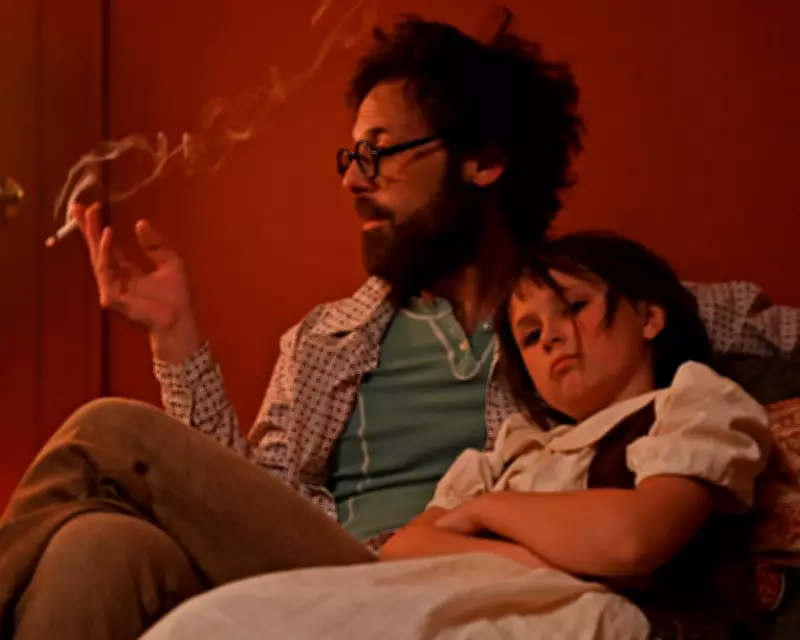
For those familiar with the Bay Area in the 1970s and 80s, Fairyland offers a glorious wallow in nostalgia. From grainy archive footage of San Francisco Gay Freedom parades to the novelty of sushi at a book launch and new wave hairstyles, the film immerses viewers in a bygone era. Yet, beyond the set dressing and costumes lies a story about what was then a new kind of family.
A New Kind of Family
At the heart of the narrative is Steve (Scoot McNairy), a gay father raising his young daughter Alysia in San Francisco after her mother is killed in a car accident. They first live in a squalid commune in Haight-Ashbury, later moving to slightly more upscale digs. Steve, still partially in the closet when tragedy strikes, loves his daughter deeply. He even turns down an offer from his ultra-straight mother-in-law (Geena Davis) to raise the little girl.
However, Steve is also a bit selfish and neglectful. He convinces himself he is teaching Alysia independence when, for example, he tells her to take a bus across town instead of picking her up from school. There are echoes of parenting techniques showcased in Marielle Heller's adaptation of The Diary of a Teenage Girl, set in a similar period, though Alysia ends up less damaged. She becomes as independent and resilient as her father hoped, even if she never learned to ride a bicycle.

The Impact of the AIDS Epidemic
The second half of the film covers the later 1980s as the AIDS epidemic claims many lives. The tragedy's shape is visible from afar, but writer-director Andrew Durham, adapting Alysia Abbott's memoir, limns the outlines gracefully with only a discreet hint of sentimentality. The cast is excellent, especially McNairy, who makes Steve profoundly lovable despite his flaws, and Emilia Jones (as teen Alysia), whose flinty vulnerability is perfectly pitched. Sofia Coppola is among the producers, though her hand is not particularly apparent in the film itself, despite her likely familiarity with the period.
Fairyland is in UK cinemas from 29 May.