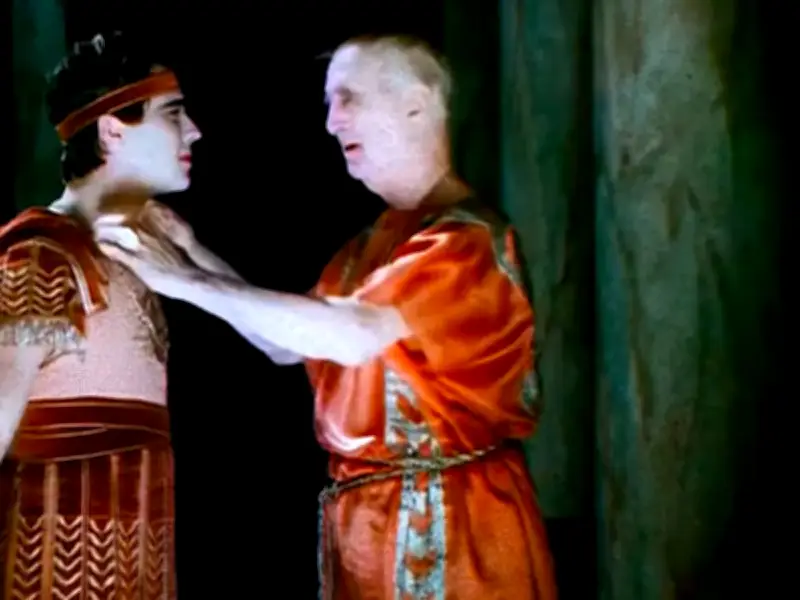
An actor was thrown from his carriage and crushed to death on the set of the original Ben-Hur, a production in which an estimated 100 horses also died. The troubled shoot was documented by film historian Kevin Brownlow in his 1968 book The Parade's Gone By.
A Chaotic Production From the Start
Producers of the ancient Roman epic quickly found themselves out of their depth. Months of largely unsupervised filming in Italy in 1923 produced dreadful footage, forcing the studio to sack the director and most of the lead actors before starting again.
Replacement director Fred Niblo resumed filming in Rome, which had been under Mussolini's National Fascist Party's grip for roughly a year. Political tensions seeped onto the set during the shooting of the first major action sequence, a naval battle between a Roman war galley and a pirate vessel. Both were full-sized, seaworthy crafts constructed specifically to be destroyed for the film.
Fire, Blades and Drowning Extras
The casting director recruited dozens of Italians to portray the ships' crews and placed fascist extras in one crew and anti-fascist extras in the other to inject authenticity into the conflict. Niblo stepped in, discovering the ships were fitted with genuine, sharpened blades, which were confiscated before anyone could be injured.
At the scene's climax, the Roman vessel was meant to catch fire. While Niblo was capturing the effect, a gust of wind whipped up the flames, causing the blaze to spread rapidly. Extras began hurling themselves overboard, some clad in heavy armour and many unable to swim. Francis X. Bushman, one of the film's leading stars, claimed he pleaded with the director to help the drowning men, to which Niblo reportedly replied, "I can't help it! Those ships cost me $40,000 apiece." Three extras were recorded as missing following the scene.
Some crew members maintain that either two or three men resurfaced days later, having been pulled to safety by a fishing boat; others remain convinced they perished. In Brownlow's words: "Opinions differ as to the casualty rate."
The Deadly Chariot Race
Other outrages included an elderly actor nearly catching pneumonia after being forced to shoot on a raft in the Mediterranean Sea for three days, Niblo throwing objects at child extras, set construction delayed by political riots, and crew members accidentally digging into an ancient Roman catacomb, destroying the site and enabling a free-for-all pillage of 2,000-year-old artefacts.
The most gruesome death happened while filming the action sequence for the chariot race, under director B Reeves Eason. The surface of the track had not been properly prepared to handle horses and chariots, and after a few laps ruts formed in the ground with lethal consequences. Bushman, who played Ben-Hur's rival charioteer Messala, described the incident: "During one take, we went around the curve and the wheel broke on the other fellow's chariot. The hub hit the ground and the guy shot up in the air about 30 feet. It was like a slow-motion film. He fell on a pile of lumber and died of internal injuries."
Dozens of horses were also killed, either during chariot crashes, one of which nearly took out the film's leading man Ramon Novarro, or because Eason ordered them to be shot. "They never had a vet attend any horse," Bushman told Brownlow. "The moment it limped, they shot it."
Re-filming and the Final Cut
The outdoor chariot race footage proved completely unusable because the location was plagued by too many shadows. The entire sequence was re-filmed on a Culver City soundstage months later by 42 cameramen and 30 assistants strategically concealed around the set.
This time things ran more smoothly, until the climactic chariot crash, when two chariots became inadvertently entangled and a devastating pile-up followed. At least five horses died, and chaos reigned to such a degree that assistant director Henry Hathaway rushed into the arena to halt the oncoming drivers. As captured in Brownlow's 1980 documentary series Hollywood, Hathaway's accidental cameo made the final cut.
Also retained in the final cut were extras leaping overboard from the blazing vessel and horses being crushed beneath chariots. Ben-Hur proved a sufficient box office success to nearly recoup its staggering $3.9 million budget, by far the most expensive silent-era production ever made, yet filmgoers had no idea just how dangerous those action sequences truly were.