The English ceramicist Lindsey Mendick presents a portrait of romantic love that is mutated, twisted, gory, and gross in her new exhibition Where You End and I Begin at the Carl Freedman Gallery in Margate. This is love as body horror, romance as drug, and co-dependency as a living nightmare.
Intimate Insights into a Relationship
The show is inspired by Mendick's love for her partner, artist Guy Oliver, and her little black pug, Telly. The opening room features grainy, gritty Polaroids of Lindsey and Guy embracing, with arms wrapped around each other, toes in one another's mouths, naked bodies writhing together, tongues licking nipples, and feet pressed against bare bollocks. It is an incredibly intimate insight into their relationship, so full-frontal that viewers feel like voyeurs.
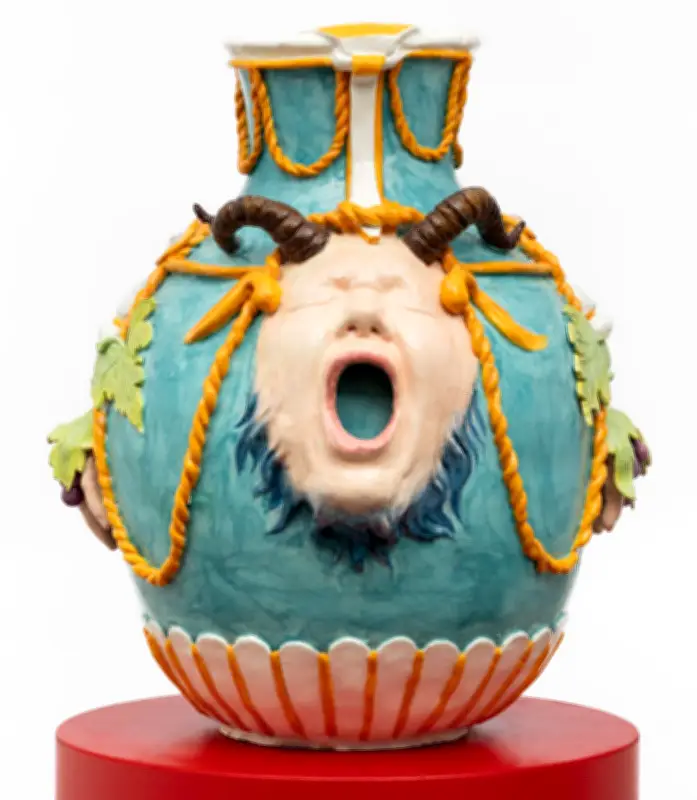
Mendick depicts herself as the Virgin Mary on a vase, with Telly as a surrogate baby Jesus. Guy's face screams out of another vase, horns poking out of his head like a fawn or satyr. The work is folkloric and religious, as if Mendick is writing the mythology of her own relationship.
Unsettling Ceramics and Hybrid Mutants
A table is laid out with ceramic sex toys that have taken on organic, uterine forms; Telly is encased in guts like a prenatal baby. There are toothbrushes with two handles and snails snogging. This is obviously about love and adoration, the anxieties of parenting, and the ups and downs of relationships—but it is deeply unsettling and uncomfortable.
The final space is filled with ceramics of Lindsey and Guy's faces knitted together, sharing a rib cage, a womb with little feet kicking out of it, and a heart with a hand wrapped around its valves pumping blood. The two lovers are so intertwined they have become one vile mutant form, joined together forever. The ceramics are white, displayed as if in a medical laboratory. Mendick is a modern Dr Moreau, fusing together a hybrid mutant creature made of pure love.
Toxic Love and Emotional Vulnerability
Panels on the wall tell a different story. Across images of seahorses, slugs, wombs, and skeletons of conjoined twins, Mendick writes phrases: 'I'm simultaneously sick of you and can't live without you'; 'I'm sure you'd be happier without me'; 'Can you not see I'm drowning?' This love has a toxic edge. It is as damaging as it is nurturing, as painful as it is essential. Mendick has realised that this is just what love is: two people getting so close that they need each other, and so close that they can destroy each other. The line between love and hate, toxic and healthy, is a thin one.
The vases are not as impressive, their slightly crude aesthetics not sitting right, but the rest of the show is great: ultra personal, super-exposed art with a woozy, tense atmosphere. There is more than a hint of Tracey Emin's no-holds-barred emotional vulnerability (the two artists are friends and both live in Margate), but that is no bad thing. Mendick has taken Emin's overwrought blueprint and pushed it into the realms of Cronenbergian body horror and Prozac Nation millennial malaise.
This show is probably Mendick's best work to date: a funny, anxious, paranoid, surreal, and unashamedly personal look at the romances that define her life. At Carl Freedman Gallery, Margate, until 30 August.