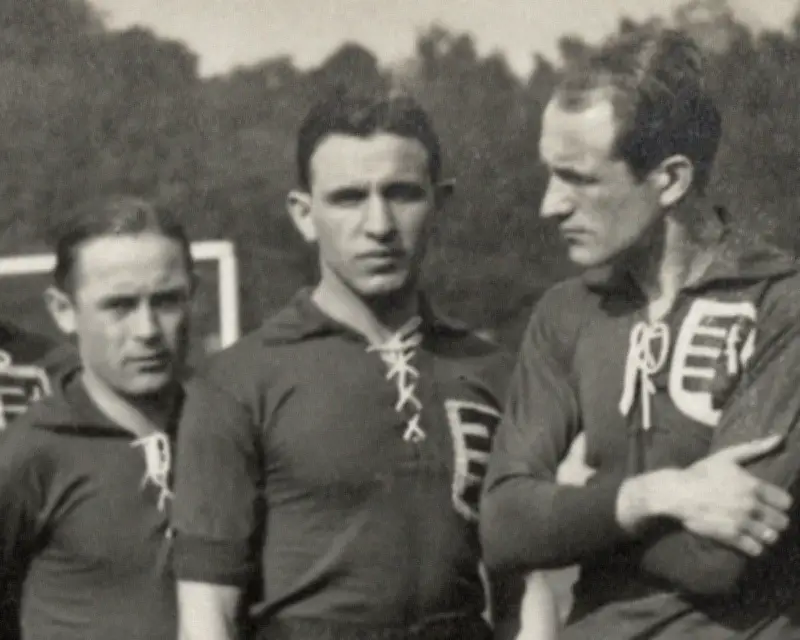
József Braun, standing in the centre with the Hungary team for the 1924 Olympic Games in Paris, is a name that football history has largely forgotten. Yet, according to author David Bolchover, Braun may have been the greatest Jewish footballer ever to play the game.
The Forgotten Greats
When asked who the best Brazilian player is, the answer is Pelé. For Argentina, Maradona or Messi; Hungary, Puskas; Holland, Cruyff; Germany, Beckenbauer; Portugal, Eusébio or Ronaldo; France, Zidane; England, perhaps Bobby Charlton. But what about the best Jewish footballer? Most people, even historically literate Jewish football fans, draw a blank. Some might smile, suggesting Jews are not very good at football, making the question pointless. However, Bolchover argues that the standard is extremely high, with two outstanding talents: Kalman Konrad and Jozsef Braun, both right-sided attacking players from Hungary.
Bolchover's instinct leans towards Braun, the youngest of 12 siblings from a religious Jewish family in Putnok, northern Hungary. At 17, Braun was selected for the Hungarian national team, then among Europe's elite. Lightning quick and technically gifted, his career was cut short in his mid-20s by injuries from vengeful defenders. By age 41, Braun was murdered, beaten to death as a slave labourer in a Russian winter by Hungarians who had once celebrated his football feats. The last image shows guards crouching over his body, extracting gold teeth.
Unlike Eusébio, Cruyff, or Maradona, Braun received no posthumous tributes. No public announcement of his death. Proud Jews have not lauded his memory. Most who might have remembered him died around the same time, along with their children and grandchildren. The story stopped.
Genocide's Impact on Memory
This is what genocide does: it eliminates not just people, but their stories. The Holocaust murdered six million Jews and shattered Jewish collective memory. Ask Jewish football fanatics about Jozsef Braun, and they might guess he was behind an electronics company, not a footballer.
Bolchover previously wrote about Bela Guttmann, one of football's greatest coaches, a charismatic Hungarian Jew who survived the Holocaust. But researching Guttmann revealed a wider story: the huge role European Jews played in pre-Holocaust football – top players, innovative coaches, Zionist teams, club presidents, administrators, passionate fans, elite referees. Bolchover felt like an archaeologist uncovering a destroyed society.
After finishing that book, Bolchover considered new subjects, but the Holocaust's scale and heroism captivated him. He began collecting biographical summaries of Jewish footballers and coaches, often with question marks about their fates. He also read about Jews in other sports, like boxer Salamo Arouch, who fought 200 bouts in Auschwitz, or swimmer Alfred Nakache, who survived Auschwitz and Buchenwald weighing 42kg, then broke another world record the following year.
Bolchover's attention turned to those who did not survive. Stories of survivors like Guttmann, Arouch, and Nakache offer hope, but he felt compelled to write about the rule: almost complete obliteration.
This is an edited extract from Digging Deep: Unearthing the Stories of Eleven Murdered Jewish Footballing Greats (Biteback, £22) by David Bolchover.