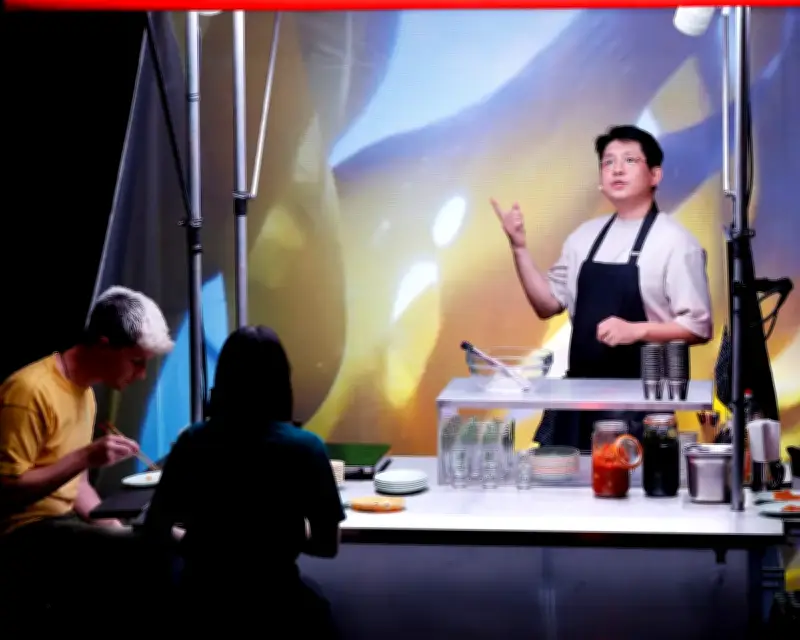
In Jaha Koo's one-man show Haribo Kimchi, a singing snail and an eel set the tone for a sweet meditation on belonging. “In every soil grows a different version of you,” sings the animated snail in Korean, projected on a screen. The eel echoes the sentiment: “My home has no location,” sings a fish that lives a life of transformation as it moves between saltwater and fresh.
A performer's rootlessness
Their experience is one shared by Koo, who left his native South Korea for Europe 15 years ago and has the rootlessness of the displaced. His sense of alienation is exacerbated by the racism he encounters, notably the assistant who complains of a stench of garlic despite sitting behind a screen.
That is a rare dark moment in a cheerful show, but the association with food is apt. Koo might be adrift in the world, but keeps his home with him via his national cuisine. Inviting two volunteers to join him at his pojangmacha, a street-food snack bar, he cooks up several courses as the show progresses: a cucumber starter, a kimchi pancake, a bowl of soup and a pudding flavoured with seagrass, mint and lime.

Food, memory, and community
Not all his food-related memories are happy: after smelling the corpses lined up after the Gwangju pro-democracy uprising of 1980, Koo's father could not bear the smell of fried chicken and retreated to the countryside to escape it.
But for the most part, in Koo's own production for Campo in Ghent, the performer reflects on a country that, like many others, finds community in food. It brings identity and salvation, not least the Haribo gummies that cheer him up away from home. Like the snail and the eel, they keep him company. Naturally, the Haribos get a song too.