Ghost Stories: Siri Hustvedt's Painful, Profound Memoir of Paul Auster
Ghost Stories: Hustvedt's Memoir of Paul Auster

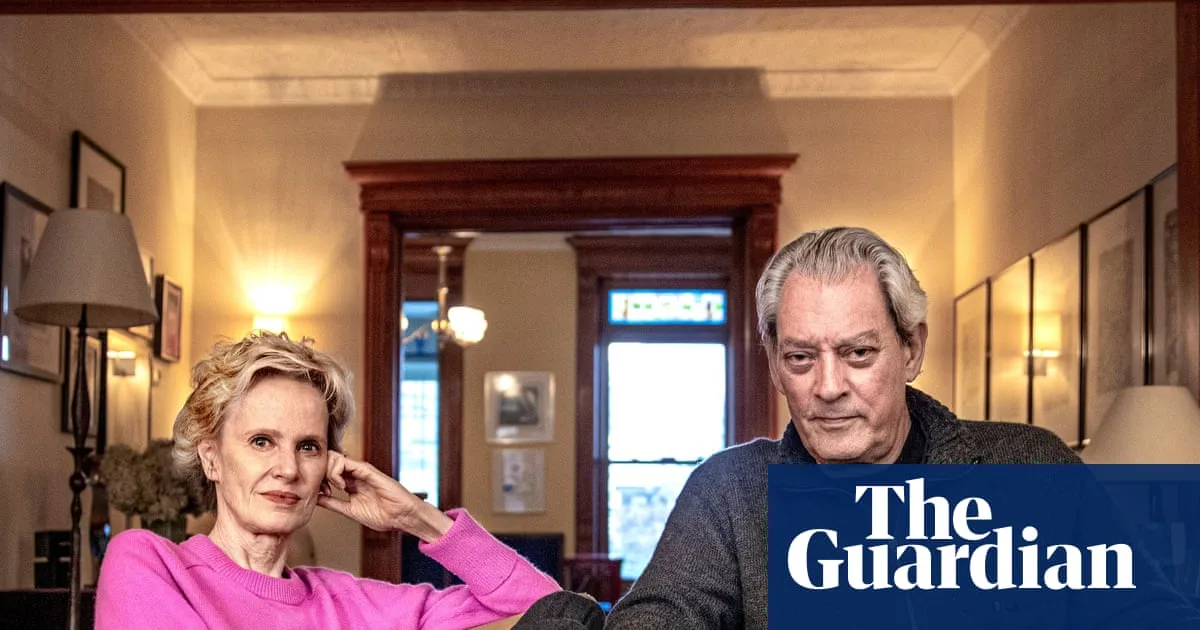
Paul Auster, the novelist, poet, and filmmaker, was a master storyteller. He died two years ago this week, but his afterlife shows no loss of narrative grip. On his deathbed, Auster said: 'I want to come back as a ghost.' In the pages of a haunting memoir by his widow, Siri Hustvedt, a renowned author of essays and fiction, he seems just as spellbinding as he was in print.

I first came to know him in 1987, the time of his UK debut with the publication of The New York Trilogy. In the heady days of that succès fou, Paul was embraced by the literary press as a new American voice, a romantic intellectual steeped in Poe, Hawthorne, and Melville, with a dash of Samuel Beckett. Later, several European critics would try to impose the influence of Derrida, Foucault, Kristeva, and Lacan on his writing. Hustvedt merrily reports that her man was not just voraciously unversed in these giants: the only Lacan he'd ever read was 'Seminar on The Purloined Letter.' Among the many pleasures surrounding this portrait is the zest with which Hustvedt discards her reputation for fearsome academic study. This sweeter and more deeply personal demeanour lingers over her text like the aroma of smoke (Auster had been addicted to Schimmelpenninck cigars) that sometimes intrudes on her grief.

A Memoir of Love and Loss

Ghost Stories is both a work of intimate reflection and a moving tribute to the 43 years she and Auster (self-styled 'lucky ducks') shared from their first meeting in 1980s New York to his death in Brooklyn in April 2024. Hustvedt honours his memory with many touching asides ('I cry in life'), but she's more narrator than sentimentalist. Her insights have the luminous clarity of truth. As a friend and editor who knew them throughout these years, I'd judge Ghost Stories to be a profound and forthright meditation on love and loss, unique in our literature.

Wide Pickt banner — collaborative shopping lists app for Telegram, phone mockup with grocery list

Hustvedt never flinches from acknowledging the unimaginable domestic tragedy that engulfed and tormented their family in the last years of Auster's life. In brief, his son Daniel, from his first marriage, had been a source of anguish since his teens. Auster was tormented by the tragedy of this young man's short life. 'After all the horrible things we've been through,' he said, not joking, 'if I die of cancer, it will make a bad story.'

Family Tragedy

Hustvedt not only places her stepson's shocking death in the context of Auster's decline, but she also describes how Daniel's two-year-old baby daughter Ruby had died of fentanyl poisoning in November 2021, breaking all their hearts. Daniel, with a history of drug-related crime, was charged with manslaughter and sent to Rikers Island prison. When released on bail, he overdosed on heroin and died on the street, destitute and alone, at the age of 40. 'It is impossible to write about Paul without writing about Daniel,' admits Hustvedt. 'Paul was cut open by the death of his granddaughter, and enraged by Daniel's negligence.'

Somehow, despite this harrowing tragedy in Auster's final years, his last months retain a poignant nobility. In classical times, the Romans spoke about ars moriendi, the 'art of dying', a rite of passage that inspired a great medieval literature. Ghost Stories is a late addition to this genre. This abyss has few biographers; yet Hustvedt's memoir encompasses love and loss, with an anatomy of grief.

Pickt after-article banner — collaborative shopping lists app with family illustration

The Art of Dying

Some of this is based on the harrowing emails Hustvedt sent out to her husband's friends and family during the nearly two years of his battle with lung cancer. I remember 'Hospice services soon' as her grim warning of Auster's endgame, which now introduces her own case study of terminal care. Not much has been left out, just as Auster himself would have wanted. At first, he fought his cancer with stoic optimism. After months of treatment, he faced a grim setback when his consultant decided that surgery (the best hope for a cure) was no longer possible. Now he underwent more immunotherapy, with terrible suffering. Finally, he went home to meet his fate. Eventually, worn out by illness, he refused further treatment. Everything that ensued speaks of 'a good death'. When his old friends Salman Rushdie and Don DeLillo make their farewells, he's cheerful to the last. With hope gone, Hustvedt prepares for the 'death watch', and then it's all over, at 6.58am, 30 April 2024, and rather Roman. In the case of Paul Auster, it was strangely in character.

I remember him now as a wise, passionate, and sympathetic soul, an American voice for his time, who knew in his storytelling bones – as Montaigne reminds us – that we 'laugh and cry for the same thing'. Ghost Stories has laughter and tears; it's a wonderful celebration of his spirit. Few writers have commanded such an audience. Even fewer possessed his mastery of voice and story, a universal gift: in New York, he was an uber-cool Easterner; in France, half French; in Britain, the face of an American avant-garde.

A Celebration of Spirit

If this seems integral to his persona, it also conceals Auster's lifelong dedication to the art of fiction. Ghost Stories shows how he continued to write – in several very moving letters to Miles, his four-month-old grandson – throughout his final weeks. As an artist, his circle had encompassed many performers and auteurs of immense stature, including high-wire daredevils, poets, graphic artists and magicians. He, too, worked his own kind of vertiginous magic.

Once upon a time, it was commonplace to compare America to imperial Rome. To me, the Auster who grew up in New Jersey was like a Roman citizen, a good democrat, committed to civic values, a quiet moralist and dedicated artist, the enemy of low conduct. During Trump's first term, when he became too incensed to speak about this gangsterish incumbent by name, Auster simply referred to 'No. 45'. I recall him getting the New York Times at breakfast, speechless with despair.

In 1992, Auster published a novel entitled Leviathan, a title borrowed from Hobbes's dystopia. In contemplation of the present condition of the American Republic, it's tempting to imagine him addressing it with savage indignation. For now, in dark times, we have Ghost Stories. Some will see it as a love letter to Paul Auster. Actually, more interesting than that, it's an account of a widow falling in love again, but with a ghost.