How Photography Shaped America's Story
The United States was founded in 1776, but it did not begin to see itself until the autumn of 1839, when daguerreotypes reached American cities. You could argue the US began again on the morning it could look at its own face. At first, photography seemed to answer the democratic promise of 1776. A portrait was no longer reserved for the rich; almost anyone could now leave a trace of their existence. The gold rush became one of the first great American dramas to find the camera: ordinary diggers squinting into the lens, looking beyond it for gold. A more emblematic American scene can scarcely be imagined: what would be called the American Dream, a lottery everyone plays and very few win. The myth was not that they all found gold – it was that the search itself made them American.
From Studios to Battlefields: The Camera Moves Outward
The camera began fixed in a studio but soon moved outward to the places where the country was inventing itself. Carleton Watkins helped invent the story of the west as the nation’s destiny, empty and sublime. Lewis Wickes Hine, Dorothea Lange, and Gordon Parks turned labour, poverty, and segregation into evidence and indictment. Robert Capa landed with the first wave at Omaha Beach on D-day and died on assignment a decade later, his camera still in his hand. Photography did not simply record the American story; it interpreted and created it. Now we live within a constant stream of images. We no longer encounter events first and photos second: for most, the image has become the event.
Truth and Myth in the Same Frame
Photography became the US’s perfect art form because truth and myth could occupy the same frame. They coexist more easily than we like to think. Even the US’s most truthful images mix fact with invention. The body of the whip-scarred man in The Scourged Back (1863) was turned into evidence of slavery’s brutality for the world to see. Magazine editors merged him with another escaper to create a single abolitionist hero and a tale of redemption. The cruelty was real, the narrative around the image partly made up. In the 1869 Champagne Photo of the transcontinental railroad, two locomotives meet, bottles are raised, and the nation imagines itself joined from sea to sea. But the Chinese workers who laid much of the track are absent, their erasure an echo of the human cost of the labour.
Slaughter as Enterprise: The Bison Skull Mountain
A few decades later, two white men in suits posed on a mountain of bison skulls bound for industrial processing. The photograph records not only slaughter, and the elimination of the plains nations, but a worldview: animals as raw material, destruction as enterprise. The myth was the land’s inexhaustibility. The men are mistaking extinction for triumph. The same fantasy of endless land helped produce the Dust Bowl, which deepened the Great Depression of the 1930s. Farmers tore up deep-rooted prairie grass, bringing drought; the dry soil rose in black storms and blew east. The catastrophe was most often photographed through its victims: Dorothea Lange’s exhausted faces; the road west; the mother made emblematic. Florence Owens Thompson, the woman in Lange’s Migrant Mother, spent the rest of her life resenting the photograph that made her the face of American poverty. The image gave the nation an icon; it did not give its subject control over what she had come to mean.
Confronting Racial Violence: Emmett Till and Beyond
Almost a century after The Scourged Back, another image confronted the US with the realities of racial violence. When 14-year-old Emmett Till was murdered by two white men in 1955, his mother chose an open casket to force white America to look at what had been done to her son. When the mainstream white press would not print the photographs, she found a Black photographer and made the image testify. Some pictures are able to expose what a nation refuses to see; others are recruited into stories that simplify what they show. In 2025, World Press Photo suspended Nick Ut’s authorship attribution for The Terror of War, the photograph long known as “Napalm Girl,” after a rival claim that the photo was taken by a Vietnamese stringer. The napalm had been dropped by a South Vietnamese plane, her own side. Only the devastated child in the frame, Phan Thi Kim Phúc, remains beyond dispute.
Patriotism as Distress: The Upside-Down Flag
In Julio Cortez’s 2020 photograph from Minneapolis following the murder of George Floyd, a protester carries the stars and stripes upside down, turning a patriotic symbol into a signal of distress. The image asks a question we are left to answer in the US’s 250th year: is showing the nation its own violence a betrayal of its promise, or the only way to keep it? Not every myth is a lie. The workmen eating lunch on a girder high above New York in 1932 are a breathtaking image of aspiration mixed with nonchalance, even if the photograph was probably staged rather than spontaneous. The sailor kissing a woman in Times Square on V-J Day can still hold the joy of victory, even now that it is shadowed by her words, “It wasn’t my choice.” The legendary musicians in 1958’s A Great Day in Harlem far exceed the society that narrowed where Black brilliance was allowed to gather. Woodstock was mud, hunger, commerce, youth, anger, hope, the stubborn belief that another US might be possible.
Iconic Images: A Gallery of American Memory
Gold Rush Miners, 1852: Joseph Blaney Starkweather’s daguerreotype shows workers operating a sluice box, filtering gold from river water. It captures the promise and lottery of the American Dream.
Yosemite, 1861: Carleton Watkins’s 30 images of granite mountains and waterfalls, taken with a 1,000kg darkroom tent, helped preserve Yosemite and laid groundwork for the National Park Service.
The Dead of Antietam, 1862: Alexander Gardner’s forensic images of decomposing corpses brought the civil war’s brutality to the public, as if he had “brought the bodies and laid them in our dooryards.”
The Scourged Back, 1863: This image of a whip-scarred escaped slave galvanised the abolitionist cause. “It changed northern understandings” of slavery’s inhumanity, says historian Barbara Krauthamer.
Champagne Photo, 1869: Andrew J. Russell’s image of the transcontinental railroad’s completion symbolised US ingenuity, but the thousands of Chinese workers who built it are absent.
Bison Skull Mountain, 1892: A photograph of two men on a mountain of bison skulls documents the near-extinction of bison, from 60 million to a few hundred, tied to the genocide of indigenous peoples.
Italian Family Seeking Lost Baggage, Ellis Island, 1905: Lewis Hine’s portrait aimed to combat anti-immigrant feeling as nearly a million people passed through Ellis Island that year.
12,000 Employees Outside Ford Plant, 1913: This photo, hailed as the most expensive ever taken due to lost labour hours, symbolised the new age of mass production. Ford’s assembly line cut Model T production from 12 hours to 93 minutes.
Police Emptying Beer Barrels, 1920: Prohibition, a national ban on alcohol from 1920 to 1933, pushed the industry underground and fuelled organised crime.
Lunch Atop a Skyscraper, 1932: Eleven construction workers perched on a steel beam 260 metres up, symbolising New York nonchalance during the Great Depression.
Migrant Mother, 1936: Dorothea Lange’s portrait of Florence Owens Thompson became an icon of the Dust Bowl. Thompson later said she “can’t get a penny out of it.”
At the Time of the Louisville Flood, 1937: Margaret Bourke-White captured Black flood victims queueing for supplies beneath a billboard of a white family, used as anti-New Deal propaganda.
American Gothic, 1942: Gordon Parks’s portrait of Ella Watson, a cleaning lady, bitterly references Grant Wood’s painting, exposing segregation in Washington DC.
D-Day Landing, 1944: Robert Capa’s blurry photos of the Normandy invasion were attributed to his trembling hands. Eleven survived.
Raising the Flag on Iwo Jima, 1945: Joe Rosenthal’s Pulitzer-winning image of the second flag-raising on Mount Suribachi became the basis for the US Marine Corps War Memorial. Only three of the six soldiers survived the war.
V-J Day in Times Square, 1945: Alfred Eisenstaedt’s photo of a sailor kissing a woman has been re-evaluated amid shifting notions of consent. “It wasn’t my choice to be kissed,” said Greta Zimmer Friedman.
Mushroom Cloud Over Nagasaki, 1945: A photo of the atomic bomb’s aftermath, but more visceral images of ground devastation were suppressed for years by US officials.
Billie Holiday at the Downbeat Club, 1947: William Gottlieb’s intimate portrait captured a shift towards raw authenticity in celebrity photography.
Actors Standing in Front of the Capitol, 1947: Celebrities including Lauren Bacall and Humphrey Bogart protested the House Committee on Un-American Activities, but the Red Scare destroyed hundreds of careers.
Audience Watching 3D Movie, 1952: JR Eyerman’s photo of formally attired audiences in 3D glasses became a countercultural metaphor for mass media conformity.
Marlboro Man Ad Campaign, 1954-1999: A fantasy invented by Leo Burnett, the campaign boosted sales by 3,000%, but at least five models died of smoking-related illnesses.
Opening Day at Disneyland, 1955: Allan Grant’s photo of the chaotic opening became an emblem of American optimism and soft power.
Emmett Till’s Funeral, 1955: David Jackson’s photo of Mamie Till at her son’s open casket forced America to confront racial violence. “People had to face my son,” she wrote.
Trolley, New Orleans, 1955: Robert Frank’s cover image for The Americans showed segregated passengers, mapping racial hierarchies. The book was initially criticised as “a wart-covered picture of America.”
Department Store, Mobile, Alabama, 1956: Gordon Parks’s photo of six-year-old Shirley Blackwell and her aunt outside a segregated store appeared in Life. The mother lost her job for advocating integration.
A Great Day in Harlem, 1958: Art Kane’s photo of 57 jazz musicians, including Dizzy Gillespie and Thelonius Monk, changed mainstream perception of jazz and inspired numerous re-creations.
At First-Aid Center During Operation Prairie, 1966: Larry Burrows’s Reaching Out shows a marine reaching toward a comrade. Burrows died in a helicopter crash in Laos.
Robert F. Kennedy’s Funeral Train, 1968: Paul Fusco’s series captured spontaneous crowds lining the tracks, creating a group portrait of the nation in mourning.
Apollo 11, 1969: Neil Armstrong’s photo of Buzz Aldrin planting the flag on the moon was watched by 650 million people, decisively winning the space race for the US.
Woodstock Couple, 1969: Burk Uzzle’s intimate photo of a young couple in a mud-stained quilt became a defining image of the 1960s counterculture.
Jeffrey Miller Shot at Kent State, 1970: John Filo’s photo of Mary Ann Vecchio screaming over a dead student won a Pulitzer and galvanised the anti-war movement. Vecchio initially resented Filo but later reconciled.
The Terror of War, 1972: Nick Ut’s photo of Phan Thi Kim Phúc fleeing a napalm attack “probably did more to increase public revulsion against the war than a hundred hours of televised barbarities,” Susan Sontag wrote.
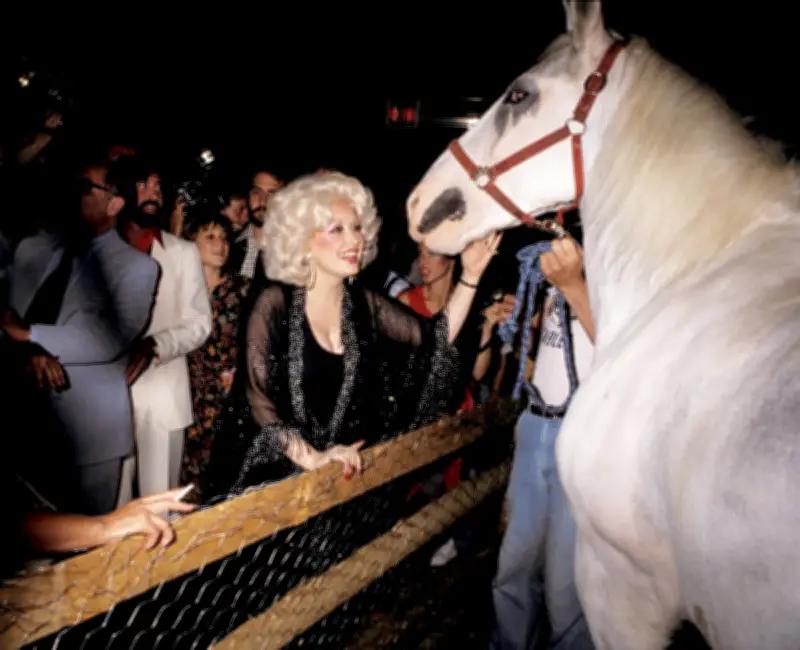
Dolly Parton, 1978: Ron Galella’s photo of Parton at Studio 54 captures a moment of carefree excess before the Aids epidemic.
Mexicans Arrested While Trying to Cross the Border, 1979: Alex Webb’s photo reflects the start of “the age of mass expulsion,” as migration was portrayed as a crisis and threat.
Petra Alvarado, Factory Worker, 1982: Richard Avedon’s portrait of a Texas factory worker with dollar bills pinned to her shirt captures ordinary life in the American west.
Jill and Polly in the Bathroom, 1987: Tina Barney’s photo of her sister and niece highlights the excesses of American privilege and the absence of struggling Americans.
Michael Jordan, 1987: Walter Iooss Jr’s photo of Jordan dunking captured his gravity-defying leap. Jordan’s Nike deal paved the way for his billionaire status and broke new ground for Black athletes.
Ku Klux Klan Rally, Arkansas, 1990: Carl De Keyzer’s photo of a Klan rally shows a historical movement superseded by modern far-right groups like the Proud Boys.
Mijanou and Friends, 1993: Lauren Greenfield’s photo of a Beverly Hills homecoming queen reveals the pressure of beauty and wealth. Prints hang in Kendall Jenner’s LA mansion.
View from Williamsburg, 9/11, 2001: Thomas Hoepker’s photo of young people lounging as the towers collapsed was initially withheld for its tonal wrongness. It later became a key representation of that day.
Torture at Abu Ghraib, 2003: A photo of a hooded detainee with electric wires marked “a turning point in how Americans understood the war,” says author Richard Beck.
Poca High School and Amos Coal Power Plant, 2004: Mitch Epstein’s photo explores “the grave results of fossil fuel production on human life and our ecosystem.”
Too Long at the Fair, McArthur, Ohio, 2004: Susana Raab’s photo of a rubbish bin overflowing with waste captures “the ugliness and litter” of American consumption.
Protester with Upside-Down Flag, 2020: Julio Cortez’s photo of a protester carrying an upside-down flag past a burning liquor store went viral after George Floyd’s murder.
Virginia Christman, Southern California, 2023: Matika Wilbur’s portrait of a Kumeyaay elder performing the Bird Dance is part of Project 562, documenting all federally recognized Native American tribes.
President Trump’s Inauguration, 2025: Shawn Thew’s photo of Elon Musk, Jeff Bezos, and Mark Zuckerberg seated prominently at Trump’s inauguration illustrated the new dominance of his far-right brand among tech elites.
Separated By ICE, 2025: Carol Guzy’s photo of children clinging to their father as ICE agents arrested him captures the human cost of immigration raids. “I lost my dad when I was six,” she says.