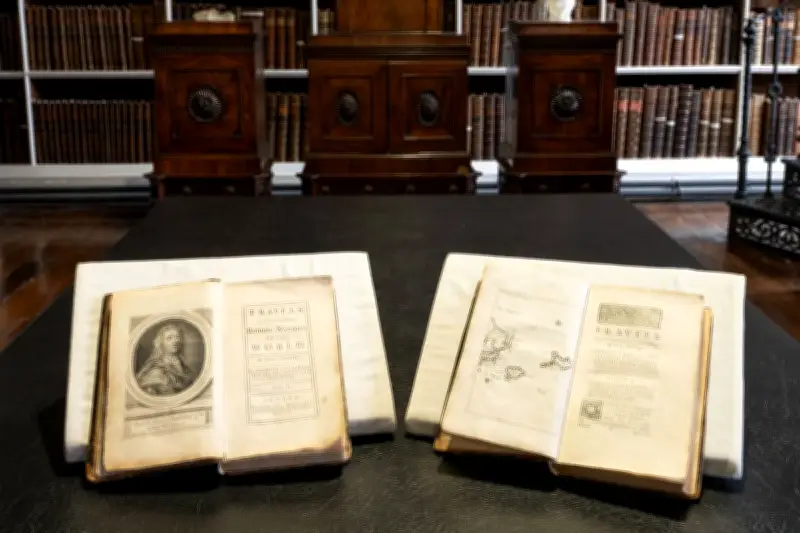
Armagh Robinson Library is marking the 300th anniversary of the publication of Jonathan Swift's Gulliver's Travels by celebrating the author's original, uncensored version of the satirical novel.
The first edition of the book, which mocks 18th-century politics, science and human nature through fantastical lands, was altered by its original London publisher, Benjamin Motte, in 1726. The changes were made to avoid prosecution for political libel, but they infuriated Dublin-born Swift, who hand-wrote his corrections directly into his own copy of the first edition.
Swift's handwritten corrections
While most readers know the approved text, Swift's personal version is held at the historic Armagh Robinson Library. The Georgian building, dating to 1771, stands in the heart of Armagh city, where Swift spent time and may have drawn inspiration for some of his writing.
The original manuscript of Gulliver's Travels has been lost, making Swift's annotated first edition one of the closest insights into the author's unfiltered intentions. In its margins, Swift crossed out the publisher's safe edits and wrote his original, dangerous words back in.
A spokesperson for Armagh Robinson Library said Swift's handwritten notes offer a rare glimpse into what he intended to be published.
“We are fortunate to have one of the very first editions of Gulliver's Travels here in Armagh,” they said. “There is something especially compelling about seeing an author's handwritten correction in a book known around the world. His handwritten notes give us a rare insight into his dissatisfaction with the version that first made its way to readers, and a glimpse into the version he originally intended.”
Celebrating 300 years
“In the Georgian era of the 18th century, the unfiltered satire would have been one of a dangerous nature, taking direct target at the government, monarchy and the legal profession alongside various philosophical, intellectual and social targets, hence its censored release,” the spokesperson added.
“While the publisher changed the text to protect his own reputation, Swift's intense frustration with that censorship is vividly alive right here on our pages in Armagh.”
The library is hosting a lecture by Aileen Douglas, Professor of Eighteenth-Century Studies at Trinity College Dublin, Swift's alma mater. She will deliver the Rokeby Lecture on Thursday, titled Travels with Gulliver, exploring how readers have engaged with Swift's imaginary remote lands and how the work has travelled through countless versions, illustrations and retellings, especially for children.
“This year, we are celebrating the 300th anniversary since that first edition was published, and today the story continues to influence readers worldwide,” the spokesperson said. “Yet despite its global longevity and success, it is fascinating that even 300 years on, none of us may be reading exactly the book that was originally intended.”
The Rokeby Lecture is part of this year's Armagh Georgian Festival, which celebrates the region's Georgian heritage, including Swift's local influence. Visitors can see the annotated book on public display.