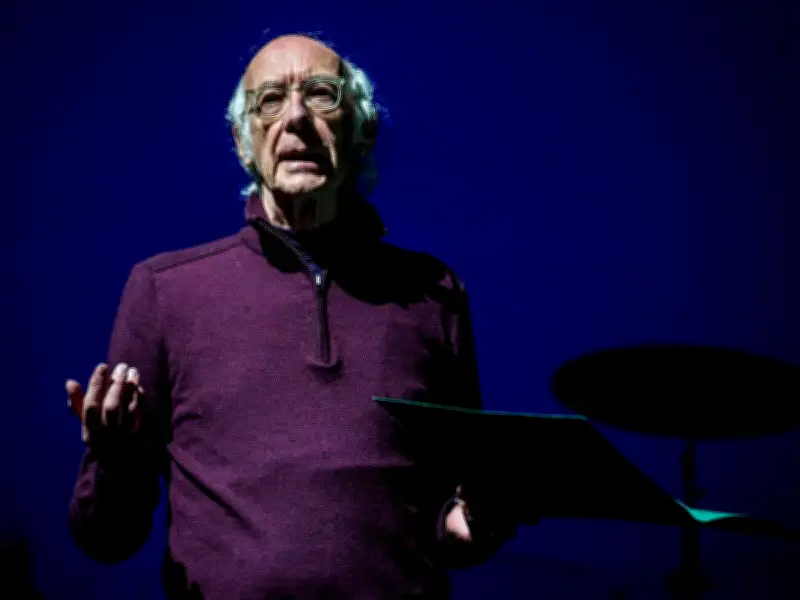
Roger McGough has opened up about using poetry to overcome a family tragedy and understand the world around him, reflecting on his rise to becoming one of the country's greatest poets. In a career spanning seven decades, McGough grew up in Litherland before studying French and Geography at the University of Hull. He then taught in Kirkby before becoming a full-time poet.
Poetry as a response to loss
McGough rose to prominence in Liverpool's emerging arts scene of the 1960s and found widespread success in 1967 when he co-authored the poetry anthology The Mersey Sound, alongside Brian Patten and Adrian Henri. The book became one of the best-selling poetry anthologies of all time. Today, he has authored over 50 works including poetry, plays and film scripts.
He told the ECHO: "I remember one of the first poems that was quite well-known was 'Let Me Die a Youngman's Death' and this was written not long after my father died. He'd worked on the docks all of his life, and I'd just come back to Liverpool from university to my dad dying. I was confused with losing my dad, and at the same time going out to The Cavern, wanting to live my life, but also thinking 'I've only got until I'm 53. I'm in my 20s now, I've got 30 years left.' So I wrote a poem."
Making poetry accessible
Since then, he has continued to rely on poetry as a way of making sense of the world. He said: "Often I don't know where the poem is going or where it is going to end, you just start writing to see where it takes you. Sometimes they're playful and funny, and sometimes it can be serious, but it's a way of dealing with life." He has also been motivated by a desire to make poetry accessible to everyone. "Literary critics would say poetry is very difficult and people should not be encouraged to write it, almost implying that unless you had a degree from the University of Cambridge, you couldn't do it. But, what Brian, Adrian and I did was write poems about going down Lime Street."
A lifelong diary
McGough described poetry as almost like writing a diary over the years. Reflecting on his father dying at 53, he said: "When I came to be that age, I was thinking, 'I'm 53, and God, I feel quite young, and my dad [died at this age].' But, that's the year my daughter was born, when I was 53, and my poems then were about, 'wow, I'm 53 and she's just a baby.'" Last year, his daughter had a baby. "I'm in my 80s, so you can't foresee what's going to happen, but you sort of write about it as it goes on."
Inspiration from Christopher Logue
McGough recalled realizing poetry could be a full-time career when a poet named Christopher Logue visited his university. He said: "I remember having had some poets come in to visit us in university, but I didn't quite understand them. But, a poet called Christopher Logue came in and he was writing poems about the war in Cyprus at the time. He was writing poems about politics and about war and it spoke directly to me. I thought 'Oh, I see, poems don't have to be about birds and bees and flowers and about daffodils and about using words I didn't understand, they didn't have to rhyme.'"