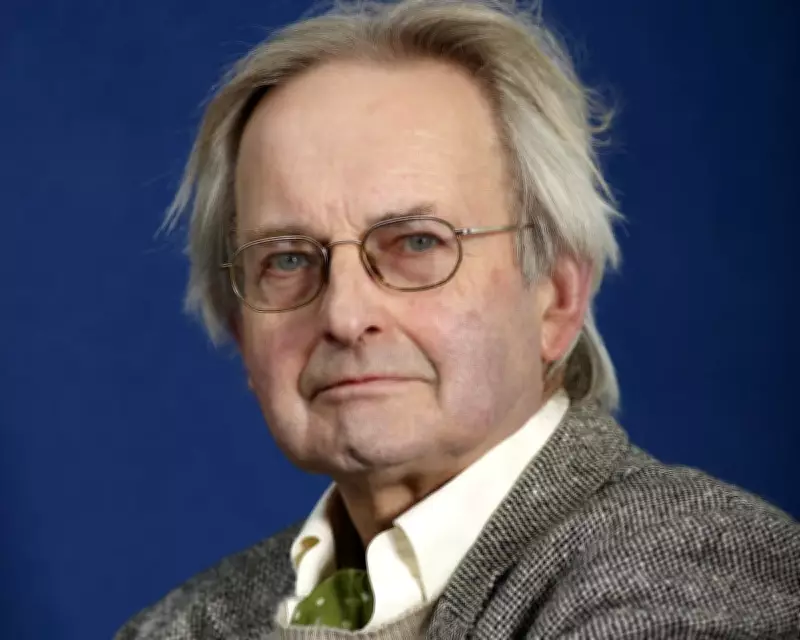
Allan Massie: Prolific Scottish Writer and Devolution Critic Dies Aged 87
Allan Massie, the acclaimed Scottish novelist, literary critic and staunch opponent of Scottish devolution, has died at the age of 87 after a battle with cancer. The writer, whose career spanned more than half a century, leaves behind a substantial literary legacy comprising over twenty novels and numerous works of non-fiction.
A Distinguished Literary Career
Massie served as The Scotsman's chief literary critic for more than twenty-five years, establishing himself as a respected voice in Scottish literary circles. His editors recall his professionalism, with his copy invariably arriving before deadline. Beyond his critical work, he contributed columns, diaries, book reviews and essays to publications including The Spectator and Daily Mail, covering topics ranging from sport to the state of the nation.
Despite his extensive journalistic output, Massie preferred to be known for his fiction. His debut novel, Change and Decay in All Around I See, appeared in 1978 and was openly influenced by literary giants Evelyn Waugh, Ronald Firbank, Henry Green and Anthony Powell. The novel explored bohemian Britain through a cast of dissolute characters, establishing themes that would recur throughout his work.

Finding His Literary Voice
It was with his sixth novel, A Question of Loyalties (1989), that Massie found his distinctive voice. The novel, which won the Saltire Society/Scotsman book of the year award, was the first in what he described as "a loose trilogy" set largely in occupied France during the Second World War. These works, which included The Sins of the Father (1991) and Shadows of Empire (1997), examined complex moral dilemmas through characters like Lucien de Balafré, an aesthete who collaborates with the Vichy government out of perceived patriotic duty.
In a 1990 interview, Massie outlined his recurring fictional concerns: "Difficulty of coming to firm moral conclusions. Interaction of public and personal life. Relationship of the individual to social background and landscape. Also, of how much people choose their own life."
Roman Novels and Later Works
Massie explored his "old-fashioned Christian" values through a series of historical novels about Ancient Rome, beginning with Augustus in 1986 and concluding with Caligula in 2003. These works, presented as fictional memoirs of emperors or those in their orbit, earned praise from American author Gore Vidal, who called Massie a "master of the long-ago historical novel."
In his later career, Massie turned to crime fiction with a series of four novels featuring Superintendent Lannes (2010-2015), set in Bordeaux during the Second World War. Though not based on direct experience, these works were praised for their atmospheric evocation of time and place.
Personal Background and Political Views
Born in Singapore in 1938 to Scottish parents from farming families in north-east Scotland, Massie described himself as "quite a typical Scot, a child of the British empire." His father, a rubber planter in Malaya, was captured by the Japanese during the Second World War and spent four years as a prisoner of war.
Educated at Drumtochty Castle, Glenalmond College and Trinity College, Cambridge, where he studied history "not very assiduously," Massie later returned to Drumtochty as a teacher. He married Alison Langlands, the headteacher's daughter, with whom he had three children: Claudia, Alexander and Louis.
Despite his mild-mannered and urbane personal demeanour, Massie was unafraid to express controversial political views in print. He was one of the few prominent cultural figures in Scotland to oppose devolution, writing provocatively on the eve of the 1997 referendum: "A student of South African politics told me recently the powers given in the white paper to the Scottish parliament are almost exactly those which the South African apartheid regime gave to the Bantustans. Vote on Thursday for 'Scotland – the new Transkei'."

Personal Habits and Recognition
Massie acknowledged struggling with alcohol, particularly after moving to Edinburgh with its many pubs. He later relocated to the Borders, recognising that writers' flexible schedules made them particularly susceptible to drinking problems. A non-driver who relied on taxis and buses, he was known for his distinctive appearance – often wearing a beret and tweeds that gave him a donnish, dandyish air.
His literary achievements were recognised with a CBE in 2013. Massie's wife Alison died in 2022, and he is survived by his three children. His death marks the passing of one of Scotland's most distinctive literary voices, a writer who combined traditional values with a willingness to challenge political orthodoxies.