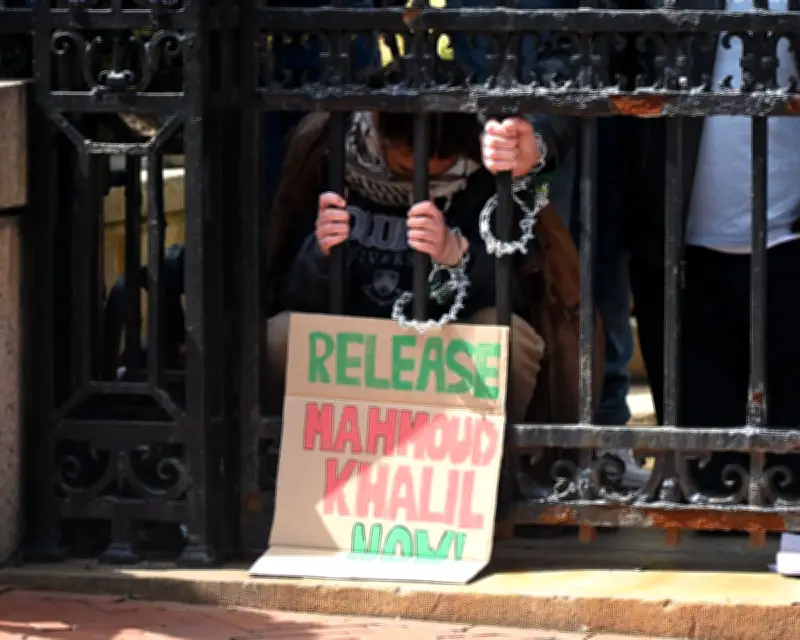
Supporters of Palestinian activist Mahmoud Khalil chained themselves to a fence at Columbia University in New York on 2 April 2025. This image captures a moment of protest that underscores a broader crisis: those who once championed free speech in the UK and US now wage war on it, particularly regarding Palestine.
The Irony of Free Speech Defenders
Mehdi Hasan reflects on the Satanic Verses controversy, the 'Je suis Charlie' movement, and constant invocations of Voltaire and Orwell. He notes the great irony that many politicians who spent years anointing themselves as champions of free speech have become its most enthusiastic enemies when the subject turns to Palestine.
For decades, Western governments lectured the world about liberal values, declaring freedom of expression the hallmark of a liberal democratic society. Protest was deemed patriotic, and the right to offend was considered sacred. Then came Gaza. Suddenly, the principles that were once non-negotiable became highly negotiable.
Repression in Britain
In Britain, the government proscribed the direct action group Palestine Action as a terrorist organisation, with the shameful support of 385 votes in parliament from across the political spectrum. Since then, priests, elderly people, and disabled individuals have been grabbed by the police for holding signs that simply said, 'I oppose genocide; I support Palestine Action.' Their real crime was daring to speak out against a UK-enabled genocide.
Last week, the British state took another extraordinary step, blocking US commentators Cenk Uygur and Hasan Piker from entering the UK. The Home Office did not explain its reasoning, simply stating their presence was not 'conducive to the public good.' The Guardian reported that it was understood both men were blocked because of concerns they could exacerbate antisemitism.
The actions are opaque, but the message is unmistakable: there are political causes the British establishment welcomes and others it fears.
The US Assault on Free Expression
In the US, the situation is even more alarming. The Trump administration's targeting of pro-Palestinian voices, particularly foreign students, represents one of the most severe assaults on free expression in modern American history. Even a rightwing, Ronald Reagan-appointed judge denounced the crackdown as a 'full-throated assault on the first amendment under the cover of an unconstitutionally broad definition of antisemitism.'
Foreign students like Mahmoud Khalil and Rümeysa Öztürk have been investigated, arrested, and detained not for acts of violence but for their speech. Öztürk's 'crime' was co-authoring an op-ed in her student newspaper calling for Tufts University to divest from companies connected to Israel.
This assault is not confined to non-citizens. Republican congressman Randy Fine called Hasan Piker, a US citizen by birth, a 'terrorist' and said he shouldn't be allowed into America. Congress keeps proposing resolutions to stifle criticism of Israel. State laws opposing the boycott of Israel are spreading. Universities face pressure from politicians, donors, and lobbying groups to punish pro-Palestine protesters. Careers have been destroyed, events cancelled, speakers disinvited, academics targeted, and journalists smeared.
Defending Democracy
How can any of this be justified in a democracy? No foreign government should be granted immunity from criticism—not China, not Saudi Arabia, not Israel. Yet the self-proclaimed Jewish state occupies a uniquely protected place in political discourse. Criticism that would be routine in any other context—don't bomb hospitals, don't kill kids—is cynically rebranded as anti-Jewish bigotry.
This goes far beyond censorship. It is an open assault on liberal democracy itself. A society that cannot honestly debate government policy cannot meaningfully govern itself. A society that punishes dissent on one issue emboldens authoritarians who want to crack down on every issue. Speech restrictions justified against one group are always eventually applied to others.
The opposition to the destruction of Gaza—and now Iran and Lebanon—cannot be separated from the defence of democratic freedoms at home. They are part of the same struggle. A genocide abroad is helping usher in fascism at home. Poll after poll shows the UK and US publics have switched support from Israelis to Palestinians. The response from pro-Israel people in power, having lost the argument on Palestine, is to prevent the argument from happening.
The question confronting Britain and the US is no longer whether free speech is under attack. The evidence is before our eyes. The question is whether citizens will tolerate the erosion of liberties that previous generations—from the Levellers and Chartists in the UK to the abolitionists and civil rights movement in the US—fought so hard to secure. Once we give governments the power to decide which political opinions are acceptable, why assume they will stop at Palestine?
Mehdi Hasan is the editor-in-chief and CEO of Zeteo.