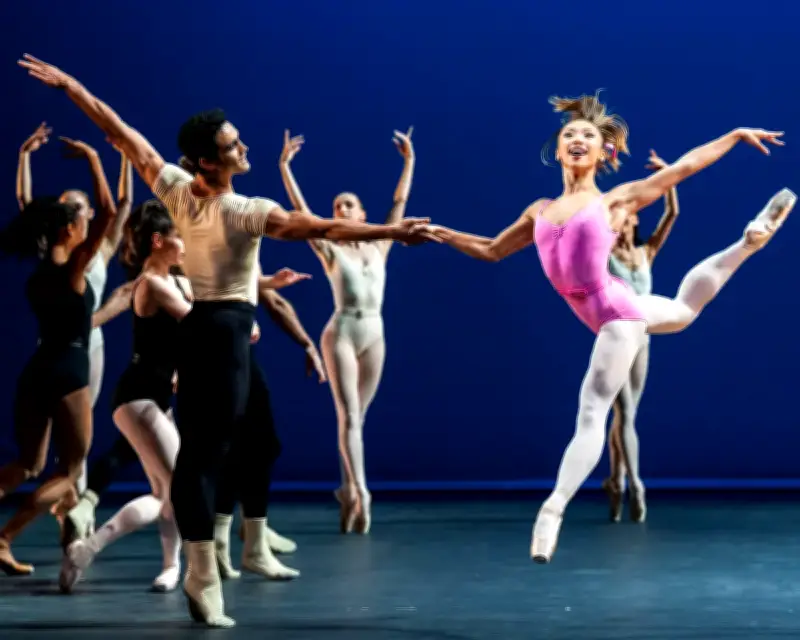
English National Ballet's latest triple bill, Rhythm Riot, brings together three dances influenced by Stravinsky, tap and William Blake's poetry, with performances full of showmanship. The programme, at Sadler's Wells in London until 3 October, has a distinctly American flavour and a focus on propulsive rhythm.
Balanchine's Symphony in Three Movements
George Balanchine's Symphony in Three Movements, made in 1972 as a memorial to Igor Stravinsky, opens the bill. The music, from 1945, is performed with palpable power by the English National Ballet Philharmonic under the baton of Maria Seletskaja. The clarity of line and stripped-back design balance the depth and crunchy complexity of Stravinsky's score.
Swanice Luong arrives with a zing in a bubblegum pink leotard, bouncing into a jazzy tuck jump. She, Emma Hawes and Ksenia Ovsyanick are like a trio of mean girls competing to be queen bee. Ovsyanick, sharp of gesture and brilliant of smile, is particularly aloof. It's a specific technique, and while ENB aren't a Balanchine company, they do it justice.
Bow Out and Auguries of Innocence
The spirit of the Nicholas Brothers arrives in Bow Out, a new piece by American choreographer Micaela Taylor, inspired by the tap duo's acrobatics in the 1943 film Stormy Weather. It's an exuberant blend of classical, jazz, hip-hop, tap and Lindy hop, in soft shoes and black tailcoats, to a soundtrack of jazz, clattering tap beats, and new music by Philip Patrick Harper Bucknor, AKA Tru. Taylor hooks tightly into the rhythm, while the dancers snatch movements from the air, with precision, virtuosity and showmanship, but also disillusionment and a grittier texture.
Another premiere comes from Jae Man Joo, a Korean choreographer who has worked in New York for 30 years. His Auguries of Innocence, named after the William Blake poem, is a vibes piece with ritualistic mass-unison movement, atmospheric visuals, and a score of two works by Latvian composer Pēteris Vasks plus Korean drumming. Everything is black, with Sangeun Lee like a goth Miss Havisham haunting the stage. The intricacies of Joo's interpretation are mostly lost to a first-time viewer, but there's plenty to get to grips with in this finale to a wildly eclectic triple bill.