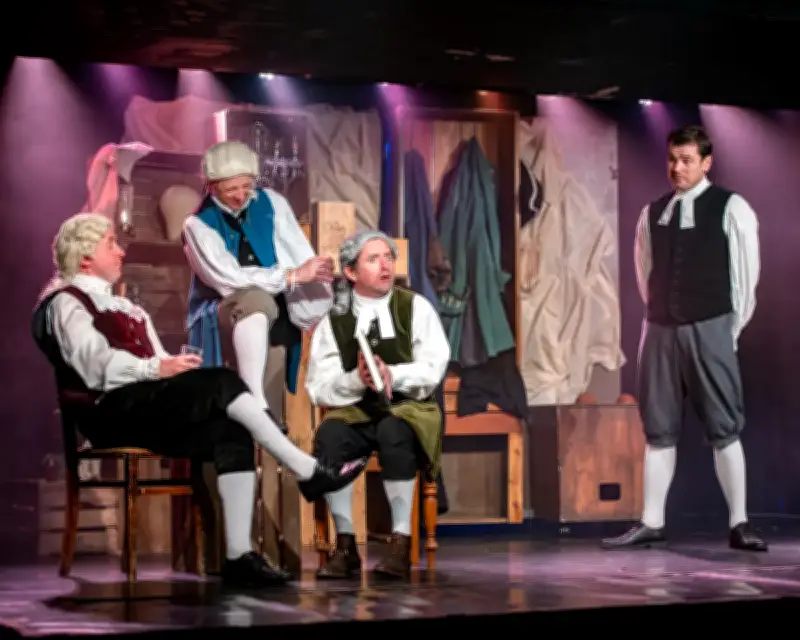
The most famous heckle in Scottish theatre history frames Brian Logan’s new play: in 1756, after a performance of John Home’s Douglas at Edinburgh’s Canongate playhouse, an audience member declared Home better than England’s most revered dramatist. “Whaur’s yer Wullie Shakespeare noo?” went the cry.
A symbolic flashpoint
Posterity cares more for Shakespeare than Home, but the performance remains a symbolic flashpoint. As presented by Logan – writer, director and Guardian comedy critic – the play and its excited reception exemplify the national and religious schisms that have played out in Scotland ever since. It is one of those theatrical events that meant more politically than it did artistically.
On one hand, the play finds a post-Union Scotland both beholden and resistant to a dominant England. Logan shows an Edinburgh establishment eager for Douglas’s success almost as a matter of principle before it even reaches an audience, not least after its brusque rejection by David Garrick in London.
Church and stage conflict
On the other hand, it finds a post-John Knox church torn between being “o’er pagan for you, o’er pious for me,” as Home (Lewie Watson) puts it. Under pressure from those who see plays as sinful, regardless of how wholesome their message, Home is forced to resign his ministry in East Lothian.
All this makes a promising premise, but it is a shouty, one-note production, co-presented by A Play, a Pie and a Pint with Aberdeen Performing Arts and the Traverse. Written in Scots, the play switches from a soft-target send-up of 18th-century acting to a two-dimensional debate about art and morality. It is on fertile ground, but fails to settle on the characters and conflict that would give the factionalism of the early Scottish Enlightenment due dramatic weight.
The production runs at Òran Mór, Glasgow, until 3 October, then tours until 17 October.