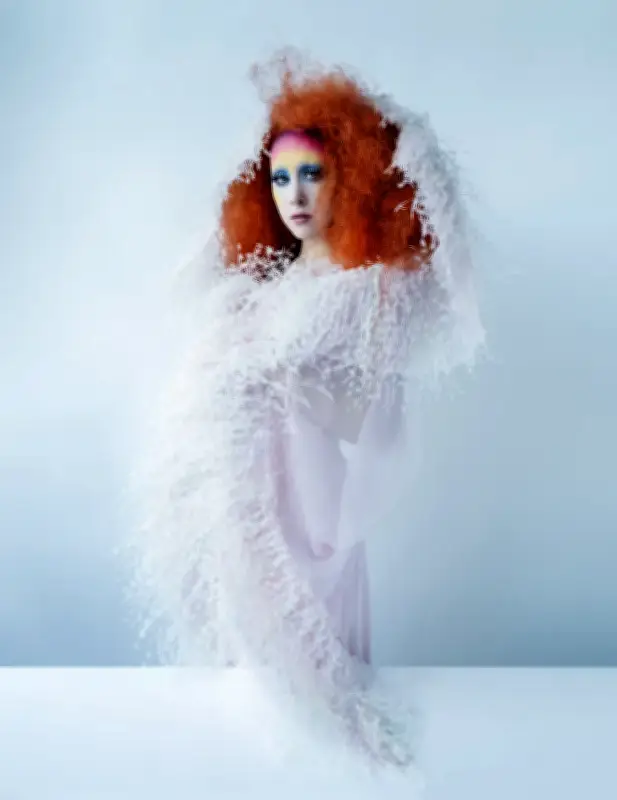
Fashion photographer Tim Walker's new exhibition, Fairyland: Love and Legends, opens at the National Portrait Gallery in London on 9 October. The show presents a tapestry of queer community in Britain, spanning decades and featuring activists, artists, writers, models, and everyday heroes such as nurses, physicians, and army veterans.
Genesis of the Exhibition
Six years ago, Walker was walking in Highbury Fields, London, when he saw a plaque on a building. It marked the site of the first gay rights demonstration in Britain, held on 27 November 1970, in protest at the arrest of Louis Eakes, chairman of the Young Liberals, for importuning. Walker was jolted by the date: it was the day he was born. He wondered: "Who were those people out marching that day? Where are they now?"
The fairy concept came from Walker's childhood. "My brother and I used to share a bedroom, and over our beds was a scene of fairyland, with little pixies and elves. I was always making camps in the garden. And by the time I was sent to school, the word fairy was derogatory. So I think the fantasy and escapism got muddied by the bullying."
Portraits and Style
The exhibition includes portraits of gay men and women from the Highbury march: Ted Brown, Lisa Power, and Andrew Lumsden. Power and Lumsden are shot in the style of Hans Holbein the Younger's Northern Renaissance portraits. "You're in the National Portrait Gallery," Walker explains. "If you go to the top floor, you have all these Holbein paintings. I wanted to put the people at the march into that realm of Holbein-esque celebration."
Activists Peter Tatchell, Phyllis Opoku-Gyimah (Lady Phyll), and Sue Sanders are shot against Walker's trademark white background, as are queer stars including Ian McKellen, Troye Sivan, and Chappell Roan. "That's the cheapest way," Walker says of the style. He discussed with each person how they'd like to be shot and asked them to bring significant items. Russell T Davies is covered in pages from the script for his drama It's a Sin, while photographer Sunil Gupta brings a camera.
Aids History and Personal Reflections
One striking image shows Graham McKerrow in a pork pie hat and suit, holding a November 1982 copy of Capital Gay, the newspaper he co-founded with the late Michael Mason. The splash says: "US disease hits London." This, says Walker, "really moved me, because he brought this newspaper from when the first news hit about Aids. That was the first time anyone was talking about it here."
Another emotional image depicts nurse Jane Bruton, who has worked with HIV patients for 40 years, holding her former patient Tony Whitehead, one of the first people whose lives were saved by combination therapy in 1996. They are photographed with Jonathan Weber, a professor of medicine. "It was such a beautiful reunion," Walker says, "but what really touched me was their gestures: that care and pride was still alive."
Walker remembers watching the Don't Die of Ignorance public health TV campaign launched in 1987 by health secretary Norman Fowler. "I feel that set the whole gay liberation movement back, it was such a terrible thing."
Erotic Landscapes and Career
The exhibition closes with explicit photography: erotic lesbian shots, a surrealist image of butt cheeks on a goldfish bowl, and S&M scenes. "There's kinky play where people dress up as dogs," Walker notes. "I think there's worlds here, erotic sexual landscapes I call them." The backgrounds are baroque, inspired by Jean-Honoré Fragonard's The Swing. The National Portrait Gallery wanted these images in an 18-plus room at the back.
Walker was born in Guildford; his mother wrote cookbooks and his father worked in industry. He attended Charterhouse boarding school, which he describes as "horrific, absolutely Victorian, so homophobic". He met his first boyfriend at Exeter Art College, but before that he had a sexual awakening watching Derek Jarman's film Sebastiane: "I wanked a lot watching it," he says.
He didn't get involved in London's gay scene until his late 20s, living vicariously through queer pop songs such as Bronski Beat's Smalltown Boy, The Power of Love by Frankie Goes to Hollywood, and Tainted Love by Soft Cell, whose singer Marc Almond is featured in the show. He eventually went to Love Muscle at the Fridge in Brixton, "a big gay night of 1,000 people on a Saturday".
After graduating, Walker moved to New York, where he worked for Richard Avedon. "Avedon was very good at communicating with the subject, and he was clear about connection. He would spend a lot of time with the subject before he photographed them."
Walker has shot Kate Moss, Lady Gaga, Björk, and Frank Ocean. His most recent W subjects were Rihanna and her baby Rocki. "She's mad!" he says. "She was in Paris looking at the couture shows and said, 'I really want you to photograph me and my baby.'" The shoot was scheduled for 2pm; Rihanna turned up at 11pm. "I've never worked through the night with someone, but it was a vibe," Walker says. "She's someone you could photograph in seven frames and you've got a picture, because she's so bodily aware."
Not all shoots were successful. He mentions a 2005 session with Madonna for American Vogue, when she was "obsessed with Cecil Beaton, in her English Lady of the Manor era". They shot at Beaton's old home in Ashcombe, which Madonna had bought. Walker photographed her in tweed and cashmere, surrounded by chickens and holding a black lamb. He felt he fumbled the attempt. "I look at all these pictures – she's actually not big enough [in the frame]," he says. "But the awful thing is we had three days to do the shoot, and the first day was like a warm-up. The pictures weren't great, but I thought we'll get there. But at the end of day one she was like, 'We've got the pictures, we're done!'"
Madonna later joined Walker and his team in the local pub. When she walked in with then husband Guy Ritchie, "the whole pub fell silent". Madonna asked Walker what he was having for lunch. "And she said, 'I'm going to have a pint of Guinness and I'm going to eat something.' So she says 'Excuse me' to the waitress, 'I'm going to get what he's having.' And the young waitress goes, 'I'm sorry, the kitchen's closed.'"
Walker admits he's not particularly interested in fashion. His favourite pastimes are reading (Denton Welch's In Youth Is Pleasure and Josh Silver's Fruit Fly are recent favourites) and walking his dog, Jack. "Fashion isn't the reason I became a photographer, it was fantasy."
He regrets the decline of glossy magazines. "We're at the end of that time, which is sad. Looking at photographs in a magazine format is beautiful because of the scale. Just turning a page I lament that passing, but we are where we are."
Fairyland is one way for him to continue working at an ambitious scale. "I think as a photographer, or any creative, you're always looking for something different," he says. "That pendulum does often swing a long way from where you've been."
He muses on the six years it took to make the exhibition: "I've been so nourished by these stories, and I've been moved to tears by these stories." For Walker, Fairyland reframes his career. "Doing this show, I now realise that everything I was doing as a fashion photographer was all camp and gay. It was my gayness escaping."
Tim Walker's Fairyland: Love and Legends is at the National Portrait Gallery, London, from 9 October to 7 February.