In The Farmer’s Wife, Hannah Khalil’s new play inspired by Helen Rebanks’ bestselling memoir of the same name, men are entirely absent from the narrative. The focus, instead, is squarely on the women quietly holding everything together – who are usually anonymous and often unseen.
Three generations on a family farm
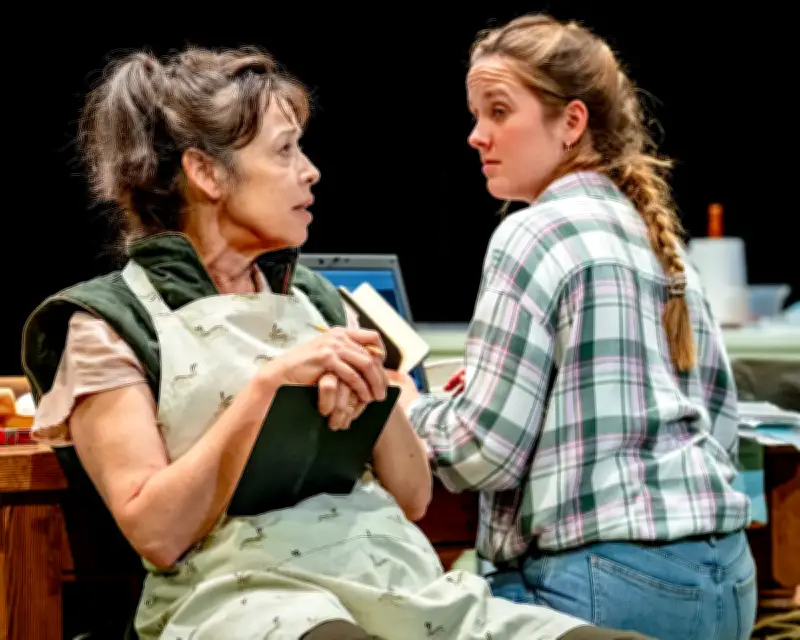
The story follows three generations of women living on a family farm, their unrelenting daily workload drawing attention to the cracks that exist in a system entrenched in tradition and routine. The trio of women, simply referred to as Young, Older and Oldest, are played tenaciously by Eireann Devlin, Christine Entwisle and Roberta Kerr respectively. They hold both the heaviness and joy of an existence rooted in the land, which can be unforgiving, particularly in the context of a rapidly changing world.
This in-the-round production presents one day on the farm – a day that seems to have some significance to the family, although we’re not privy to why until the very end. As Older maniacally rushes around to get everything ready, it’s hard to ignore the feeling of claustrophobia that creeps in when pieces of the family kitchen are wheeled on and placed in the corners of the stage, peppered with supplies, crockery and utensils.
Set and sound design
Louie Whitemore’s inventive set, combined with Mark Melville’s highly affecting sound design, contribute to the depiction of this rural scene as something inexplicable and otherworldly. For example, when a flurry of paperwork falls from the ceiling as Older drowns in the weight of responsibility, or when the excited bark of an imagined dog reverberates around the stage and in the wings, as the characters scramble to catch this invisible, yet completely vivid, being.
At the centre of the action is an unassuming wooden kitchen table, which bears witness to the monotony of farm life, with never-ending bills and chores, and moments that alter the course of the characters’ lives. It becomes a battleground for the conflict between mothers and daughters, but also a literal stage, for a Shakespearean monologue and a rowdy rendition of I Will Survive.
Direction and finale
Through these contrasts, as well as emotional flashbacks, Liz Stevenson’s direction underlines the tumultuous nature of farm and family life. But in the end, community proves to be key, and in its moving finale The Farmer’s Wife emphasises the true power of perseverance and camaraderie.