An immersive exhibition shaped like a fictional Irish pub is giving women of Irish heritage in Liverpool a space to tell their stories, exploring themes of migration, identity, family, folklore, loss, and belonging.
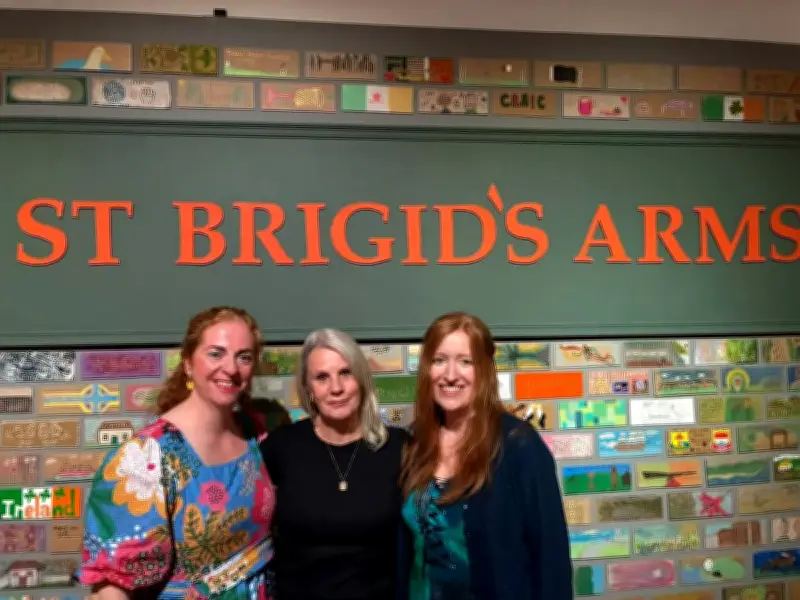
St Brigid's Arms, now at the University of Liverpool's Victoria Gallery & Museum, was created by Emerald LENS co-directors Rosarie Walsh, 45, and Lydia O'Hara, 37. The project brought together women of Irish heritage from Liverpool, Manchester, and Leeds, from first-generation migrants through to women several generations removed from Ireland.
A personal journey of belonging
For Liverpool woman Diana Bradley, 58, from Fairfield, the exhibition offered a chance to explore a question she had carried for years: Am I Irish enough? Her Irish ancestry stretches back generations, and she created a sheela na gig, an ancient stone carving of a naked female figure, during the Liverpool workshops.
She told the ECHO: "I went to the workshops out of interest. But, at first, I was like, 'Oh, am I going to be welcome here?', because my great-great-granny was Irish, so it was fragmented Irishness."
She added: "I think when you're several generations removed as well, it's all very bitty, so pulling it all together like this in this kind of lovely, warm space is amazing."
For Diana, the experience provided a place to examine what she described as an "invisible thread" connecting her to the generations who came before. She said: "I had these ancestors that came over here and suffered during the famine, so there's a part of you that feels like you kind of owe it to them to pick up on that and reflect on my Irishness."
Creative workshops and shared stories
Over six groups, the women took part in five weeks of creative workshops, using art, storytelling, and other creative forms to explore what their Irish identity meant to them. Lydia said: "It's really hard to put what your Irishness means to you into words. It's quite an intangible thing. So, using a creative process to do that captures meanings beyond words."
The exhibition moves through different aspects of Irish identity, with the outside of the pub exploring the warmth, humour and community often associated with Irish culture, while inside looks at the things which are less openly discussed. Visitors can see bottles created by participants that carry messages hidden inside, representing what people see on the outside and what they choose not to share. Elsewhere, the exhibition explores folklore, superstition, and the stories passed down through generations. The final space turns to loss, including the feelings of people who fear they have become too far removed from their Irish roots.
A space for women's stories
Rosarie said the pub was deliberately chosen as a space for women's stories. She said: "We wanted everything to be tangible and warm feeling. Lots of pubs are named after men, and there's not really many spaces for women to hold their stories. So the idea of St Brigid's Arms is that the arms wrap around you and hold those stories."
For Lydia, the question of belonging is personal too, as her Irish connection comes through her grandparents, making her third-generation. She said: "I definitely had those moments at times of thinking, 'Am I even Irish enough?', but I think that's one thing we definitely wanted to get across when we came in, is that anyone is Irish enough if they feel that connection."
When it came to deciding where to host the exhibition, Lydia and Rosarie said the Liverpool connection was particularly significant. Rosarie said: "It was a no-brainer, really, to be honest. I think for everybody, including people in Ireland, Liverpool stands out as the port of entry into the UK. It just feels like Irishness in embedded in Liverpool."
Lydia had previously worked with the Liverpool Irish Festival on the Liverpool Irish Famine Trail, exploring the plaques across Liverpool and Birkenhead which commemorate that history, but the creators wanted to look beyond the well-known historical narrative.
Rosarie said Irish migration was often viewed from a male perspective focusing on the people who built roads and infrastructure or, in later generations, the nurses who became such an important part of the NHS. She questioned how often the stories of the women behind those families were heard. She said: "I don't necessarily know if we always talk about the women who allowed all of that to happen, who raised lots of children in a country they didn't know, sometimes being surrounded by prejudice, sometimes in pockets of poverty. I don't know if that's always recognised."
For the women involved in the project, those conversations have created more than an exhibition. The creators said strong friendships developed during the workshops, despite each group spending only five weeks together. Rosarie described the bonds as "unbelievable" and said the groups became safe spaces where women could share, connect, and form friendships.
Lydia said: "We definitely want people to have a kind of 'wow' reaction because we feel it has that ability. I think there's also something important about celebrating stories of migration and people's heritage, and having a space where we can see all these different things that link us together but are hard to pin down."
The free exhibition is running from October 3 2026 until April 17 2027 at the University of Liverpool's Victoria Gallery & Museum.