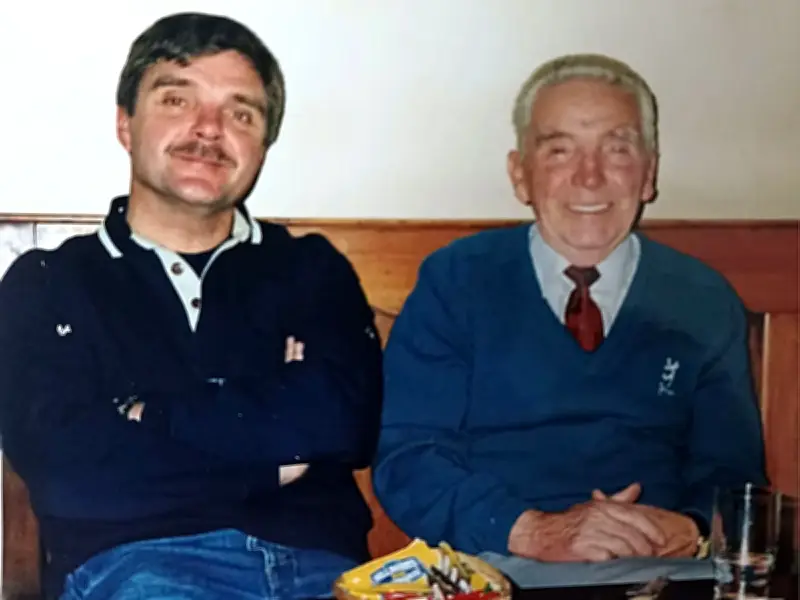
Ken Crawford, 74, who lives in Sweden but grew up in Manchester, has revealed that reading his late father Gordon's handwritten wartime memoirs "blew my mind." Gordon, born in Withington, died in 2002 aged 79, and had penned his incredible wartime escapades just a few years earlier.
Ken said his dad "never really spoke about it" until Ken's daughter Lucy, then about 12, asked her granddad to write about his war experiences for a school project. "My dad just loved the question, and he then went and wrote his memoirs every night, my mum told me about it," Ken said. "He just carried on writing and writing, and then we got the finished product and it just blew my mind."
Sole survivor of friendly fire
One of the biggest revelations in Gordon's memoirs was how he ended up the sole survivor when the bomber he was in was shot down by 'friendly fire'. On February 7, 1944, Gordon was a crew member aboard a Douglas Boston III bomber aircraft flown by Pilot Officer George Dean. The plane had taken off from Pomigliano in Italy on an armed reconnaissance operation. That night, the aircraft failed to return to base, with no distress message received and no explosion witnessed by other air crews. War records later revealed that the aircraft had been attacked and shot down by its own allies - an American crew flying a British-made Bristol Beaufighter.
The pilot and two other crewmen were killed, but Gordon escaped by parachute only moments before impact. In his own handwritten manuscript, Gordon described the Beaufighter being "right on our tail." He wrote: "There was an almighty noise of gunfire hitting our plane and cannon shells exploding. Both our engines were on fire and one wing had been practically cut in two. In other words we were in a bit of a mess. Our plane went into a steep dive and we were completely out of control."
Desperate escape
Gordon described how the pilot's intercom went dead and his crewmates were killed from "direct fire from six machine guns and four cannons." He continued: "I quickly realised that I had to get out because the plane was completely out of control and was heading for the ground in a dive and spinning. I think Dixie [the pilot] was also hit, and I hoped that he would be able to get out." After a last failed attempt to contact his crewmates, Gordon jettisoned the door to his compartment and bailed out, despite having no parachute training.
"By this time my cockpit was full of smoke and flames were beginning to come in from the sides of the plane. I realised that if I didn't get out now I would be trapped in," he wrote. "I saw our aircraft which by now was well below me and heading for the ground. It was just a ball of fire. I watched it hit the ground with a terrible explosion. This was the worst few seconds of my life watching that plane on fire and hopelessly out of control with my three best friends inside it."
Captured and escaped
Tragically, Gordon was the only survivor. Pilot Officer George Dean, Sgt S.W. Clarke, and Sgt R.S. Conroy were later buried at the Beach Head War Cemetery in Anzio, Italy. Ken said getting information about friendly fire incidents from the archives had proved difficult, but he remembers his dad telling him he had to go to London to attend a court of inquiry after the war, and he doesn't remember any charges or guilt being placed on the American crew.
After leaping from the aircraft, Gordon described his days spent alone in enemy-held territory as he tried to evade German forces. He was eventually captured, interrogated, and sent to a prisoner-of-war camp. In January 1945, he escaped from Stalag XX-A in occupied Poland. Ken said: "They moved him to Poland, and he and two of his mates, who were also prisoners of war, were in the march. And they had no idea where they were taking them, but by that time the German soldiers were tired and less alert." The three prisoners jumped into a field and lay at the bottom of a slope, making their escape through the Polish countryside.
Full of admiration
Ken says his dad joined the RAF as soon as he could, aged just 18, despite his father's wishes. After the war, the family moved to Rochdale, where his dad opened a car-selling business, and they worked together for years before Ken moved abroad. Ken says learning in his later years about his dad's war exploits left him "full of admiration" and brought "tears to my eyes."
Ken has thought about having his dad's memoirs published, but wasn't sure it was the right thing to do because of the other families of the lost bomber crew. Now, he feels, enough time has passed. "With my dad, I did have the time," said Ken. "With us working together, I did have the time to talk to him about private things he would tell me, you know. So I don't feel as though I've missed anything, to be honest."