Ross McElwee's new documentary, Remake, is a grief-struck tour-de-force that confronts the real-world repercussions of film-making. After his son Adrian died from a fentanyl overdose at the age of 27 in the bathroom of McElwee's Boston home, the director could barely bring himself to watch his old clips of the boy. When at last he did, it became the genesis of an extraordinary project.
McElwee used to film Adrian for a few minutes each month, tracking the kid from infancy to adulthood, trying to catch the significant turns of his life. When tragedy struck, it back-shadowed the footage. Maybe every home movie is a ghost story at heart.
"I look at the footage to convince myself that you were alive," McElwee says, addressing his son as though he's still in the room. "But also to convince myself that you're gone."
A Film That Was Never Meant to Be
The plan was for a completely different film. A Hollywood producer wanted to shoot a fictionalised version of his 1986 documentary Sherman's March. McElwee decided to follow the process – to make a new documentary about adapting an old documentary. That might be funny, he thought. But events overtook him. Adrian's mental health was deteriorating, and he became addicted to opioids.
"Everything immediately ground to a halt," the director recalls. "My son was gone. I was devastated. And compared to everything I was facing, the film seemed banal and frivolous." He took a year to regroup and plotted a new course.
A more traditional film-maker would have junked the original idea. McElwee has audaciously chosen to preserve it, so that Remake plays as a kind of absurd counterbeat to the anguish of Adrian's death. The film would have been too depressing otherwise, he says. "And in a sense I'm remaking my life by picking up the camera again. I'm reconstructing the life of my son from the scraps and pieces that had ended up being filmed."
Adrian's Voice and the Ethics of Filming
Adrian, we learn, was gung-ho for a Hollywood version of Sherman's March. Remake shows him discussing the project at length. He feels that his dad should be making more mainstream movies. He says, "Why not just do some big blockbuster hit?"
After seeing Remake, I rewatch Sherman's March. It's a joyous, insightful, free-ranging affair; a film that delights in taking the road less travelled. McElwee is ostensibly making a civil war documentary, but he keeps being set up with various "nice southern girls". In one scene, Charleen Swansea – his voluble former English teacher – demands that he turn off his camera before a big date. "This isn't art," she roars. "This is life!"
The success of Sherman's March made Swansea a cult celebrity. A poll of American critics named her "the greatest documentary character of all time". But when McElwee revisits Swansea for Remake, he finds she is now in the grip of dementia. She has no memory of the movie, or of teaching him English. "Things just disappear," she says with a frown.
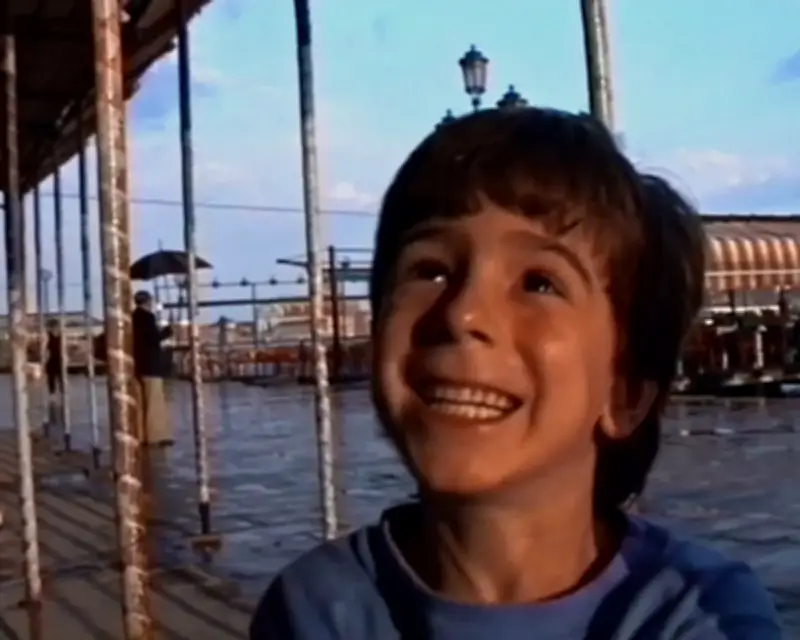
People disappear, that's the tragic logic of life. Except that on the screen, in the footage, Adrian still feels alive, which is both a comfort and a torment. McElwee dips back through the archive to show him as a gorgeous, earnest little kid, netting crayfish on the rocks ("I just love the deep surprise of the ocean," he says). Now here he is again as a tense, watchful teenager, raising his hand to block the camera lens. "There was no evidence for me that my films were a problem for him," McElwee tells me. "Overall I would say that they were more a plus than a minus." All the same, he can't help but wonder.
Divided Loyalties and a British Counterpart
Might the issue be one of divided loyalties? McElwee has a set of responsibilities as a parent and a set of responsibilities as an artist. But maybe these are always going to be at loggerheads. McElwee nods. "Yeah, they're antithetical. And when it works, the antithesis is what gives a film its creative friction. Because it never resolves itself. It's always part of the problem. You have the camera, which means you have the power and other people don't. And that's the big responsibility. You can't push your subject to say what you want them to say. You have to keep that in mind when you shoot and you edit."
If McElwee has a British counterpart, it might be the film-maker Victoria Mapplebeck. On Motherboard, her fabulous 2024 documentary, Mapplebeck condensed two decades of life as a working single mother alongside her phlegmatic son, Jim. After speaking with McElwee, I call Mapplebeck. She says she relates to Remake and the ethical issues it raises. It's about the compulsion to film and its effect on a family; the granting of consent and how that is understood by both parties.
"Watching it," she says, "I felt both ashamed and moved. Because the thing with both Jim and Adrian is that at times they do provide consent [to film] because they recognise what it means to you. I think Jim definitely got more from the process than Adrian did. It was a useful way to get us talking. But fundamentally I needed to do it more than Jim did."
Photographic Memory and the Unanswerable Questions
In his 2011 film Photographic Memory, McElwee painted Adrian as a troubled but basically resilient young man. The pair promoted the picture at the Venice film festival. Adrian posted pictures of speedboats, gondolas and wild parties. It should have been a triumphant moment. But McElwee now worries that his film got Adrian wrong and that the subsequent fuss turned his head and caused problems.
"Did I give him a false impression of who he was? That he was more or less invincible and could therefore keep doing drugs?" He doesn't know; he fears the worst. "For a child to see himself in a movie that his father has made and to then travel with him to festivals – often that would be wonderful for both father and son. But then all these other things arose from that. So there is a possibility that it had a corrosive effect on him and that I was somehow in denial about that. It was only later – after he got into trouble and then after he died – that I began to see the film in a different light."
I'm glad McElwee has made space for his unquiet old work. It speaks to Remake's themes of representation and memory, and suggests that a film is never truly finished. The Sherman's March remake, for instance, is initially billed as a comedy feature from the director of Paul Blart: Mall Cop. We then see it redrafted as a dramatic miniseries and a TV sitcom before it's finally rolled out as a verbatim live opera. McElwee wonders what his son would have made of all that.
What, for that matter, would he have thought of Remake? That's the unanswerable question; the director can't say. "I'd like to think that he came out the other side sober, and that he would think it had honoured him and was honest, and also that I was admitting the mistakes I'd made. But I'll never know for sure." Another thought strikes him. "It's also possible that he'd say, 'Yeah, this is good but you need to get a proper Hollywood deal.' He was relentless about that. He liked my films, but I could tell they were never quite up to snuff in terms of the interest they generated and the money they made. He saw them as interesting exercises but a waste of time when I could have been doing something else."
McElwee is 79 and slowing down. Ideally, he'd like to make one last documentary – something light, warm and funny. But something is missing: the old itch, the compulsion. "I've been to family reunions in North Carolina," he says. "Also, I had a nephew who got married. Each time I thought, 'Gosh, I should be filming this.' And I just can't do it. This whole past year. I want to take a break and let life be life without me trying to turn it into art." It reminds him of what Charleen said in Sherman's March: "This isn't art, this is life." That's four decades ago now. McElwee almost smiles. "I'm a slow learner," he says. Remake is out now.