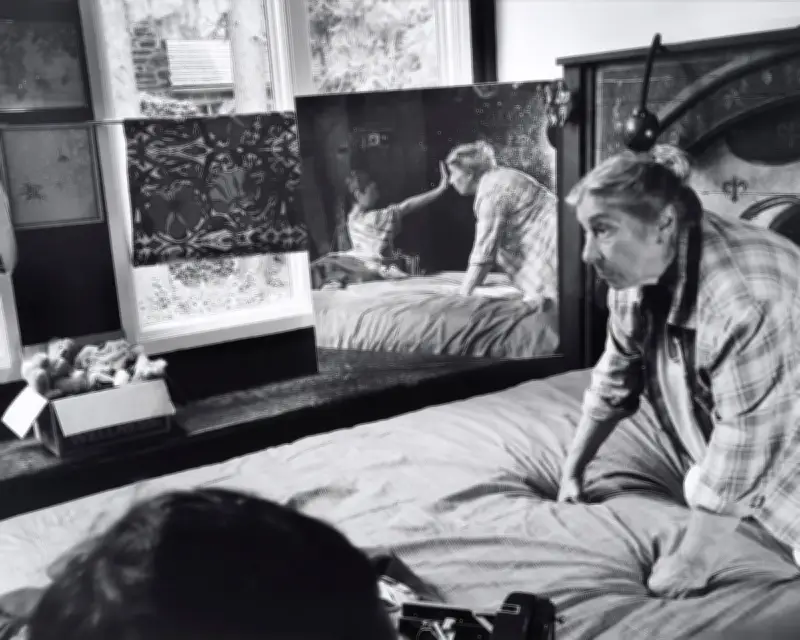
At the peak of the Covid-19 pandemic in 2020, artist Katherine Hubbard started to sense something was not right with her mother, Antonette Berger. “It was impossible at the time to say what I was noticing, but something was off.”
Berger was living alone in Philadelphia, and as restrictions were lifted, Hubbard went to stay with her. Berger was eventually diagnosed with LATE [limbic-predominant age-related TDP-43 encephalopathy], a condition which causes symptoms similar to Alzheimer’s, though the decline in memory and day-to-day functioning is slower. The diagnosis was “a painful, drawn-out and confusing process – then a feeling of so much grief, so much loss”, Hubbard explains on Zoom from New York.
A five-year photographic project
Finding herself suddenly in the role of a “caretaker under duress”, Hubbard decided to photograph her housebound mother and her environment. “The camera fails us in so many ways,” she says, “and the absurdity with dementia is that I was constantly making lots of images of things that can’t be shown in an image. But I make images because of how they feel, not how they look.”
She set up two vintage Polaroid cameras and her equipment at her mother’s apartment in Germantown, and didn’t take it down for five years. The wrenchingly beautiful images became the series The Great Room, published as a book, One Fifty One, named after the house’s street number. The Great Room photographs and installations based on Berger’s apartment are included in Hubbard’s solo exhibition at Studio Voltaire, London.
A maze-like family home
Hubbard grew up in Philadelphia, but in a different, “more modest” house than the incredible, maze-like, sprawling setting seen in The Great Room. The apartment that appears in the photographs belongs to a huge, dilapidated building Berger owned and rented out for 40 years. 151 formed an important part of Hubbard’s upbringing and early imaginary – they would regularly visit Berger’s many tenants there, “it was kind of like a community centre, there were always people around, complaining about things breaking”. The title The Great Room references Berger’s own description of the apartment’s main living space.
“My mum is incredibly headstrong, eccentric, and difficult – she’s completely her own person,” Hubbard says. They completed daily domestic duties together there, and slowly began to pack up and empty out the apartment, so that Berger could move to a care facility.
Theatrical scenes and mirrors
Some of the scenes are thrillingly theatrical: at one point, Hubbard created a stage for her mum with “a set of rotting 1960s mirror doors I found in the garage that I thought were stunning and built them on to stands, so she could roll them around.” Mirrors became an important feature in the images as “a way of never leaving my mum alone in the image, to project myself into the image. If I’m in the image there with her, it changes some of the authority and power dynamics of the camera”. The reflections give a feeling of transition and loss, an image about to disappear – they hold their images in the same space, the way the photograph does, but sometimes give the sense that they are missing each other. It’s a quiet confrontation with the pain of brain disease, of disappearing while being.
Magnificent and bristling with tension, Berger often commands the image with authority in majestic light, framed by her grand and rambling home. “Something wonderful happened at some point where we both stopped thinking about the cameras, and we stopped seeing ourselves as an image – the cameras were just present, and the time to make photographs created interruptions into an otherwise brutal, demanding time that was not pleasant.”
Body prints and consent
The camera allowed moments of levity and playfulness into their otherwise gruelling day to day life. “I could ask my mum to engage with me in a way I never would have if I hadn’t been making the photographs.”
That also included persuading her mother to strip off to make body prints together in the darkroom. “They were weird and hard to make,” Hubbard says. “We would go to the darkroom in the mornings when she had energy. We’d get naked and covered in Vaseline, and Then we’d use our bodies as a printing tool on to photo paper – like a performance in darkness, but it was very choreographed, a lot had to be around her safety getting her on to the floor and on to the paper, and back up again.”
The main problem was that Berger “hates Vaseline – she found it suffocating. But when I’d ask her if she didn’t want to do it, she’d get offended and say ‘of course I’ll do it, are you stupid? You think I can’t do it just because I don’t like it!’”
Hubbard emphasises that she doesn’t see Berger as a collaborator, and that consent is more complex to navigate with someone with dementia – “her willingness was important, and me being respectful and responsible of who I know her to be, and knowing what her limits are”.
Impact and acceptance
The 4x8 ft contact prints represent the physical entanglement of mother and daughters bodies, a private performance in the dark, the texture and movement of their bodies preserved on silver gelatin, while Berger’s inner world was being radically altered and transformed. Made without the intervention of a camera, Hubbard sees them as a “bridge to something more psychic, more energetic” between them than the more traditional representation in the portrait photographs. They convey a sense of freedom, letting go, and trying to hold on, all at once.
Making the photographs has affected their relationship in various ways, and at different times, throughout the last five years. Hubbard took over the management of 151, inheriting families of squirrels and raccoons living in the walls, broken pumps in the basement, and a host of other issues. “It was an insane time – I had a lot of anger towards my mum – I felt it was irresponsible not to prepare for old age.”
The cameras have helped her come to terms with the anger, the frustration, the loss – and feel a kind of acceptance, and ultimately, love. In the photographs, Hubbard could still see Berger as she’d always been. “I wonder how early the disease really started, when her reality shifted, and I’ll never get the answers.”
What does Berger think of the photographs? “She gets a huge amount of strength and sense of value from being part of it, and she trusts me completely. And she’s never had anything but unconditional love for me.” Katherine Hubbard – The Great Room is at Studio Voltaire, London from 7 October until 10 January 2027.