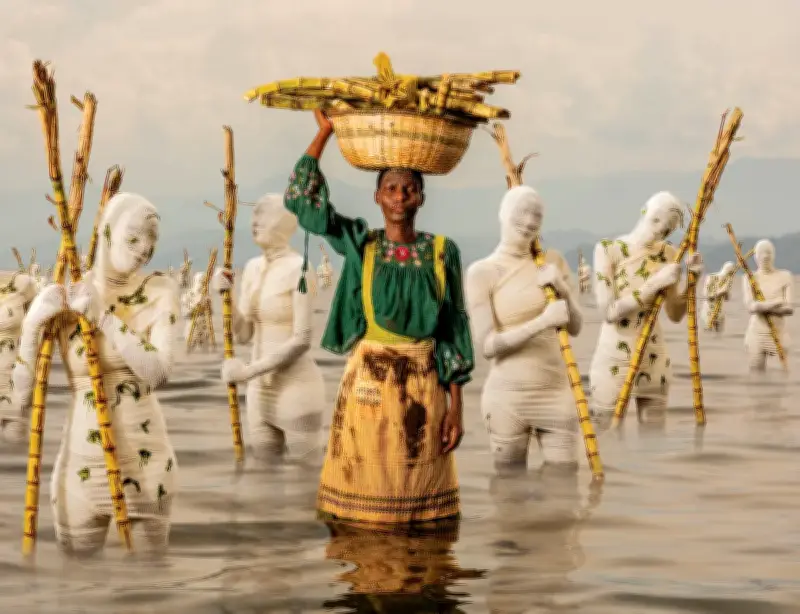
Congolese photographer Pamela Tulizo's latest series of photographs started with a question. “I asked myself, why are woman in my community in particular, and African woman in general, so strong?” says Tulizo, an artist and photographer from the Democratic Republic of the Congo. “Where does this strength come from?”
Growing up in Goma in eastern DRC, Tulizo was informed and inspired by the women she was surrounded by, including her mother, her sisters, her mother's friends and her neighbours. Years later, when she began to look into the role of women throughout African history, she says: “I realised that perhaps women have been forced to be strong since the dawn of time, forced by circumstance to build that resilience.”
Women at the centre of Mababu
Her research brought her to slavery, the “cruellest period in human history”, which is often just associated with the men who were forced across oceans to form workforces abroad. Women, she noticed, were largely invisible, their stories untold.
With that in mind, Tulizo placed women at the centre of her series of 23 staged photographs called Mababu (“ancestors” in Swahili). In it, she portrays figures such as Kimpa Vita and Queen Nzinga, who were both renowned for resisting the European colonisation of Africa in the 17th and early 18th century.
“Because of racism, there's always been this belittling of African women that portrays them as vulnerable, as victims, and suggests they lack strength or intelligence,” says Tulizo. “I wanted to end that narrative by showing that despite everything they endured, they remained strong and fought for freedom.”
Overcoming obstacles in photography
Tulizo's path to photography has not been easy – in part, she believes, because she is a woman. She started her career as a reporter but decided to focus on photography when she felt she could not write about everything she wanted to cover. There was nowhere to train as a photographer in Goma so she took photos whenever she could, and became one of a handful of female photographers in the city.
“It wasn't easy at first because I didn't have a role model to follow, or anyone to guide me in my early days,” she says. “The community didn't accept me right away – whether it was my parents, or even other photographers – since it was very much a male-dominated world. But facing so many obstacles motivated me to stick it out to the end and prove that I could be a woman and a photographer,” she says.
In 2020, her work Double Identity won the Dior photography and visual arts award for young talents, a series that contrasted the media portrayal of Congolese women as victims with their true identities. This allowed her to finance the creation in 2021 of a cultural centre in Goma for women and girls, Tulizo Elle Space. When renewed violence broke out in the region in early 2025, she fled and now lives in France.
Fashion and resources in the series
She approached her latest series of work, Mababu, as if she were making a film, using cinematic staging with actors, costumes, makeup and outdoor sets to create vivid scenes. In one set, a woman stands in Lake Kivu holding a basket of either cotton, tobacco or sugar cane, and surrounded by other women bound in bandages (wrapping the body being a common practice in funeral rituals). The images, which were shot in Goma and Belgium, are defiant, and do not gloss over past suffering.
Fashion is a crucial element of the series and Tulizo uses it to elevate and pay tribute to women. She uses colour, accessories and styling to express hope, courage and strength. In some images, where a woman is bound or suffering, she is still elevated through a hat, dress or gloves, says Tulizo. “To me, she remains a heroine, and fashion allows me to honour her, giving her the strength and power she deserves,” she says.
Some of the photos incorporate images of natural resources. The titles of the opening works – Tumbako, Miwa and Pamba – refer to tobacco, sugar cane and cotton, three commodities that played a central role in fuelling the transatlantic slave trade. “Slavery did not happen in a vacuum,” says Tulizo. “It was driven by the pursuit of natural resources.”
Modern parallels and exhibition
The photos echo what is going on today in eastern DRC, where devastating conflict and sexual violence have been driven by decades of competition over rich mineral resources. “Regrettably, today we are experiencing a modern form of slavery driven by technology, development and global progress,” says Tulizo. “Back then it was tobacco, sugar and coffee. Today it is war and sexual violence over lithium, gold and minerals.
“Everyone wants to conquer the world, to be the first to produce electric cars, or to be the leading global power with nuclear weapons. None of that is possible without these raw materials. Unfortunately,” Tulizo adds, “humanity has not learned its lesson, and we are repeating the same mistakes in a modern form.”
Mababu – Spirit of the Ancestors by Pamela Tulizo is at GC De Markten, Brussels, as part of the Vrije Universiteit Brussel cultural diplomacy initiative, from 8 to 31 October.