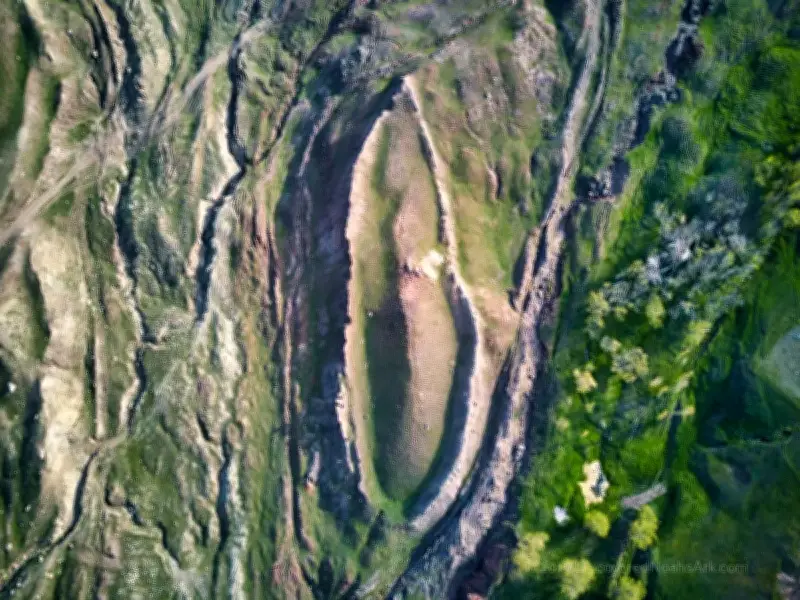
A researcher involved in the search for Noah's Ark has demonstrated the vast scale of the site she believes could be the legendary Biblical ship by walking around its perimeter. Kez McGarvie, who works for Noah's Ark Scans, shared a video on Instagram timing her walk around the 515ft Durupınar formation in rural Turkey.
Walking the perimeter
In the video, McGarvie explained that she decided to walk the entire perimeter of the formation and time herself to give a better idea of its size. The walk took 8 minutes and 30 seconds, which she said included "some serious huffing and puffing."
She noted that it is hard to understand the scale from photos or drone footage, adding: "When you're standing at the bottom and looking up at the sides of the formation, it just keeps going." She also warned anyone hoping to visit the site to "bring good shoes."
Claims and research
According to the Bible, Noah's Ark is the ship that saved humanity and every kind of animal from a catastrophic flood, which some biblical chronologies place more than 4,300 years ago. The team of researchers believes it has "100% confirmed" the find.
Previously, the team drilled into the site and lowered a miniature robot nicknamed Gopher into an 18-metre borehole to inspect spaces they believe were detected by radar. The robot struggled to move through loose sediment, and the team said its wheels would need modifying before it could look around properly. They also claimed the attempt supported their earlier finding that it had not encountered solid bedrock in the hole.
Unconfirmed status
Noah's Ark Scans founder Andrew Jones has said he is convinced the formation contains the buried remains of the Ark. The team interprets radar readings as possible walls, passageways and chambers, and is searching for traces of decayed wood. They say five prominent anomalies inside the mound may form a possible tunnel system extending across roughly 151 feet, with an average structural height of over 14 feet.
The formation has not been confirmed as Noah's Ark, and the group's interpretation of its scans and drilling remains is yet to be confirmed by independent researchers.