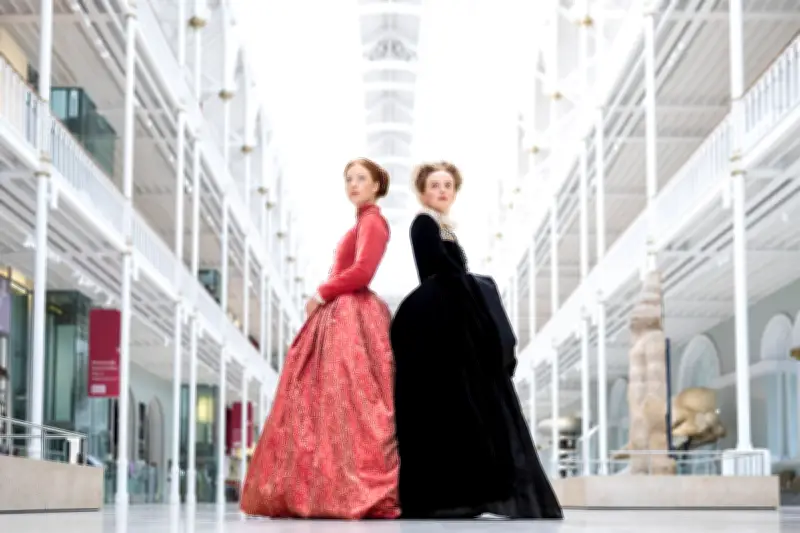
A new exhibition presenting Mary Queen of Scots as a Renaissance queen and giving a flavour of what it was like to be in her “vibrant” court is to open in Edinburgh next year.
Curators said that while many think of Mary dressed in black and see her through the lens of her death, the exhibition aims to challenge perceptions and show a contrasting side, when she was a sophisticated figure moving between palaces.
Exhibition details and highlights
Mary, Queen of Scots: Renaissance and Resistance, which opens at the National Museum of Scotland next June, will bring together about 100 loans from across Europe, some never seen in Scotland before.
As a widowed teenager, Mary, Queen of Scots returned from France in 1561 to a Scotland riven by the Protestant Reformation. She reigned until her forced abdication in 1567 and was executed on February 8 1587 after 19 years as a prisoner of her cousin, Elizabeth I of England.
Highlights of the exhibition include a portrait of Mary by Francois Clouet, lent by the King from the Royal Collection, which shows her dressed in pink and wearing pearls.
Curator's perspective
Dr Anna Groundwater, principal curator of Renaissance and Early Modern History at National Museums Scotland (NMS), said the exhibition will explore the different dimensions of the story of Mary, who was raised at the French court, spoke several languages and was well educated.
She said: “I think the big challenge when we think about Mary’s history and who she was is that we endlessly see her dressed in black, and through the lens of the knowledge that she’s executed.
“So, we see Mary’s life through her death, and what this exhibition is going to do is to see her life in the time in which it was lived, to see her very much as she was in the historical moment, and that is the Mary that is captured in the Clouet portrait of her, where she’s dressed in eye-catching pink and dripping with pearls.
“So, we’re not going to downplay what happens to her in the end, and we absolutely will engage with that.
“But if anyone takes any impression away from this exhibition, as opposed to any other exhibitions about Mary, it is that she was very much alive, and she ran this very vibrant court in Scotland that really drew on her upbringing at one of the foremost Renaissance courts in Europe, in France.
“It was a life lived moving from chateau to chateau with beautiful interiors and music and pageantry, and she brought a lot of that back to Scotland with her in the way in which she conducted her own reign in Scotland from 1561 to 1567.
“So, it’s really about trying to recover the whole Mary rather than just seeing her through the fact that she came to this tragic end.”
Exhibition experience and items on show
NMS said the exhibition will present both the young Mary and the Scottish queen in her final years, dressed in black and fiercely resisting those who conspired to take her crown, and ultimately, her life.
Jewellery and letters will be among the items on show, as well as a silver casket that is believed to have once held the correspondence and sonnets which played a role in her downfall.
The exhibition will be a multi-sensory experience with music and perfume made according to 16th century recipes which visitors will be able to sniff by using a dispenser that dispenses the scent into a box.
Dr Groundwater said: “It’s quite a rich, textured exhibition.
“We’re trying to really inject what it would have felt like to be at Mary’s court in Scotland in the 1560s, including music.”
She added: “It’s really giving Mary her European context, in particular, her French experience.
“It’s placing Mary as a Renaissance queen on a European stage, rather than just only looking at her within that context of the relationship with England and Elizabeth.
“That in creating Mary the whole person, European Mary was as important.”
The exhibition runs from June 12 to November 14 2027.