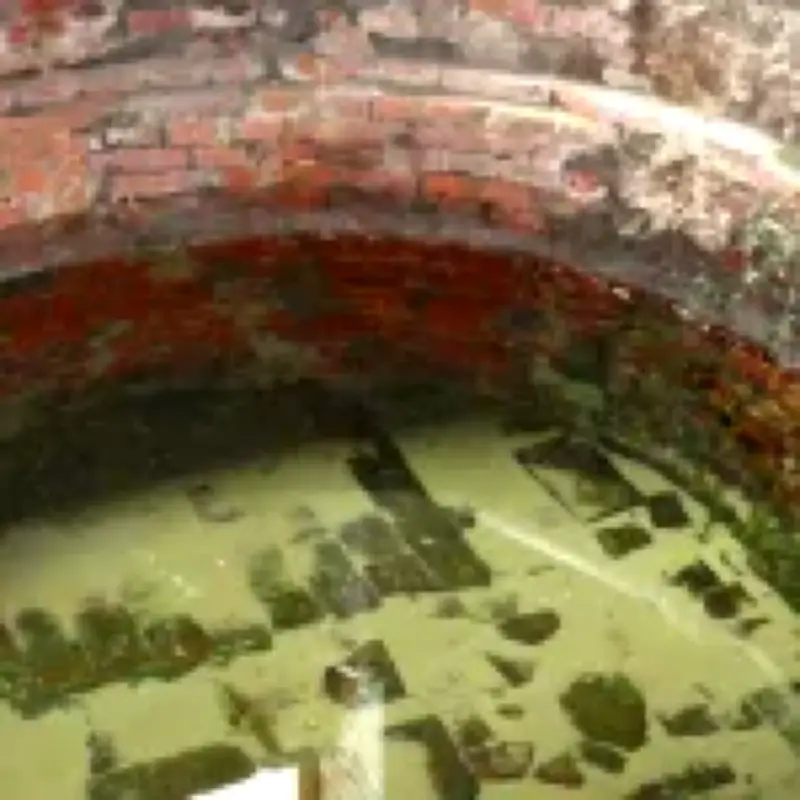
Hidden behind Somerset House on Strand Lane, a curious attraction at No. 5 Strand Lane bears an old wooden sign proclaiming a National Trust Roman Bath underneath the building. But the baths are not Roman at all, and they weren't originally a bath.
The Strand Lane Baths, called Roman since the 1830s, are actually the remains of a cistern built in 1612 to feed an ornate fountain in the gardens of the old Somerset House. At the time, the house was a palace and a residence for royal consorts. The house entered a long period of decay from 1688 onwards, and the cistern was left to rot.
From cistern to cold plunge bath
It wasn't until the 1770s that the cistern was used again, when a man named James Smith moved into 33 Surrey Street, a property that backed onto it. In 1776, he began advertising it as a cold plunge bath for ladies and gentlemen 'supplied with water from a spring'. James later expanded, adding a second bath known as the 'Essex bath', lined with tiles and marble.
The baths continued to run after James's death in 1782, but by then they had gained a reputation after several strange incidents, including an MP's death. To restore appeal for visitors, the baths were given a 'gimmicky' rebrand, and in 1838, under the proprietorship of a Mr Charles Scott, they became known as the Old Roman Spring Baths.
Roman myth and modern reality
Within a decade, the story of the bath's Roman origins had become ingrained in the public consciousness, even being referenced in David Copperfield by Charles Dickens. It wasn't until the National Trust took the space on in the 1940s that the proper history was revealed. The LCC Architect's Office conducted a historical investigation which concluded in 1951 that the baths were 'almost certainly not Roman, but worth preservation as a historical curiosity all the same'.
Today, the baths are still owned by the National Trust but managed by Westminster City Council. They are not open to the public at all times, but visits can be arranged by contacting the council, with at least one week's notice required, and visits only possible at certain times between Monday and Friday.