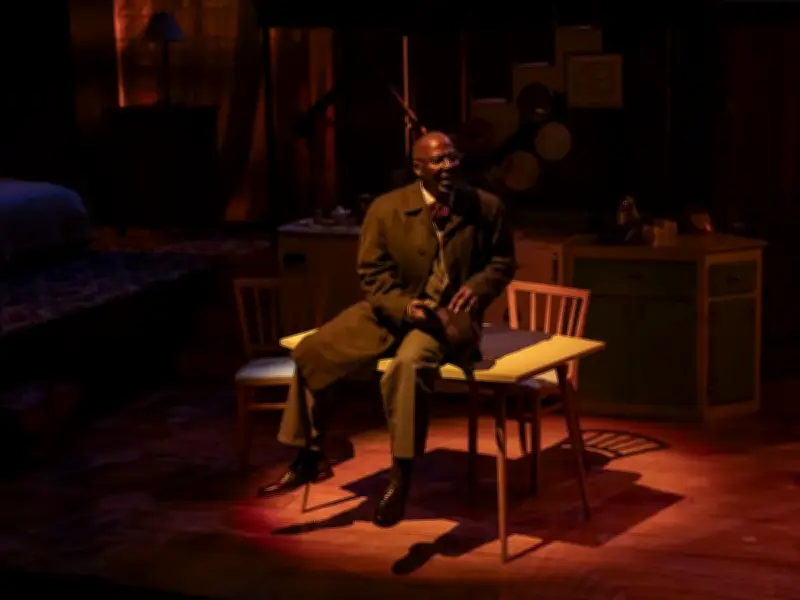
A Liverpool crowd was brought to its feet last night after a distinctive take on a classic play. Death of a Salesman, a 1949 stage play by American writer Arthur Miller, is now showing in a new adaptation at the Everyman Theatre on Hope Street.
Set in 1940s Brooklyn, it follows the tragic tale of Willy Loman, a failing travelling salesman. The play shows the disintegration of Willy's mental state as he struggles to reconcile his supposed early success with how his life has transpired as he approaches retirement.
When the play opens, Willy is still travelling around the US but not making any money. He and his wife Linda are struggling to pay the bills. Both their sons, Biff and Happy, are staying back home temporarily.
Eldest son Biff, who Willy has clearly invested all his faith into, is going from job to job with no sense of purpose in life. Meanwhile Happy, much like Willy, boasts of having a far more successful business career than he actually does.
Original success and narrative style
The original was a smash hit, winning the Pulitzer Prize for Drama and the Tony Award for Best Play. It has since been performed on Broadway and the West End, and is a text studied by pupils on A-Level English Literature courses in England.
Willy's story is told through a montage of present day events, flashbacks and dream-like sequences constantly overlapping with each other, symbolising his decaying mental state.
This aspect can make adaptations of the play difficult to follow at times, but director Tristan Fynn-Aiduenu utilises the geography of the space to negate this, positioning cast members in different positions and rooms to make the distinction between past, present and montage clear to those watching.
If you don't think a tale about working-class New Yorkers written almost 80 years ago has any relevance to you, think again. Willy, like many, has worked for decades but doesn't actually own anything - from his house and his car to his fridge and washing machine, which were bought on credit.
Willy and Linda are in constant debt. He is nearing old age but can't provide for his family despite the long hours he has put into work. He has severe mental health issues but is clearly ashamed of it and won't discuss it with those who love him.
Biff meanwhile is lost, feeling he has no other option but to try and make it in the cut-throat world of sales to get on in life. Long-term employment is hard to come by and he ends up living with his parents in his 30s.
As mentioned earlier, Happy is a bluffer, making out he is living a glamorous lifestyle while the reality is far more mundane. Linda has to mend her own stockings and feels unable to challenge her husband's worst traits.
The first change
The biggest change Fynn-Aiduenu makes to Death of a Salesman is portraying Willy as a West African migrant to America and Linda as an Irish migrant.
In the original, the Lomans can appear as a white family, although many speculated they were meant to be Jewish migrants. This was later confirmed by Miller, who based Willy off his Jewish uncle but did not include explicit references to religion or ethnicity to create a universal American tale.
By making Willy explicitly an immigrant, it emphasises that he is an outsider in society, desperately chasing the American dream as many others in his position have done.
It also gives another dimension to Willy's obsession with popularity above everything else - he is desperate to fit in, to be liked and to be accepted as an American. At times, certain lines are replaced with African dialect. Willy's attachment to his brother Ben symbolises his attachment to his native country.
The cast
All of the cast were outstanding, but particular praise must go to Cyril Nri as Willy and Laurence Ubong Williams as Biff. Willy is in nearly every scene and Cyril is fantastic at portraying the character's fragile mental state, his fear about his future and his anger at Biff.
Laurence encapsulates the two stages of Biff's life - as a happy teenager who loves his dad and is close with Happy, played by Kiren Kebaili-Dwyer, and a dejected adult who can't stop fighting with both of them, brought on by his discovery that Willy is having an affair.
The second change
While changing Willy to be explicitly a migrant worked in my view, what didn't work was the odd items of modern day life that were thrown in during a few moments of the play.
Towards the end of the first act, Linda, played by Emma Cater, is shown using a vape and then studies Willy's incomings on an Apple laptop. At the start of the second, she is seen taking a call from a Bluetooth headphone and wearing a lanyard, as though she works in a corporate office.
Noah Olaoye is fantastic in his dual roles as family friend Bernard and Willy's boss Howard Wagner. But during his scenes as Howard, he wears a pink baseball cap backwards. I don't think this is authentic business attire of the time.
I don't understand why these aspects were introduced when the rest of the play's setting and dialogue remained rooted in post-war America. You either have to go traditional or remake it fully in a modern setting, but this does neither.
In what was otherwise an immersive play, these aspects really took me out of the experience. The use of the vape drew some laughs from the audience, so maybe it was introduced for comic effect.
But Death of a Salesman isn't lacking in light-hearted moments - the audience also laughed at the razor sharp, straight talking dialogue.
If it was meant to show how the themes of the play were relevant to the modern day, I don't feel that was necessary either. As discussed earlier, you don't need to see a laptop to relate to what these characters are going through.
Verdict
All in all though, the play was excellent. As with all adaptations, it makes you feel sad, uncomfortable and moved, as evidenced in the standing ovation the audience gave to its wonderful cast.
While its use of random modern items is misguided in my view, its other change - making the Lomans an explicit migrant family - is both faithful to Miller's thinking and brings out a new aspect of the play that I hadn't dwelled too much on before.