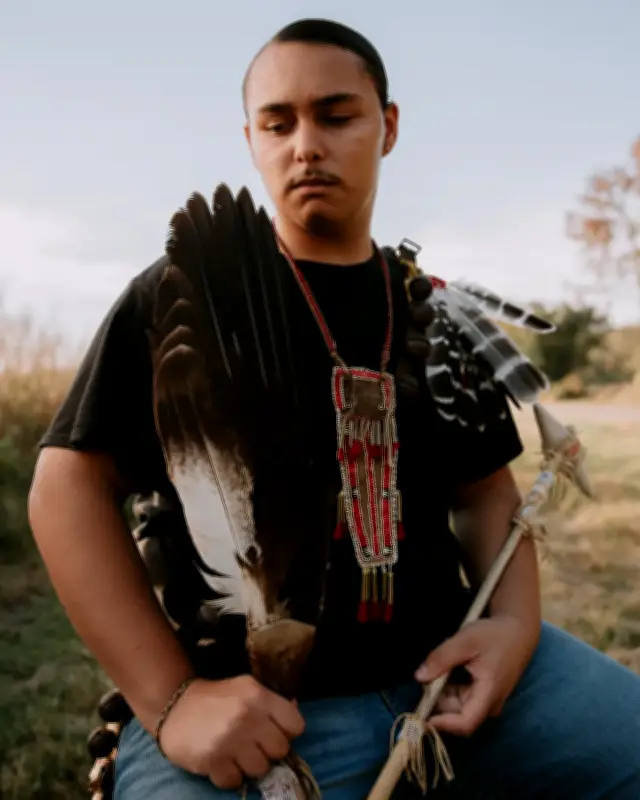
A new exhibition at the Museum of the City of New York, Halumii Ktapihna: Lenape Legacies and Futures, presents the modern-day culture of the Lenape people as vibrant and alive, countering a history of forced assimilation and displacement.
During the 19th century, the US government funded more than 500 “Indian boarding schools” aimed at forcibly assimilating Native American children into western culture. Students were taken from their families, frequently by force, and forced to cut their hair. They were stripped of their original names and taught to feel shame regarding their heritage and customs. Run like military academies, these institutions required children to wear uniforms and subjected them to severe physical punishment, such as solitary confinement and flogging. Richard Henry Pratt, who established the first of these schools, declared that their explicit purpose was to “kill the Indian, save the man”.
A painful legacy and a formal apology
These assimilation practices persisted for decades, during which numerous children endured physical and sexual abuse. At least 1,000 children lost their lives, though the actual casualty count is believed to be significantly higher. The US government issued no formal apology for these atrocities until 2024, when former president Joe Biden described the boarding school system as “one of the most horrific chapters in American history”.
Some of the children at these schools were Lenape people, an Indigenous group that live on the north-eastern coast of the US. In 1874, a Toronto missionary society published a hymnal that translated Christian worship songs into Munsee, one of the languages spoken by the Lenape. The hymnal was part of the state’s attempt to assimilate Indigenous children; they were expected to learn Christian worship songs instead of their own culture’s prayers.
From symbol of erasure to language revival
Today, the hymnal hangs in the new exhibit. More than 150 years after its publication, the book now serves the opposite function it was intended for. Rather than forcing Lenape children to learn English, it has become a primary source for Lenape people who are now revitalizing a language that was nearly lost due to systemic racism and genocide. The hymnal, once a symbol of erasure, teaches vocabulary and grammatical structures to a new generation.
Halumii Ktapihna contains visual art created by Lenape people, along with traditional dress, samples of music, and efforts to revitalize Lenape words and phrases. “We lost a lot of the culture and language, but yet [some] has remained,” said Brent Stonefish, a founding member of the Éenda-Lŭnaapeewáhkiing Collective and curatorial adviser on the project. Next to the hymnal hangs a bolo tie made in 2024 that reads: “We matter.” “Between those two [pieces], there’s a whole history there,” Stonefish added.
Correcting the Manhattan myth
If most people know anything about the Lenape, it’s their role in New York’s apocryphal origin story: that Manhattan was sold to the Dutch for $24 worth of trinkets. The story goes that Dutch settler Peter Minuit swindled the island’s Native inhabitants, the Lenape people, out of what would eventually become one of the most expensive places on Earth, in effect displacing them from the island they called home and named. Manhattan comes from Manhatta, which means “a place for gathering wood to make bows” in Lenape.
This story is not true: there’s no paper record of the trade, and the Lenape people did not believe that land could be owned or sold. Most scholars agree that what we now know as New York sits on stolen, unceded Lenape territory. There are now land acknowledgments posted around the city’s cultural institutions, such as a plaque outside an entrance to the Metropolitan Museum of Art. This gives the impression that the Lenape people’s story ended hundreds of years ago – but the new exhibit aims to correct that assumption, presenting the tribe’s modern-day culture as still very much alive.
By the Revolutionary war, most of the Lenape people had been killed or pushed west by settlers. The US government’s ensuing genocide and forced displacement of Native Americans further decimated the Lenape population. But there are still state and federally recognized tribes in the US and Canada dedicated to preserving their heritage and language. Some of these groups have sovereign tribal governments and have received grants to buy back ancestral land.
Art, protest, and seven generations
Modern-day art in the exhibit highlights the Lenape’s original homeland of New York; one piece by Ramapough Munsee artist June Lee Van Dunk explicitly juxtaposes the silhouette of an Indigenous figure clad in traditional dress with the scene of a bustling New York block with the Empire State Building in the background.
Angel “Monxo” López, the museum’s curator of community histories, worked on the exhibit. López is not Lenape; he hails from Puerto Rico and now lives in the Bronx. Going into the project “I was originally expecting a lot of resentment, sadness, grievances, name-calling against the occupiers of their land,” López said. “But when you walk into the gallery, there is not a single moment that speaks about that. They found a way of dealing and engaging with those historical wounds in ways that are not ugly, nasty, or resent-driven. I’m like, ‘Oh shit, I wouldn’t be so polite.’”
The exhibit also features a protest banner made in 2019 by Georgetown professor Ashton Pemapanik Dunkley. The image of the Earth and an Indigenous woman in red is spray-painted over canvas alongside the words: “Mother Earth and her Indigenous daughters are under attack.” This banner connects the disastrous impacts of the climate crisis with the issue of missing and murdered Indigenous women, who face a high rate of assault, abduction and murder. (More than 1.5 million Indigenous women have experienced some sort of violence in their lifetime; red dresses have come to represent these women.)
Stonefish attended the opening of the exhibit with his daughter Emma, who is coordinating an upcoming Lenape/Lunáapeew Nations Pow Wow in Brooklyn’s Prospect Park, a tradition which started back up last year after a 53-year break. When speaking about his family, Stonefish referenced the Indigenous concept of “seven generations” – a rule that every community decision should be made with seven generations in mind, to promote a sustainable future.
“My kids used to ask me, ‘What generation am I?’” Stonefish said. “I would tell them, you’re the seventh, and you’re the first. You’re tied to those who are behind you, but you’re also creating the foundation for the next set. You’re all of them.” Halumii Ktapihna: Lenape Legacies and Futures is on display at the Museum of the City of New York through 17 April 2027.