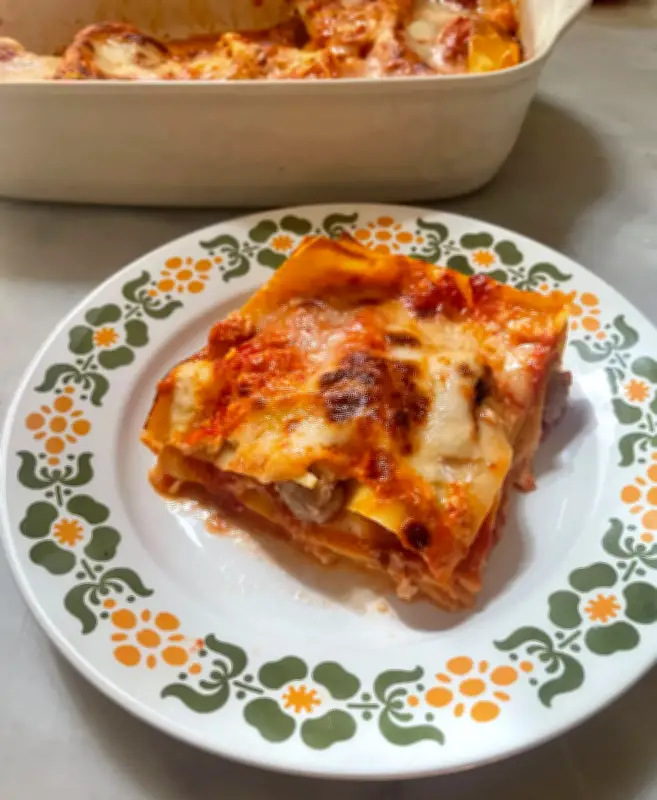
Rachel Roddy's lasagne with three cheeses, tomato and tiny meatballs is a deep, ingredient-busy take on the classic, built with four layers of pasta and a little geometric thinking.
Building the Lasagne
Bearing in mind that lasagne is a construction, it pays to start with some easygoing geometry. That is, think about the size of the dish you want to fill in relation to the size of the sheets you are using and the number of layers you want the lasagne to have. For four to six servings, Roddy uses a particular ceramic dish, because its 20cm x 29cm proportions mean that, broadly speaking, two fresh sheets of shop-bought egg pasta or four dried ones make a single layer (homemade pasta can be rolled and cut with scissors to whatever size you like, so is less relevant here).
Having calculated how many sheets are needed for each layer, the next question is: how high do you want your lasagne building to be? Height depends on the density of the filling, which, in the case of this recipe, includes sausagemeat rolled (using wet hands and speed) into small, grape-sized meatballs that act like height-boosters in shoes. This elevation, along with tomato sauce and three cheeses, means that, even with just four layers, this lasagne has depth and cuts into satisfying squares.
Origins and Components
All this emphasis on the dish is also fitting because the word lasagne seems to derive from the Latin lasanum (cooking vessel), which in turn derives from the ancient Greek λάσανον, which signified either a cooking vessel or a tripod set over a fire.
Back to 2026, though, and this busy, joyful lasagne borrows from both the Neapolitan lasagne di carnevale, with the inclusion of very small meatballs, tomato sauce and mozzarella, and a Sicilian lasagne in the use of ricotta loosened with a little milk (so it has a soft, spreadable texture) in place of bechamel. A four-layer lasagne is also convenient in that all the other components are split into quarters, then spread, splattered or arranged on each of the layers. Roddy suggests using fresh pasta, but dried works, too, although that will need a more liquid tomato sauce to cook through. She also recommends a 30-second pre-boil, which starts to cook and firm the sheets, although she notes that readers may disagree and do otherwise.
Recipe: Lasagne with Three Cheeses, Tomato and Tiny Meatballs
Serves 4-6. Ingredients: 4 tbsp olive oil; 1 small garlic clove, peeled and gently bashed so it's broken but still intact; 250g sweet cherry tomatoes, chopped; 1 400g tin plum tomatoes, crushed or passed through a food mill; 1 pinch red chilli flakes; salt; 1 small handful basil; 4 pork or vegetarian sausages; 250g ricotta; milk, as required; 300g mozzarella, drained for at least 12 hours; 75-100g parmesan; 8-12 sheets fresh lasagne, depending on the size of the sheets and your dish.
Working in a deep frying pan or saucepan on a low heat, warm the olive oil and garlic for a minute or two. Add the fresh and tinned tomatoes and the chilli, stir, then raise the heat so the tomatoes simmer in a lively way for about 20 minutes, mashing them with the back of a spoon to break up any lumps. Once the sauce has lost any wateriness, add salt and a few basil leaves, then set aside.
Squeeze the sausage meat from its casings, then, working with wet hands, form the meat into grape-sized balls. In another frying pan, heat two tablespoons of oil and fry the balls lightly, so they're almost, but not quite, cooked through. Beat the ricotta with the milk and some salt to form a soft paste, thinly slice the drained mozzarella and grate the parmesan.
If you are doing the pre-boil, bring a large pan of salted water to a boil; have a bowl of cold water ready and spread a tea towel alongside it. Working in batches, drop the pasta sheets into the boiling water for 30 seconds, lift into the cold water to cool, then lay them out on the tea towel.
Construct the lasagne in a 20cm x 29cm (or similar sized) dish, bearing in mind that it has four layers, so divide all of the components by four, but the meatballs only by three, because they don't go on top. Rub the dish with oil, then make a base layer of two (or more) pasta sheets. Spread with a quarter of the ricotta and the tomato sauce, dot with meatballs and mozzarella, some basil, and scatter over parmesan. Cover with a second layer of pasta and repeat until everything is used up. Finish with a scattering of parmesan.
Bake at 190C (170C fan)/375F/gas 5 for 25 minutes, until the top is golden and the sides are bubbling. Leave to rest for 30 minutes, then cut into squares and serve. Leave the lasagne to rest for at least 30 minutes, so the flavours can settle and the whole thing firms up, before serving in geometric squares.