The British Museum has opened a new blockbuster exhibition upstairs, while crowds flock to see the Bayeux Tapestry. The Korea exhibition takes visitors through 2,000 years of cultural history in a similar sized space, and in a manner that is equally stirring. With twelve national treasures among its rarities, the show efficiently illustrates the creative history of a nation, one which has uniquely been tied into the governance, societal and religious structures and values of its different eras.
From Iron Age to Three Kingdoms
The exhibition takes visitors down a central section tracing the history of the country, with rooms off the main spine providing a deeper glimpse into certain areas. It begins with the period from 400 BC, the early Iron Age, through the period when Korea was split into Three Kingdoms – rival states Goguryeo, Baekje and Silla – before Silla then united the country in 676 AD. Rattles from that Iron Age show were likely from Shamanic ceremonies, the dominant localised faiths in these early eras. Despite being subsequently banned, Shamanism continued to exist as an underground faith and still plays a role today.
There is a flair for bling on display. Chunky gold earrings worn by high ranking men and women in the Silla era, beautiful gold and copper wings that were once attached to a crown, and a pair of gilt bronze burial shoes which look like Gucci slippers. The technical skill is remarkable, and as Buddhism was introduced around AD 300, bringing with it new developments in medicine and government, artistry was accelerated too. A beautiful little Bodhisattva with a halo from this era has a delicate radiance, with power in grace.
Celadon Ceramics and Sutras
In the subsequent Goryeo Dynasty, Buddhism became the official religion and the arts flourished, with monasteries becoming centres of cultural productions. A huge chunky gong in one of the dedicated side rooms, replete with dragons and final boss deities, shows the swagger in the faith. Also here are sutras – texts including stories and teachings of the Buddha – which were so important that commissioning them was deemed an act of duty and devotion by governments and high-ranking individuals. One section of text on display here from The Flower Garland Sutra is rendered in gold leaf on indigo paper and would be the show-stealer were it not for the celadon ceramics which follow it.
Celadon is one of the most iconic Korean achievements, and you can see exactly why. Using techniques gleaned from China, the Korean potters developed a delicate bluish-green glaze which is beautifully tasteful, and used the 'sanggam' technique for decoration; rather than paint on designs, you incise them into the unfired surface then fill it with coloured slip. The items here are dazzling. In a curatorial continuation of such flair, beside these is a contemporary work by the ground-breaking South Korean artist Yeesookung. One strand of her practice involves reclaiming ceramics that were destroyed because they didn't reach the Korean standard of perfection (with feminist and social conformist connotations) and here celadon fragments of pots and shrines are melded back together with gold, these fragments coming from both North and South Korea. The sculpture looks almost organic, monstrous even, yet it is messy and newly alive. It is both satirical and hopeful.
A lovely moon jar from the Joseon dynasty – which took up neo-Confucianism over Buddhism – items which were prized for their imperfections and personality, shows that refinement didn't have to come at the expense of humanity. It sets up one of the most moving pieces here, The Amitabha Buddha Sutra, transcribed by Queen Inmok. After the death of her husband King Seonjo in 1608, the Queen's son, the crown prince, was killed by the new monarch, his half-brother, and she was confined to an isolated palace. There, she began copying out sutras, with this one here from 1621 – you can only imagine the emotion going into every character.
Modern Works of Rebellion and Reflection
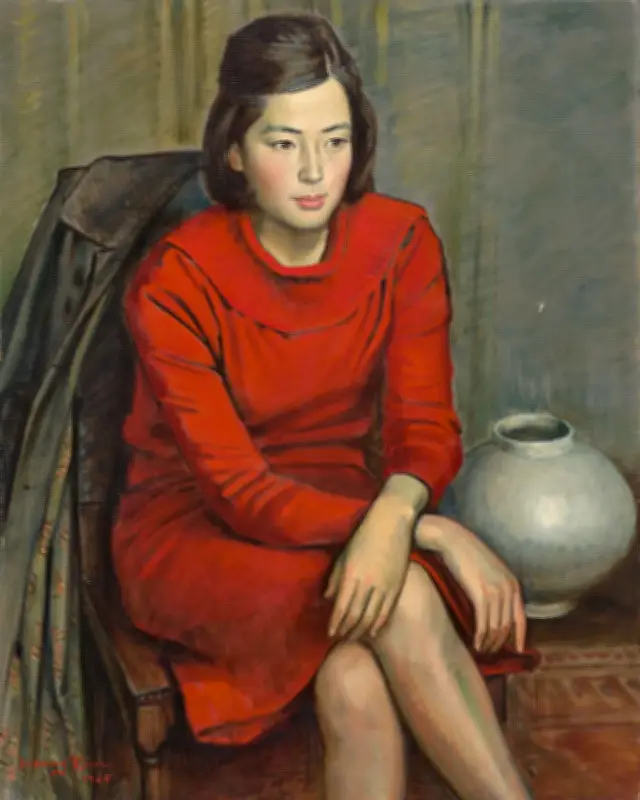
After all these absorbing items, the dreaded move into modern times comes; yet this exhibition finishes on a high when most others of this type fall. Given the turmoil and brutality of the 20th Century, the show gear shifts into showing work which is no longer about national pride or displays of power but personal, a means for saying the unsayable as a form of rebellion after the war and subsequent military repression. In Thinking Woman from 1992, artist Choi Jongtae puts a spin on the pensive Bodhisattva, but this is not calm here, this is angst, the woman turned in on herself, not radiating anything except 'leave me alone'. Woman in a Red Dress by Kim Insoong from 1965, meanwhile, depicts a figure who is every inch the modern woman yet inscrutable, the moon jar to her left suggesting the weight of the ancient past remaining with her in every moment.
Shamanism 3 by Park Saengkwang from 1980 delves into the old folk rituals with a dancing shaman, dragons, and that old sense of wildness below the surface, also present in Pak Nosoo's Mountain Spirit from 1960. This ink painting shows a naked woman on horseback rushing into the mountain forest in the moonlight and has the magical feel as Clearing After Rain on Mount Inwang, from 1751, a national treasure which is displayed earlier, almost hidden away like a holy relic. Other works are more direct – and disturbing. Two small images on scraps of paper by Lee Jung-Seop are utterly haunting. Separated from his family by the Korean War, the artist fell into poverty and suffered breakdowns and an early death. One of the small works is a heartbreaking fantasy of him returning home on a boat to his wife and children, the other – literally done on the back of a fag packet – is a scene scratched into the foil of prisoners of war bound in chains.
This sequence is topped off by the huge oil painting Modern History of Korea – Synthesis by Shin Hak Chul, which captures the post-war decades in one Pop Art-meets-Bosch disturbing totem. Piles of corpses provide a base for a nightmare of vehicle parts, naked torsos, American tanks, Yamaha motorbikes, bulging biceps, which lead up to a fountain producing a new generation. A much quieter take on this is the final piece of the show by Do Ho Suh (who had a retrospective at the Tate Modern last year) called Self-Portrait. Made up of threads, it shows his traditional Korean house hovering above him, its trailing threads making up his own figure. Suggesting the past both protects and traps, it is about not defeat but a kind of acceptance. The past cannot be escaped but it need not entirely entangle you either – and in the case of Korea, there's still plenty to be inspired by.