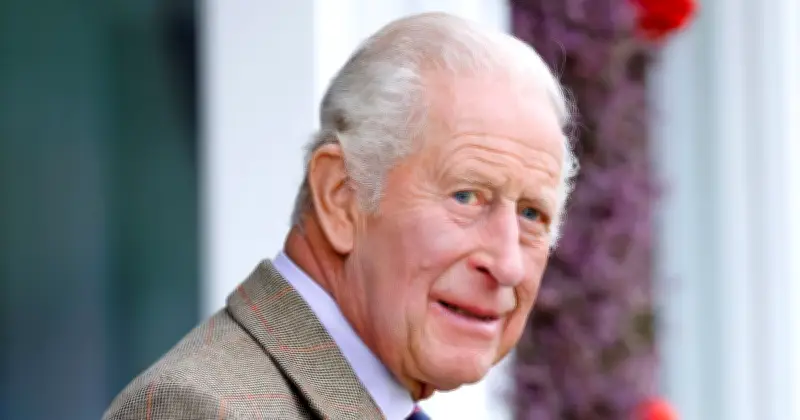
King Charles's longtime friend Jonathan Dimbleby has said Buckingham Palace "cannot conceivably respond in kind" to any claims made in a book or biography, as the Royal Family are powerless to respond to the royal 'soap opera' generated by scandalous books and biographies.
The broadcaster and author, 82, made the pointed assessment just days after Earl Spencer's book about his late sister, Diana, Princess of Wales, hit the shelves. In an exclusive chat with the Daily Express, the long-standing friend and prominent media commentator on the monarch was reticent to delve into the current furore surrounding the publication of the Earl's book, Swan Song: My Sister Diana, but offered a pointed observation about the public perception of the Royal Family.
Media's role in the 'soap opera'
Speaking over Zoom, Mr Dimbleby pointed out that writing a book about a celebrity or politician is completely different to penning one about the royals, as Buckingham Palace "cannot conceivably respond in kind". Levelling blame at the media's door, he said: "In general, the media talks about the soap opera. The soap opera has to have scriptwriters. It has to have producers and editors. And the producers and editors of the soap opera are the media themselves.
"I find that quite hypocritical because those who participate, who are in the glare of that soap opera, who are on stage, cannot conceivably respond in kind. They can't do it. The institution of the monarchy does not do it."
The broadcaster continued: "I think, therefore, it too often gives licence to gossip, innuendo, supposition based on quotes, which may sometimes be true, equally not true."
Defamation risk and public appetite
"If allegations are directed against a politician or someone who could answer back, a pop star or a footballer, you will be very careful to make sure to have that allegation stood up because otherwise you might be found in defamation. That will not happen [with the Royal Family] and the media know that. And I speak about both the broadcast media and the written media, and that's really all I have to say on the subject."
However, Jonathan, who wrote The Prince of Wales: A Biography in 1994 and conducted the landmark ITV interview Charles: The Private Man, The Public Role, which saw the then-Prince Charles speak candidly about his marriage and upbringing, admitted there is a huge public appetite for stories about the monarchy.
"Social media has played its part in that too. And the fact is that the public loves it and it helps sustain the sales of newspapers. [They want to be] able to say, 'I got this exclusive,' and there are so many different exclusives all at the same time."
Any Questions? experiment
He recalled an experiment while presenting Any Questions?: "I remember a long time ago, when I was doing Any Questions?, an issue came up about a book that had been written about the Princess of Wales. One of the panellists said: 'I think it's absolutely awful that this is serialised and given all this attention' – it was going to be serialised in the Sunday Times.
"So I asked the audience, we were in Sussex, 'How many of you share that view?' All the hands went up. Everyone on the moral high ground in a small village, hands went up. So I said, 'How many are going to refuse to buy the newspaper?' All the hands went up again.
"So we thought we'd double-check. The programme went out on the Friday, repeated on the Saturday, as it still is. The next Monday, one of the members of the team rang the only newsagent nearby and said, 'How did you do on sales?' He said, 'Well, we'd stocked up and we sold out.'"
Charity milestone
Jonathan was speaking as he marked a huge personal milestone, having been a trustee of the Richard Dimbleby Cancer Fund for six decades. The charity was set up in 1966 following the death of his father, the legendary "voice of the nation" Richard Dimbleby, at the age of 52 from testicular cancer.
Rather than send flowers, members of the public "sent small donations in brown envelopes, totalling the modern equivalent of £10 million". Jonathan admits counting the money and setting up the charity "was actually for us very good because it sort of filled the space of pain".
The fund exists to offer care and support to people affected by cancer in the UK, including patients, their families and carers. Among its many initiatives over the years is one of its most recent innovations: a nationwide map showing people living with cancer where they can find support and services.
"We thought, why don't we do an online map, which we call the Cancer Care Map? One of the great things about being a small charity is you can do big things quickly. So, we were able to then establish this about six, seven years ago now. We took time to build it and so now we have this website.
"I don't like saying we're proud of what we've done, but it is the case that I'm very happy to say that we have punched above our weight and I think make a really valuable contribution nationally now through the Cancer Care Map to providing crucial support and information, pointing people in the direction [of resources]. It's very carefully monitored and very carefully audited," he said.
Jonathan Dimbleby is Chair of the Richard Dimbleby Cancer Fund. For 60 years the charity has funded pioneering work in care, research and service delivery to help provide better support for people living with and affected by cancer. Its focus today is the website Cancer Care Map, a UK wide directory of over 6,500 care and support services.