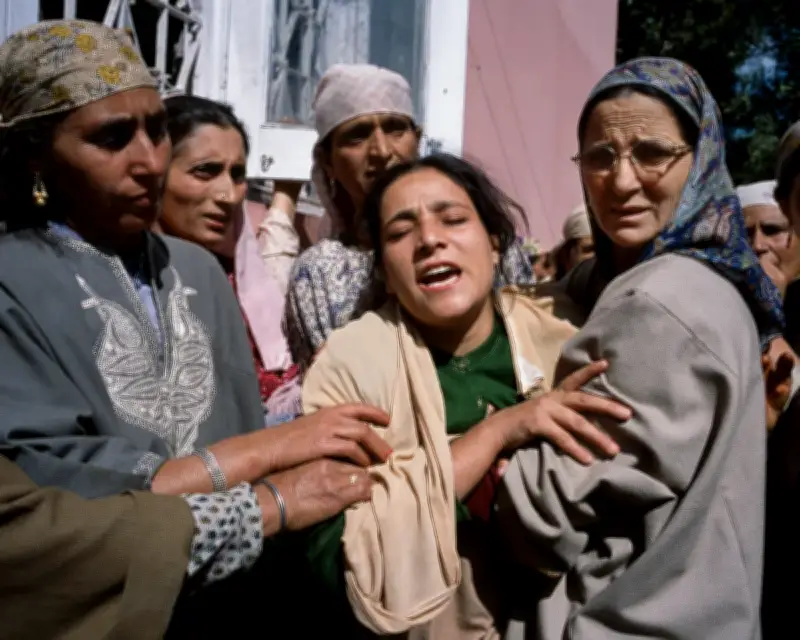
Photographer Robert Nickelsberg has documented the plight of the Kashmiri people for more than 20 years, capturing how trauma has settled into the fabric of everyday life in one of the world's longest unresolved conflicts.
His images, collected in the book Kashmir, the Valley, show the consequences of a political uprising that began in 1989 and continues to shape daily existence in the region.
Two Decades of Documenting Trauma
Nickelsberg visited Kashmir repeatedly over two decades, witnessing how the armed uprising evolved and how its effects became embedded in everyday life. 'For me, as a photojournalist, the Kashmiris' plight was the essence of the story,' he says. 'This work is my personal commitment, over two decades, to recording the deadly tactics deployed by both Pakistan and India. Twenty years later, tragically, the picture is unchanged.'
His photographs include a Kashmiri man suffering from temporary loss of eyesight being treated with prayers and curative koranic verses in Srinagar on 14 January 2008, and an Indian schoolteacher standing near a sign at a closed public high school in Ladakh in January 1998.
The Uprising and Its Toll
The armed uprising in favour of Kashmiri independence from India began in 1989, triggered by a rigged state election and supported materially and politically by neighbouring Pakistan. After 18 years of conflict, the population's mental health has been severely affected. Figures of Kashmiri dead vary from 10,000 to 45,000.
In one image from Srinagar on 10 January 2008, a widow, Farida Sunderwani, whose husband was killed in crossfire between Kashmiri militants and Indian army soldiers in 1992, is treated by psychiatrist Dr Arshad Hussain at the outpatient department of the state-run Sri Maharaja Hari Singh Hospital.
Everyday Life Amid Conflict
Nickelsberg's photographs stay close to the people living within overlapping political realities. Muslim families, Hindu Pandits, soldiers, local politicians, children and pilgrims inhabit the same visual field. The photographs resist easy hierarchies of victimhood or heroism; what holds the work together is a sustained attention to lived experience.
His images show mourners raising clenched fists at a funeral in Srinagar on 20 September 1990, a pro-Pakistan Kashmiri militant brandishing a Kalashnikov rifle during a demonstration on Pakistan's Independence Day in 1995, and Indian tourists sightseeing from a traditional Kashmiri boat on Dal Lake in 2008.
Spiritual Solace and Lasting Impact
Nickelsberg made efforts to visit shrines in Kashmir, where he could observe Kashmiris as they appeared to momentarily drop their fears and experience a period of calm. 'Inside, I could quietly observe Kashmiris as they appeared to momentarily drop their fears and experience a period of calm, a sense of peace, either in deep thought or prayer, to recharge themselves, replenish their spiritual sides and find strength for their daily encounters with the conflict outside the walls of this historic site,' he says.
The photographs document the conflict's lasting impact, from the assassination of law minister Abdul Ghani Lone in 2000 to the Kargil conflict of 1999, where Pakistani army soldiers were pictured near the Line of Control. The conflict, which lasted slightly over 11 weeks, began after Pakistani forces occupied Indian army positions that had been abandoned during the preceding winter months.