The Standard is being helped through K-Beauty emporium Olive Young, which despite it being nearly midnight, is heaving to such a degree that this lanky Englishman is in danger of being trampled underfoot by young Koreans. Beauty never sleeps, and neither does Seoul. With its Blade Runner ad screens and public Pop Art and hip shoppers, you might say it’s the modern equivalent of Swinging London, given its worldwide cultural impact.
K-Pop, K-Drama, K-Beauty, Squid Game, Parasite, Park Chan-wook, Son Heung-min (Spurs’ loss is advertising’s gain), K-Pop Demon Hunters… South Korea is booming. Yet in this city of the future, history is never far away, as we are discovering on a trip deep into the country with the curators of a new exhibition called Korea at the British Museum to discover the creative heart and soul of the nation.
2,000 Years of Creative Excellence
It becomes apparent that today’s K-everything is a continuation of 2,000 years of creative excellence — and a triumph over many scars. “The show covers 300BC to 2019, but even though it’s a long period, there are certain patterns you see — Korean resilience and creativity,” says Sang-ah Kim, the lead curator, “because Korea neighbours China and Japan, they always adopted new technology and culture — but they transformed it. That kind of pattern survives. [K-pop] is not the traditional form of Korean music but they found some new system of pop to show the world.”
Seoul is surrounded by mountains. Tigers would once roam down from the forests and pick off residents, though they remained a national symbol of courage and mischief, both crucial to Korean identity. During the Japanese occupation from 1910 to 1945, the occupying forces hunted and wiped out the tigers — an attack on national pride — and demolished most of the old palaces and public buildings. But since the 1990s, many have been restored, including the Gyeongbokgung Palace in the centre of Seoul, now back to its original 1395 good looks.
Palaces and Pop Culture
Young Koreans are posing in Hanbok national dress for TikTok videos as we’re taken around what was the first royal palace of the Joseon Dynasty, a neo-Confucianist era that lasted to 1897 renowned for its veneration of education and refinement. Goofiness too; stone animals stick out their tongues and mock the solemnity. Such strands of the national identity are everywhere, with innovation at the core.
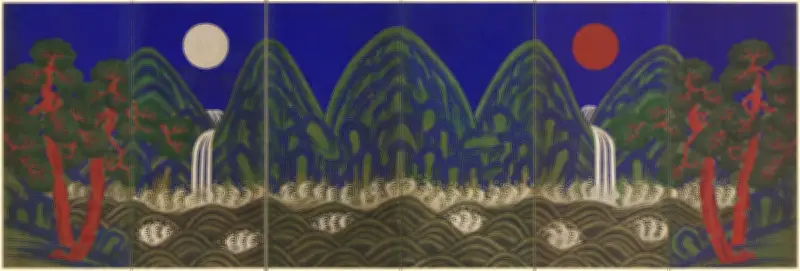
Most importantly, on a screen in the throne room is the famous image of the five holy mountains of Korea, the sun and the moon. The king would sit in the centre of this image of harmony and authority, and showed how art can convey not just power but values. K-Pop Demon Hunters featured the same throne room image in one scene and trendy pop culture seems duty-bound to support historical appreciation.
At the National Museum of Korea, BTS member RM is featured on captions drawing young fans’ attention to certain pieces; he is a huge artefacts fan. Behind the scenes, items bound for the exhibition in London are being meticulously worked on. Sang-ah’s job is to pluck a selection from a vast archive donated by the late Samsung chairman Lee Jun-hee. It includes gold and copper wings that were once attached to a crown — Jenny from Blackpink wore something similar in one of her videos — and a pair of gilt bronze burial shoes that look like Fendi Crocs.
Celadon and the Buddha
Back out in the museum itself — complete with robot guides to interact with — the other project curator, Yoojin Kwak Choi, takes us through the Celadon Gallery. Examples of this legendary ceramic style are bound for London, and she explains that its distinctive blue-green colour was developed in the unified Silla period (from AD 676 to 935) and was enough to even make the Chinese jealous. “It’s a subtle colour, very elegant and could only be achieved with perfect control of the glaze and the firing environment.” With motifs of the lotus flower appearing, they showed the turn the nation had taken from early Shamanism into Buddhism.
A bullet train ride south takes us to Gyeongju, a city that was once the capital of the Silla kingdom. Here the large burial mounds, almost Teletubbies esque in colour and size, sit amid the bustle of restaurants and coffee shops. As Silla gave way to the Goryeo Dynasty, Buddhism reached its apotheosis in Korea, and out in the mountains near here are some astonishing results.
The Haeinsa Temple is a World Heritage Site on Mount Gaya, and sports shiny reception lounges and cutting-edge research laboratories. Yet the main treasure housed here, the Tripitaka Koreana, seems to be preserved more by faith than technology. The Tripitaka is a collection of Buddhist texts engraved on to 80,000 wood blocks between 1237 and 1248, but is housed in a simple wooden building.
In fact, as the charismatic director here, the Venerable Kyung Am, tells us as we are granted a rare look inside, the building utilises a clever mix of materials in the floor to ward off damp and vermin, while the architecture keeps the temperature cool. Still, he readily states that its remarkable preservation is, because, “we believe it is protected”. His assistants pull out a couple of blocks, they are in remarkable condition — enough to tingle your spine.
But even these national treasures are outdone by a subsequent visit to the Seokguram Grotto, on Mount Toham. Up in the forest, this grotto houses a huge statue of the Buddha, and we are given special access to walk around it. Korean craftsmanship and faith, suddenly come together: the construction of the inner chamber where this Buddha sits is such that the hush inside is not silence, but a vibration; truly, the statue feels alive.
From the 20th Century to the DMZ
The 20th century was a horrendous time for the country. After those centuries of glorious dynasties, the Japanese occupation followed, and when it ended in 1945, the country was divided in two. Almost immediately the Korean War followed, which killed one in 10 Koreans. Back in Seoul, the kids are all flocking to see Damien Hirst’s show at the National Museum of Modern and Contemporary Art. When the museum first opened in 1969, North Korea and South Korea were among the poorest countries in the world. Things shifted for South Korea after the Olympic Games in 1988 and the world opened up.
We pay a visit to the studio of multidisciplinary artist Yeesookyung, a leading name here, she is quick to dismiss her work as “monstrous” and the flock of boobs featuring in a work in progress as the product of her own, “perverted mind”. But her work is dazzling and satirical; a key strand, Translated Vases, involves reclaiming broken ceramics, and making new constructions from them, the cracks covered over with gold. “One day I went to visit a ceramics master and during my visit I witnessed him smash away most of his pottery,” she says, “It was in fashion to destroy, to not allow even a speck of imperfection. For me, that was really heartbreaking. Since when I was young, my mum used to say you have to behave and if you lose your virginity it is the same as broken pots… Korean women in my generation had to go through those weird and absurd high standards.”
One of the highlights of the British Museum show is a work she has made from pieces of celadon, acquired from both North and South Korea, which feels deeply moving, hopeful even. “I can’t say this monstrous pottery is more beautiful than the perfect vase, but it can have more narratives to people in every society who have all kinds of difficulties to overcome,” she says.
The morning after we head to the Demilitarised Zone dividing North and South Korea, a short drive outside Seoul. Passing through checkpoints with armed guards, and hordes of American tourists, we assembled on a viewing platform to look through telescopes into North Korea. A small town is on the other side of the DMZ, and we watch some people walking in the fields. It’s strange, as if looking at beings from another world; which, cut off in Kim Jong Un’s dictator state, they kind of are.
Apparently North Korea sees itself as a successor of the Joseon Dynasty, but what use is history if you just remain stuck in it. It’s just not very Korean. While South Korea forges ahead, hopes are fading for reunification any time soon, and it’s why the exhilarating race through history in this new exhibition cannot help but be tinged by loss. However, this story isn’t over. Korea is at the British Museum until 31 January 2027.