The new British Museum exhibition, Korea, explores how the global ubiquity of 'K' culture today stems from 2,000 years of Korean creativity and resilience, according to its lead curator.
The show spans 300BC to 2019, and lead curator Sang-ah Kim said that despite the long period, certain patterns of Korean resilience and creativity emerge. "Because Korea neighbours China and Japan, they always adopted new technology and culture — but they transformed it," she said. "That kind of pattern survives. [K-pop] is not the traditional form of Korean music but they found some new system of pop to show the world."
Seoul's historical heart
Seoul, a city of Blade Runner-style ad screens and hip shoppers, is surrounded by mountains where tigers once roamed, remaining a national symbol of courage and mischief. During the Japanese occupation from 1910 to 1945, occupying forces hunted the tigers to extinction and demolished most of the old palaces and public buildings. Since the 1990s, many have been restored, including the Gyeongbokgung Palace, now back to its original 1395 appearance.
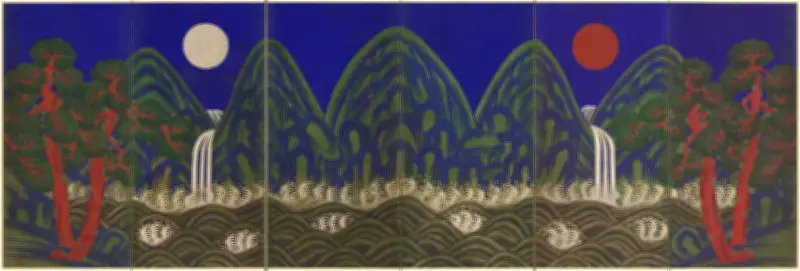
Young Koreans in Hanbok national dress pose for TikTok videos at the palace, the first royal palace of the Joseon Dynasty, a neo-Confucianist era lasting to 1897. In the throne room, a screen displays the famous image of the five holy mountains of Korea, the sun and the moon, where the king would sit at the centre of this image of harmony and authority.
Treasures bound for London
Behind the scenes, items for the London exhibition are being prepared from a vast archive donated by the late Samsung chairman Lee Jun-hee. These include gold and copper wings once attached to a crown and a pair of gilt bronze burial shoes. At the National Museum of Korea, BTS member RM is featured on captions drawing young fans' attention to certain pieces.
Project curator Yoojin Kwak Choi explained that the distinctive blue-green colour of celadon ceramics, developed in the unified Silla period (AD 676 to 935), was enough to make the Chinese jealous. "It's a subtle colour, very elegant and could only be achieved with perfect control of the glaze and the firing environment," she said.
Buddhist heritage and modern art
A bullet train ride south leads to Gyeongju, once the capital of the Silla kingdom. Near here, the Haeinsa Temple on Mount Gaya houses the Tripitaka Koreana, a collection of Buddhist texts engraved on 80,000 wood blocks between 1237 and 1248. The Venerable Kyung Am, the temple's director, said its remarkable preservation is because "we believe it is protected".
The 20th century brought Japanese occupation, division in 1945, and the Korean War, which killed one in 10 Koreans. Today, artist Yeesookyung's work, including a piece made from celadon acquired from both North and South Korea, reflects on brokenness and healing. "I can't say this monstrous pottery is more beautiful than the perfect vase, but it can have more narratives to people in every society who have all kinds of difficulties to overcome," she said.
The exhibition, Korea, is at the British Museum until January 31.