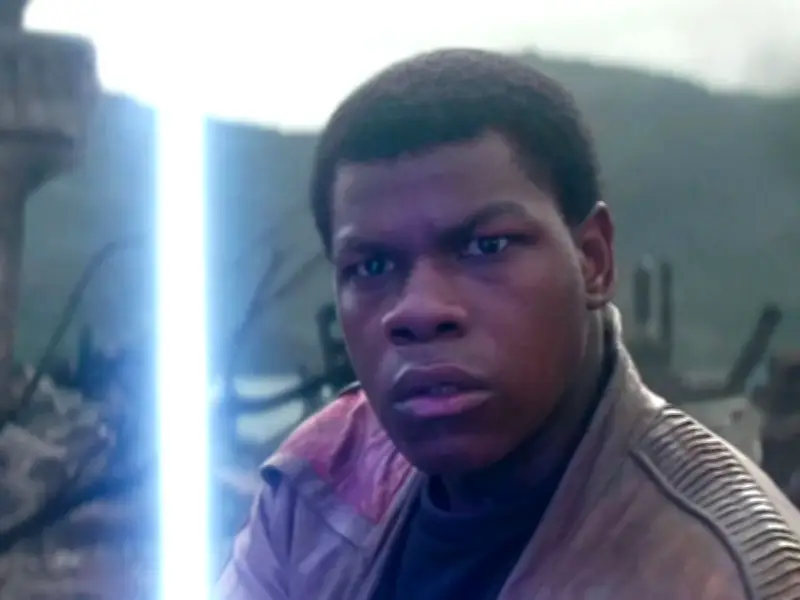
John Boyega has opened up about the death of his school friend Damilola Taylor, 26 years after the 10-year-old was killed by two bullies on the steps of his council block in Peckham, south east London. The Hollywood actor, known for his role as Finn in the Star Wars sequel trilogy, was one of the last people to see Damilola alive.
Boyega, now 34, has made a documentary, Damilola: The Untold Story, to pay tribute to Damilola's memory. The film highlights how the young boy from Nigeria, who had settled in Peckham, lost his life and how he inspired Boyega to pursue his acting dream.
A special friendship remembered
Boyega attended Oliver Goldsmith primary school in Peckham with Damilola, who was two years older and in the class of Boyega's big sister Grace. Boyega says he always looked up to Damilola.
"Damilola's aspirational side impacted me personally. The confidence he had was quite special," he says. "Back then I didn't know what being in a council estate means, because you're getting a roof over your head and you're cool. But later you realise just where you are."
"And I think a combination of all of that and Damilola's death gave me the motivation to figure out what I wanted to do - hence why I started [acting] so young." Shortly after Damilola's death, Theatre Peckham founder Teresa Early offered Boyega a scholarship.
The night Damilola died
On the evening of his death in November 2000, Boyega and Grace were with Damilola at Peckham Library. Grace walked him nearly all the way home. After they had separated, Damilola was attacked with a broken bottle by local brothers Ricky and Danny Preddy, who were just 12 and 13. An artery in his left leg was severed and he bled to death on the stairwell of the North Peckham Estate.
Damilola, captured on CCTV on the day of his death skipping in a silver jacket, had recently moved to London with his mother and older brother Tunde from Lagos. Boyega, who was eight when his friend died, says: "He always came across as charismatic and confident because he was Nigerian. We're British-Nigerian, so we have that Brit side, we can merge in here. He could not merge. And guess what? He didn't care about merging. I always found that quite intriguing."
Boyega says he does not think Damilola would have changed for anyone. "It was like Damilola had had a glimpse of the future," he adds. "I feel like he wouldn't have changed because how we all are now as British Nigerians, we are very confident, especially with our African side."
Impact and legacy
The BBC film, directed by Emmy nominee Alex Thomas, details Damilola's last 24 hours and the aftermath of the murder. It features an emotional appearance from caretaker Bill Casale, in whose arms the schoolboy died, and older brother Tunde, who now runs the Damilola Taylor Trust.
Boyega recalls the aftermath: "We still had to go to school and I'm just trying to comprehend what this death is, as a young kid. And then obviously me having to see my sister's pain, her being much closer to him and having that friendship. It really impacted me. I was just like, 'I think this is really bad.'" He admits he was so filled with terror he only left home to go to school. "I stayed in for years," he says. "If I went out, I'd be hand in hand with my mum, going through the market. The fear that it creates in the community, it is a very real thing."
Boyega, who now lives with his wife Tae Heckard in LA, credits Theatre Peckham as his sanctuary. "As much as there was negativity in Peckham, I can't help but highlight the people who pulled up their bootstraps and said, 'I'm going to do what I can'," he says.
Speaking about why he made the film, he says: "I wanted to be able to unpack sides of my past through art rather than a therapy session or something. It was nice to get the perspective that made everything make sense to me." The documentary also examines the fraught police investigation and the ecosystem of bullying and fear around youth violence in the area.
Lessons for the future
Boyega reveals he was inspired by a poem written by Damilola which was read out a lot after his death. "I was just very impressed by that because of the way that his writing was packaged to me," he recalls. "It was something that was quoted and recited, almost like it was from Shakespeare."
He feels that had Damilola survived, he would have become a doctor or a lawyer. "Yeah, he would have been something special," he says. To make the documentary, he enjoyed looking back at footage of them all as carefree kids. "Having to go into my dad's little treasure chest of VHS tapes and watch so many memories and just appreciate life. It was sweet," he says.
He believes there are still important lessons to be learned from the tragedy. "You want to create an environment that does not promote the kind of situation where this could happen again," he explains. "What that means is extra-curricular activities, more interest in the community, in the building up of kids. I'm a beneficiary of it. I benefited from all these people who decided to make these activities."
"As well as being informative, it is quite a positive film, and I wanted to support something that would have a long-term positive impact." The Hollywood star acknowledges the film is a difficult watch. "The first time I watched it, I was in tears," he says. "You're reliving it and that comes with its hardships. But it was nice seeing the people that were integral and really cared about him."
Damilola: The Untold Story is on BBC2 at 9pm on Monday.