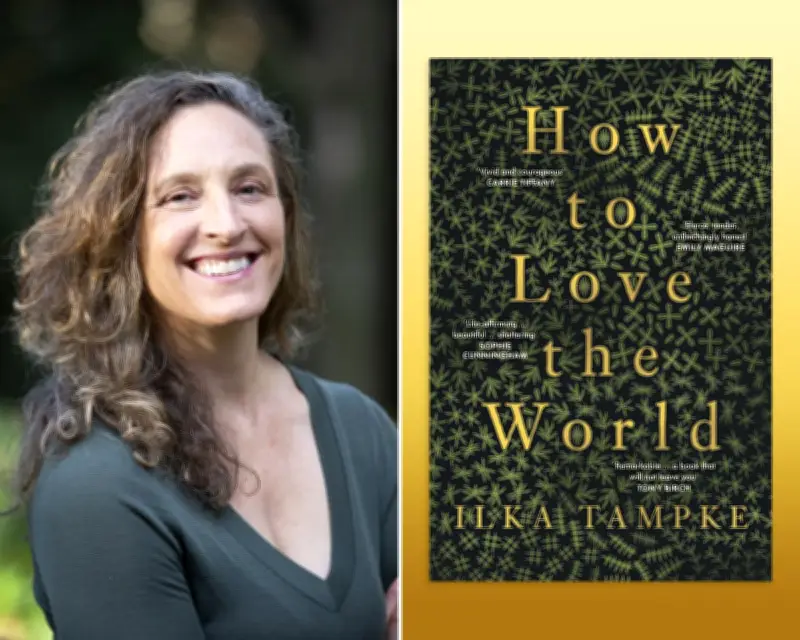
Ilka Tampke's new novel, How to Love the World, is a work of decolonial ecofeminism that explores radical immersion in the more-than-human world and its intelligences. The story begins when a large branch falls on a woman named Nellika, trapping her in the forest. She wakes up belly-down, cheek jammed against dirt, with the world on its side. The branch struck her across the back, causing great pain, and she wonders how a tree could do this to her.
Two Timelines Unfold
The novel operates on two timelines. The first follows the slow tick of the clock as Nellika remains trapped, with subheadings recording time passing. The tension builds as readers wonder if she can free herself or if help will arrive. The intimate third-person narration offers no hints about whether this is a survivor's tale. The second timeline, marked by the subheading 'Earlier,' reveals what happened before the accident: a terrible argument with her teenage children, her life as an artist, mother, daughter, and partner. This timeline paints a portrait of a child who felt 'difficult,' neglected, and humiliated for being 'too much.' Nellika understands that her parents passed on their pain, and she yearns to provide safety and nourishment to her children but cannot contain her explosive rage. The narrative keeps alive the possibility of repair, as her parents later apologize, and Nellika constantly tries to mend relationships damaged by her anger.
The Forest as Refuge
Nellika's daily walks through the forest offered a retreat from intergenerational violence, providing a perceptible lifting of shame. As the long day of entrapment proceeds, her practice of paying attention to the forest becomes a survival strategy. She clings to every detail, willing the tree to keep her awake. Trapped under the heavy bough, she watches a leaf fall and feels moved to witness its precise moment of falling, observing its liminality when it is sure to die but not yet dead. The best writing in the novel conveys the intensity of Nellika's attention to her surroundings. She reflects that never had she looked at one thing for so long.
Placelessness and Decolonial Themes
Nellika has no ancestral connection to the land on which she might die, and this realization shatters her. She feels the great wound of her placelessness rising around her, with agony in her crushed skeleton and tattered muscle. As she reckons with the past, the forest brings her back to the present. The novel shares broad political commitments to decolonial ecofeminism, expressing radical immersion in the more-than-human world and its intelligences.
Reading Experience
The novel demands a slow read, but it doesn't always reward it. The first reading may involve flipping pages when the pace plods, driven by the need to find out whether Nellika survives and to leave harrowing scenes of family violence. However, subsequent readings reveal the novel's request to be read slowly, with attention to each inflection of Nellika's experience. The writing often lacks the vividness required to reward that attention. Nellika aspires to report the world fairly, capturing every leaf falling and every angle of every domestic dispute. Tampke sparingly uses figurative language, favoring precise descriptions that might appear in a field report. The result is a meticulous catalogue of detail, some quite banal.
It is a lot to ask of a reader to spend several hundred pages with a suffering woman trapped under a log as she tries to figure out her life and hopefully get saved. Nellika's diligence, realizations, and revisions overwhelmed and sometimes bored the reviewer. However, the novel sparked much discussion with others, a sign that it left a mark. The reviewer talked mainly about how much they wanted to love a novel that is fearless in its efforts to conceptualize a decolonial phenomenology of place and willing to center a protagonist who is not only wounded but has inflicted wounds on others.
Earnest Purpose
How to Love the World is heavily laden with a sense of earnest purpose. This purpose and earnestness inhibit the novel's style, but the questions it asks are no less urgent. Through Nellika, Tampke asks settler readers to think deeply about what it means to live and die on land to which they have no deep ancestral connection, to relinquish colonial fantasies of belonging, and find a way to love the world as it is. The novel is published by Simon & Schuster.