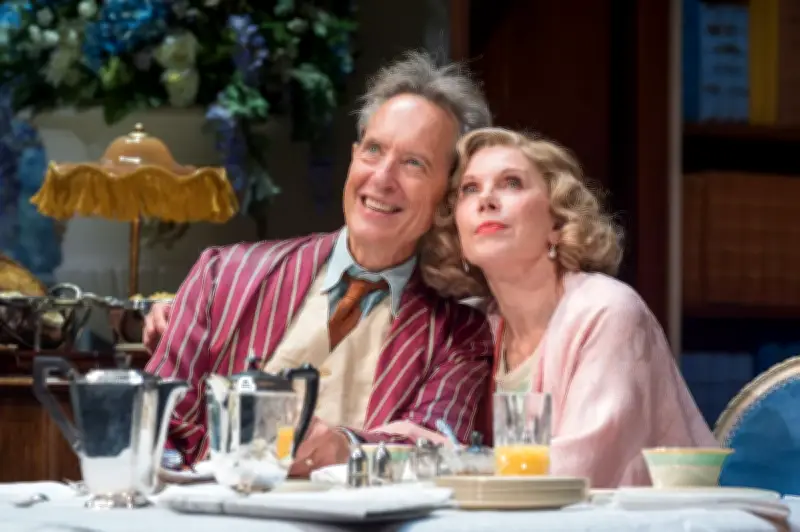
Noel Coward's 1925 comedy of bad manners has opened in the West End as a handsome, old-fashioned star vehicle for Christine Baranski and Richard E. Grant. Baranski plays retired stage icon Judith Bliss, with Grant as her novelist husband David, egomaniacs blind to social convention who, with their two similarly-wired adult children, confuse and confound four enamoured guests at their Cookham country house.
A Star Vehicle for Two Character Actors
The mechanics of the vintage piece were not entirely smooth on opening night, but the intended audience is surely after surefire laughs and glamour rather than perfect line-readings or radical reappraisal. That, this Hay Fever surely delivers, and it will doubtless tune up once it has run in for a bit.
Audiences are primed for Judith Bliss's first appearance by her bantering son Simon (Will Close) and daughter Sorel (Ophelia Lovibond). Since withdrawing from the stage she has channelled her theatrical urges into cultivating a bucolic pose, and toying with a string of young admirers. Baranski duly makes her grand entrance through the French doors, dripping in silk and jewellery, in a straw hat the size of a wagon wheel, removing galoshes to reveal sparkly heels.
Baranski's West End Debut
She has been memorising plants to impress a new conquest: "The red ones are somebody's name. Asters, that's it!" The lines are brittly witty, but the oomph comes from the fact it is Christine Baranski saying them in her West End debut. Those knowing eyes, that tip-tilted nose, that amused rosebud mouth, and the accumulated clout of five award-winning decades on stage and screen, embracing Cybill, The Good Wife and Mamma Mia.
The question arises why director Emily Burns did not encourage her to use her natural accent. Judith could easily have been a transported American thesp, the bohemian equivalent of the title-hunting US heiresses of the early 20th-century. But, like Kim Cattrall in Coward's Private Lives in 2010, she is stuck in a sort of strangulated, transatlantic Received Pronunciation. It adds another layer of artifice to this already-mannered milieu, and it does not hurt Baranski's comic timing, particularly her descent into dark-brown tones on lines like: "I was married veeeery young." But it is veeeery odd.
Grant's Return to the London Stage
Grant, back on the London stage for the first time in 20 years, hams it up no end. Which, again, sort of works. David blows into scenes like the storms that suddenly burst outside. He is all raffish hair, vulpine grin and shiny eyes that only look inward, dashing in military white tie or elegantly crumpled linen. David has lured a dazzled young flapper to Cookham to "study", analogous to the strapping Sandy whom Judith suffers to adore her.
Sorel and Simon's admirers Richard and Myra are slightly older. The one-liners pile up. Judith accuses Myra of using "sex as a sort of shrimping net". Myra, in turn, talks of being "mowed down by theatrical effects" in the Bliss household. The family toy with and re-order affections on a more or less age-appropriate level before disregarding their playthings to return to their internal squabbling fondness.
Supporting Cast and Production
There are echoes of Midsummer Night's Dream here, but it is also fascinating that this Hay Fever opened in the West End the night after the similarly star-led Who's Afraid of Virginia Woolf, where guest-baiting takes on a crueller edge. In Burns's production, the grandstanding of the central duo is built on a layer of dependable support. Nancy Carroll and Charles Edwards are faultless as the baffled and buffeted Myra and Richard, right down to their body language. Lovibond is deliciously pert as Sorel.
Lucy Karczewski is unrecognisable from her terrific, Stevie Nicks-ish stage debut in Stereophonic last year. As the ingenue Jackie she is drippy, muted, awkward, and absolutely hilarious. The set and costumes, by Frankie Bradshaw, are as good-looking as the cast and could, like the production, date from any decade between the 1920s and now.
The standout USP of this show is that you get to see Grant and Baranski strike sparks off each other and see Baranski demonstrate how one lights a cigarette "winsomely". Sometimes, that is all you need. Runs to 12 Dec at Wyndham's Theatre.