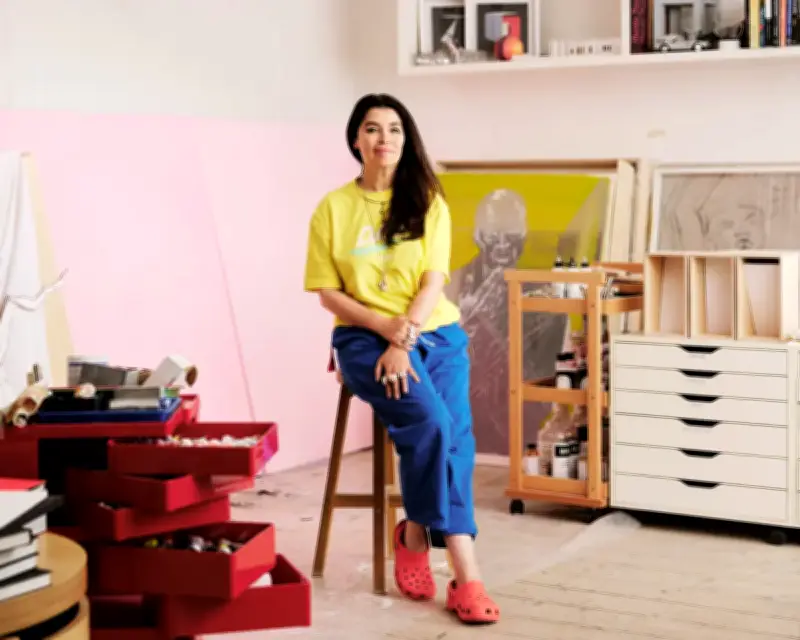
British artist and designer Es Devlin's retrospective, Es Devlin: Other Worlds, opens at the Design Museum in London on 2 October and runs until 4 April. The show maps out 30 years of Devlin's practice in sculpture, film and installation, with an expansive display of archival drawings, paintings, collages, diaries and prints that give an insight into how she gets things done.
A kindred spirit in Goncharova
Four years ago, the V&A East Storehouse in east London got in touch with Devlin. The museum's curators wanted to invite her to respond to a 100-year-old theatrical backdrop by the Russian artist and designer Natalia Goncharova. For a 1926 London production of The Firebird by the Ballets Russes, Goncharova had painted a fortified Muscovite cityscape festooned with onion domes and spires, rust-red and golden against a deep-blue sky.
Devlin didn't know much about Goncharova. But alighting on the term she had favoured for describing her kaleidoscopic approach to art-making, Devlin realised she'd found a kindred spirit. "She called herself an 'everythingist'," Devlin says. The title of the large-scale sculptural work she made in response is The Everythingists.
Three decades of spectacle
In the 30 years since she won the Linbury prize for stage design in 1995, Devlin has established herself as a go-to set designer for highbrow theatre, international opera, global pop (Bad Bunny, Lady Gaga, Beyoncé), official celebrations (two Super Bowl half-time shows, two Olympic ceremonies), fashion runways and public sculpture. She has three honorary doctorates, multiple Oliviers, Tonys, Emmys and Critics' Circle awards, the London Design Medal, an OBE and a CBE.
At the show's core is a large circular piece that combines several milestone projects including the 2021 mirror-maze piece Forest of Us; the rotating glass box-based set designed in 2018 for The Lehman Trilogy, directed by Sam Mendes; and the union jack stadium-floor covering designed for the London 2012 Olympics closing ceremony.
An unrelenting workflow
In 2023, Devlin published a monograph titled An Atlas of Es Devlin, which comprised a double fold-out list, detailing more than 120 projects she had worked on over 30-plus years. A revised edition now adds 30 new projects to the list, evidence of an unrelenting workflow. Recent collaborations have included the set for a production of Rajiv Joseph's Archduke at London's Royal Court theatre; a retrospective at Futura Seoul, South Korea; and London Oratorio, a one-night production at the South Bank, in collaboration with musician Jacob Collier, composer Kieran Brunt and scores of the capital's choristers. She is designing Olivia Rodrigo's forthcoming arena tour.
Devlin was born in Kingston upon Thames in 1971. Her father was a journalist and her mother a teacher – to Devlin's mind, both artists. When she and her three siblings were all under 10 years old, her parents took in three of their cousins for a year, seven children fitting into a three-bedroom house. "Any time there was a Christmas or a birthday, you know, my mum would just say: 'Well, you can't buy anything. Make something,'" she says.
Devlin's unflappable nature has taken her everywhere – Compton, the Louvre, Morocco's Agafay Desert, Malawi – collaborating with everyone from Rosalía and Kendrick Lamar to Max Richter. In 2013, she told the Guardian that a low point of her career had been sending groundplans to Shakira while in labour. Young artists often ask how she holds on to her identity when collaborating with powerful people. "The best answer I've given to this question is: I actually am not too afraid to lose my identity. By being prepared to lose it, you encounter other aspects that are probably more interesting," she says.
What is SOS right now? "The Design Museum is SOS," she says. So too, the 2026 British Museum Ball in October, for which she is the artistic director. She and a member of her team went on a tour of the museum and met "six people who've worked there, a combined number of 137 years; profound knowledge, profound understanding of objects which tell our history and explain who we are". What she wants her design to communicate, she says, is the museum's staff, all 1,000 of them. She sees them as protagonists, much like the 50 refugees of whom she did portraits for her UNHCR installation Congregation in 2024, or the 55 million adults invited to take part in her A National Portrait project for London's National Portrait Gallery.