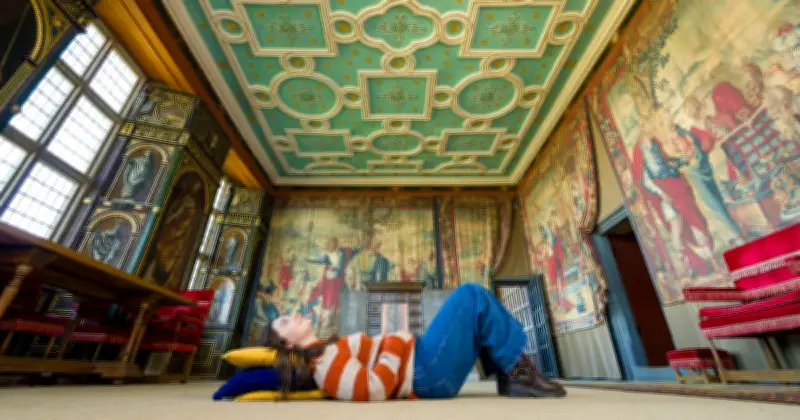
English Heritage is inviting visitors to lie back and admire some of the most stunning architectural and decorative views in the country – its ceilings. For one month, visitors at five historic attractions will be encouraged to lie down in some of England’s grandest rooms and take their time admiring the beauty above their heads, with cushions provided.
Why ceilings are often overlooked
From the jaw-dropping ceiling of the Durbar room at Queen Victoria’s Osborne on the Isle of Wight, to the ethereal canopy of the Star Chamber at Bolsover Castle in Derbyshire, the heritage charity cares for some of the finest ceilings in England. Yet visitors often miss these architectural triumphs because they can’t properly see them – or at least not without risking a crick in their neck.
Often passed by or missed out, ceilings in historic places are a vital part of the story of the people who lived there and of the buildings themselves, according to the charity. They might demonstrate the architecture fashions of the period, the wealth and power of the owner or the finest craftsmanship. They are a crucial puzzle piece in the story of the past.
Permission to lie down and look up
Emma Fernandes-Lopes, Assistant Operations Director at English Heritage, said: “We hear it time and time again from visitors: they’d love to get a better look at the ceilings and roofs, but they don’t want to get a crick in their neck and they feel far too embarrassed to lie down and do it. So we’re taking away the embarrassment and giving everyone permission to lie down and look up.
“We’ll have cushions ready at some of our most popular sites to make it even easier for visitors, as well as mirrors for those who would prefer them. With the busy summer season behind us, there’s more space and time to really take in the details without worrying about getting in anyone’s way or having people trip over you.”
Five sites with spectacular ceilings
The Durbar Room at Osborne House, Isle of Wight: One of many decadent rooms in Victoria and Albert’s luxurious seaside retreat, the Durbar room was designed by Rudyard Kipling’s father, Lockwood Kipling, and master carver Bhai Ram Singh. This unique room is detailed with intricate Indian-style plaster work to reflect Queen Victoria’s status as Empress of India. The ceiling is the room’s pièce de résistance, made up of intricate floral plasterwork and honeycombed muqarnas vaulting.
The Star Chamber at Bolsover Castle, Derbyshire: The creation of horse-mad Cavalier playboy William Cavendish, this breathtaking castle high on a ridge is full of remarkable wall paintings and interiors. The stunning Star Chamber gets its name from its striking sky-blue and teal ceiling, which is decorated with 254 gleaming gold-leaf stars, casting a constellation above visitors’ heads.
The Great Hall at Eltham Palace, South East London: The Great Hall at Eltham is a reminder of the palace’s Tudor origins. The house was purchased in the 1930s by Stephen and Virginia Courtauld, who created an art deco party palace. The Great Hall, with its magnificent oak hammerbeam roof, is the most impressive remnant of its Tudor architecture. Commissioned by King Edward IV, the original roof dates from the 1470s and was dismantled and reassembled in 1911–14.
The New Hall at Belsay Hall, Castle and Gardens, Northumberland: Set within the evocative landscape of Northumberland’s ‘border country’, Belsay is both a medieval castle and a Greek Revival mansion. The 19th century New Hall is a masterpiece in the Greek Revival style, and one of the earliest examples of its use in domestic architecture in England. The overall impression is that of an ancient temple. Looking upwards from the centre of the hall creates a truly remarkable view, where the full scale and symmetry of the space can be appreciated.
The Drawing Room at Wrest Park, Bedfordshire: There are many gems to be found within the intricate wall and ceiling décor of this 19th-century ‘French château’ style mansion. Pause in the drawing room and take in the ornate ceiling painting depicting Venus and Cupid soaring through the sky.
Jeremy Ashbee, the charity’s Head Curator of Properties, added: “Ceilings are often the most overlooked parts of historic houses but, if you have the chance to look up, they can reveal so much about the people who lived there.
“From elaborate decoration and craftsmanship to the materials, colours and designs they chose, a ceiling can tell us about wealth, taste, fashion and even how a room was used. We tend to focus on what’s at eye level but sometimes the most fascinating stories are right above our heads.
“Osborne, Queen Victoria’s palace on the Isle of Wight, is a great example of this. The intricate ceiling of the Durbar Room acts as a reflection of Queen Victoria’s status as Empress of India and, in its stark contrast to the more modest family rooms, shows us it was intended for hosting royalty and dignitaries.”
For more information, visit english-heritage.org.uk/autumn.