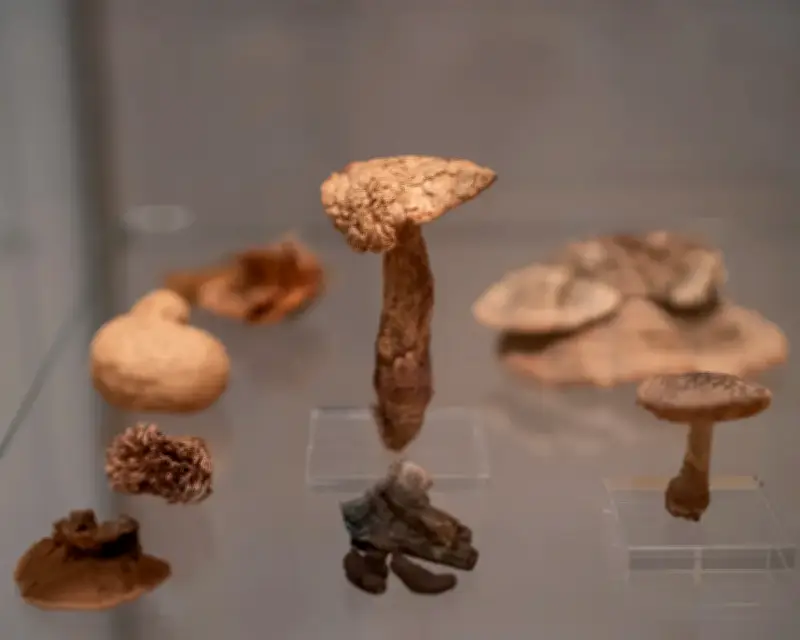
A new contemporary art show in Exeter celebrates the “cultural world” of fungi, featuring installations such as a soundscape created from the electricity emitted by mushrooms and a kinetic sculpture honouring Beatrix Potter’s work as a mycologist.
Living Labyrinths, at the Royal Albert Memorial Museum & Art Gallery (RAMM), includes a piece for which musician Jason Singh spent hours in woodland “collaborating” with fungi. Another exhibit is a kinetic sculpture of an extinct fungus, acknowledging Potter’s lesser-known expertise in mycology.
Five years in the making
Lara Goodband, the contemporary art curator at the RAMM, said the exhibition had been five years in the making. She noted that south-west England was a suitable focus for fungi, citing the region’s warm, damp weather and a special local affinity for the organisms.
Goodband said fungi enthusiasts in the south-west range from ecologists studying soil health to ravers interested in hallucinogenic mushrooms and storytellers drawn to toadstool folklore. The museum’s Victorian collections of fungi, including specimens of stinkhorn and bird’s nest fungi, appear alongside the modern works.
Mushroom music and Beatrix Potter
Interest in fungi has grown sharply in recent years, partly due to Merlin Sheldrake’s book Entangled Life, which argued that fungi offer key insights into the planet. “I think we’ve hit a moment,” said Goodband.
Jason Singh’s sound installation, The Intelligence Below, uses biofeedback sensors to measure electricity from mycelium and translate it into sound. “All the notes that you are hearing are translations of voltage being emitted from the living thing,” Singh said. “This is music being generated by the living system of the mushroom.”
The exhibition also displays watercolour studies by Beatrix Potter, loaned by the Victoria and Albert Museum, alongside a recent work by Jo Pearl based on the fungus Potteromyces asteroxylicola, named after Potter in 2023. Another piece by Gemma Anderson-Tempini, created with scientists from the University of Exeter’s MRC Centre for Medical Mycology, maps her own mycobiome.
Exhibition details
Anderson-Tempini gathered red sandstone from Exmouth and soil from Killerton for her watercolours, which she ground up herself. “Every one of us is carrying a fungal ecology and until now nobody had drawn it,” she said.
Living Labyrinths opens on 3 October and runs until 21 February. This article was amended on 30 September 2026 to correct Lara Goodband’s title to contemporary art curator.